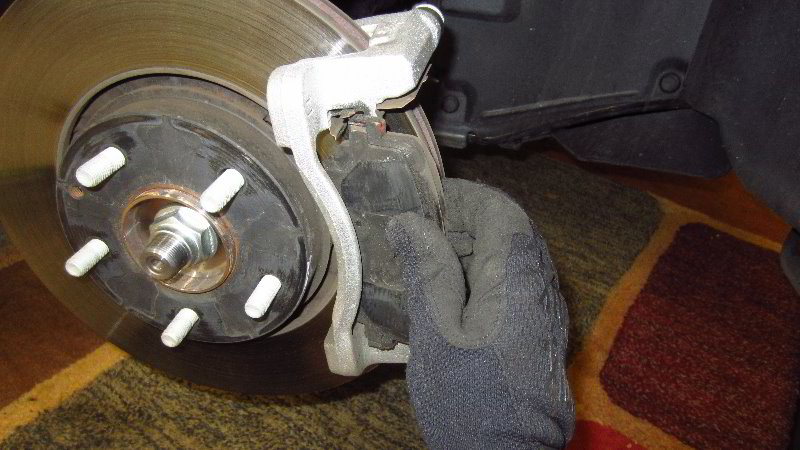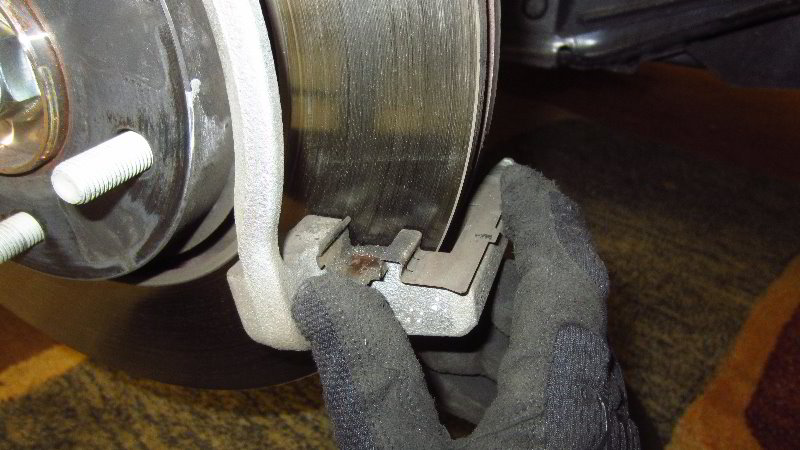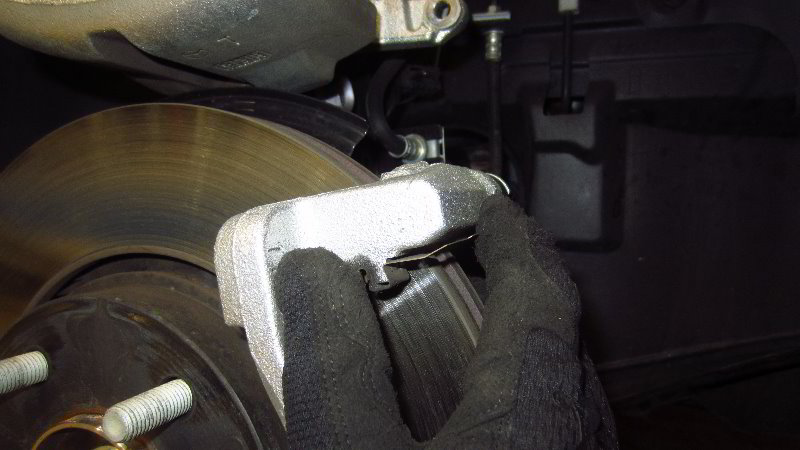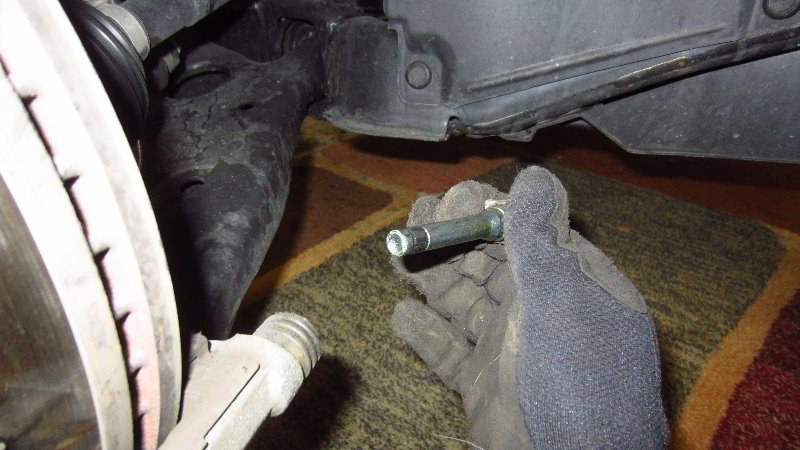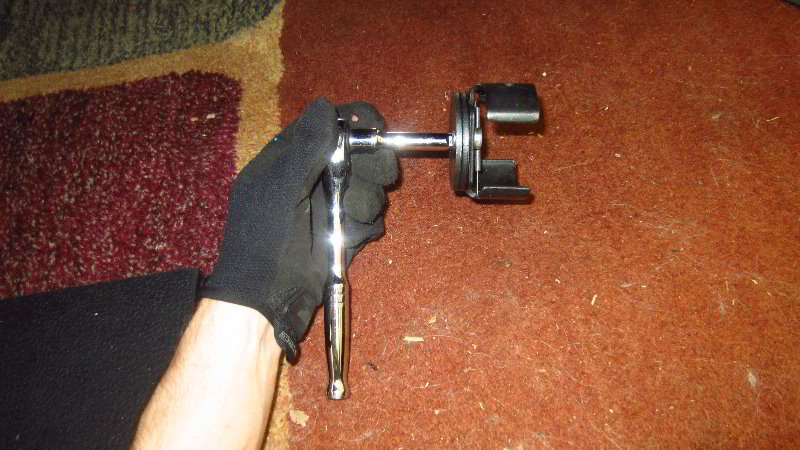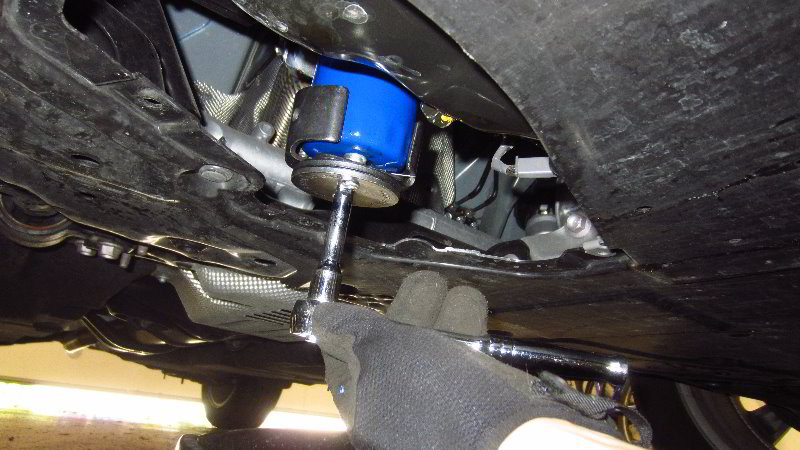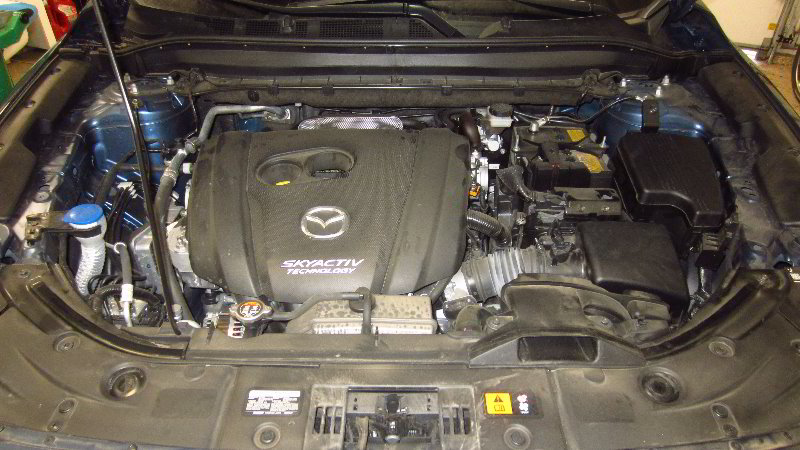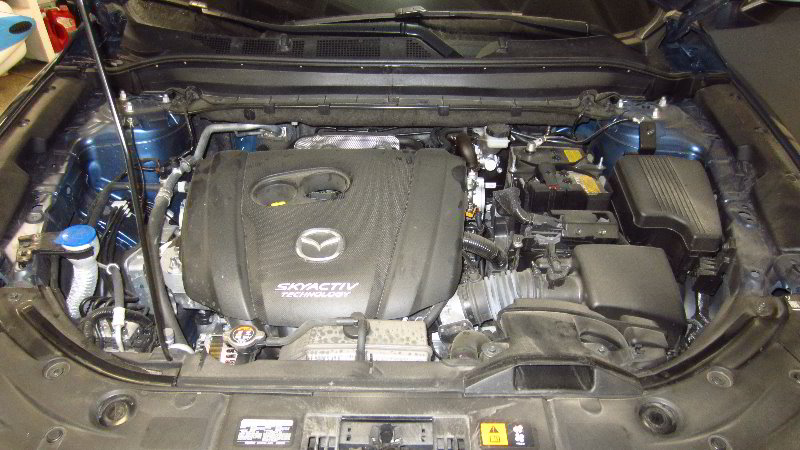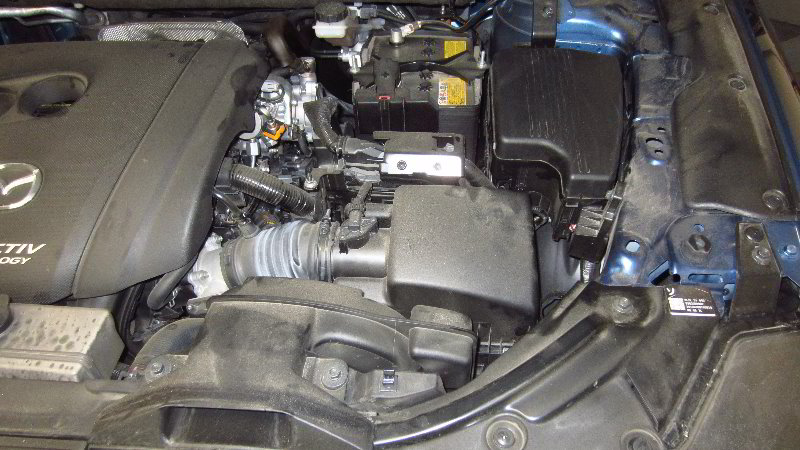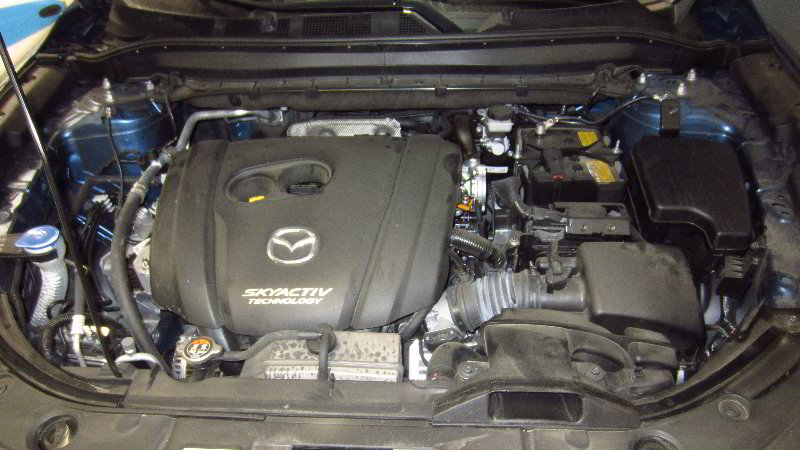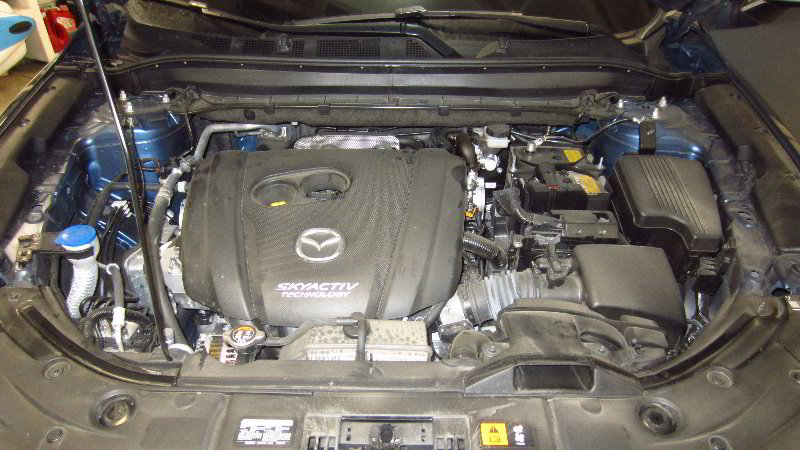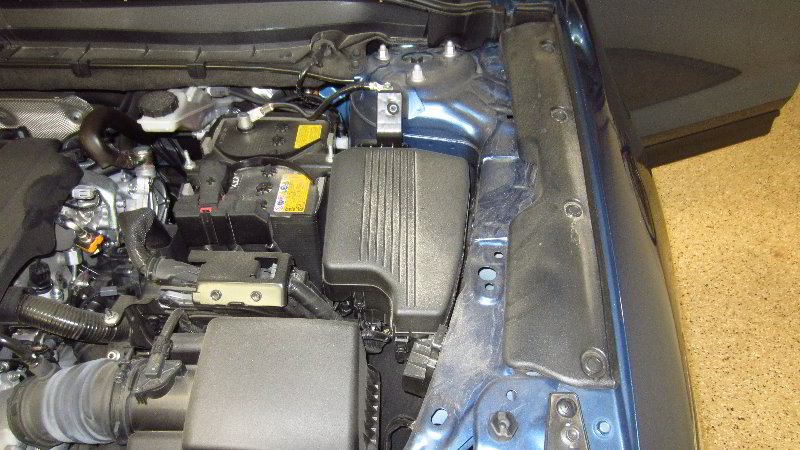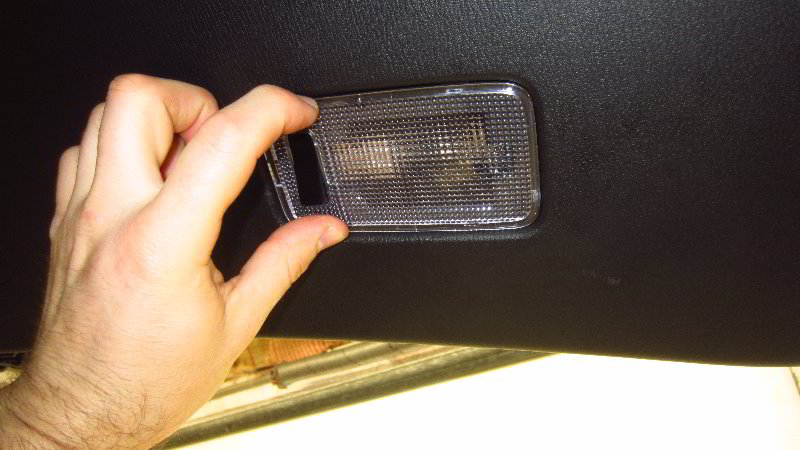
2017, 2018, 2019, 2020, 2021, 2022, 2023, 2024 & 2025 Mazda CX-5 Rear Brake Pads Replacement DIY Guide (With EPB – Electric Parking Brake)

This automotive maintenance tutorial was specifically written to assist owners of the second generation (2017, 2018, 2019, 2020, 2021 and 2022) Mazda CX-5 SUV equipped with the EPB (electric or electronic parking brake system) in changing the rear disc brake pads and lubricating the caliper slide pins. Plus directions for replacing the rotors if necessary.

Owners of other Mazda vehicles such as the CX-3, CX-30, CX-7, CX-9, Mazda3, Mazda6, MX-30, MX-5 Miata, Mazda2, CX-4, CX-8 and BT-50 may also find these DIY instructions to be helpful.

A few compatible replacement sets of new rear brake pads with their part numbers are as follows: Power Stop 16-1846ACDelco 17D1846CHRaybestos EHT1846H and KFE KFE1846-104.

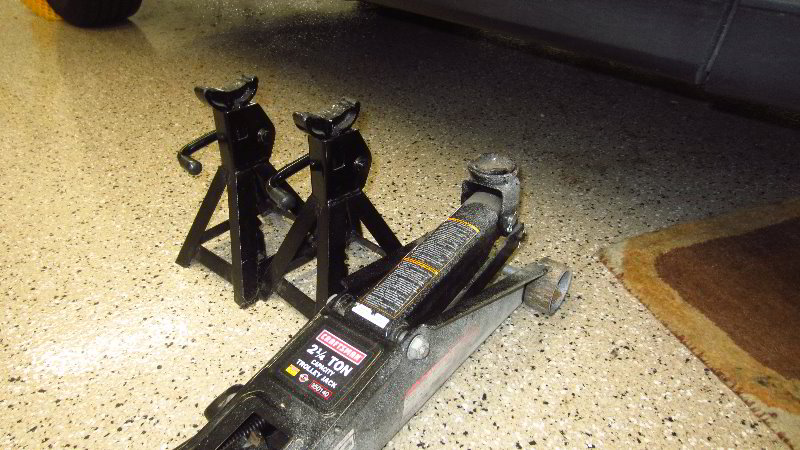
The tools and other items needed to complete this procedure include a lug nut wrench, a floor jack, two jack stands, wheel chocks, a 14mm socket with a 3/8″ drive ratchet, an “F” clamp and a tube of brake caliper grease.

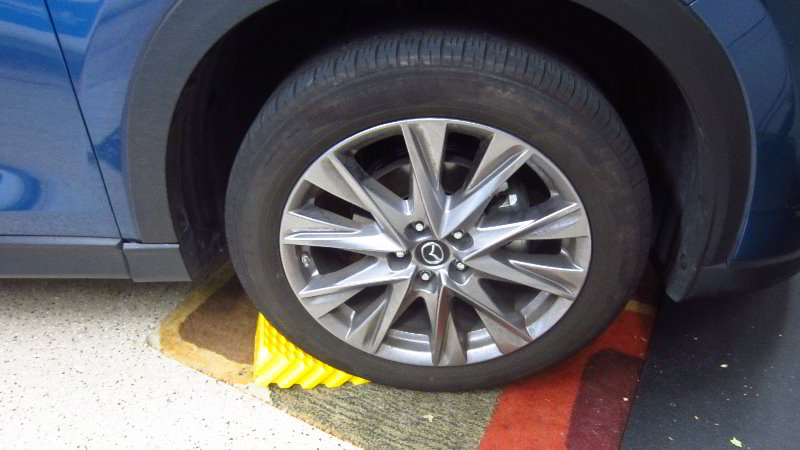
The first few steps are to drive your SUV on to a level surface, shift the transmission into “P” (Park) and turn off the ignition.

Place wheel chocks on both sides of the front tires to help prevent the vehicle from moving.

Attention: If your CX-5 is equipped with the “EPB” (electric or “electronic” parking brake) system, it must be placed into “service” or “maintenance” mode before you can continue with the pad replacement.
 Please proceed with caution and at your own risk! 

Release the electric parking brake by pushing down on the brake pedal and then push down on the EPB switch located at the rear left (driver) side corner of the gear selector assembly.

When the parking brake is released, you will hear the two rear EPB actuator motors make some noise for about a second or two. You will also see the red “(!) BRAKE” symbol on the speedometer turn off.

On some vehicles, I’m able to use my Foxwell NT680 OBD2 scanner (also known as an “OBDII scan tool”) to easily place the electric parking brake system into service mode.

Luckily, Mazda has provided an easy DIY method for owners to place the EPB system into service mode with just a few steps.

Complete the following steps to place the EPB system into service or “maintenance” mode to fully retract (wind back) the parking brake actuator motors so that the rear caliper pistons can be easily compressed to make room for the thicker new brake pads.

Make sure the front wheels are blocked on both sides and the transmission is in “Park” to prevent the car from moving unexpectedly!
 Please proceed with caution and at your own risk! 

1. Switch the ignition to “ON” but do NOT start the engine.  (Keep your foot off the brake pedal.) You will need to press the “START” button a total of two times. Once to turn on “accessory power” and then again to turn the ignition system on.

2. If you haven’t already done so, release the parking brake by placing your foot on the brake pedal and then pushing down on the EPB switch near the gear selector.

3. Release the brake pedal.

4. Press the accelerator (gas) pedal all the way down and at the same time push down the EPB switch and hold them both in that position. Continue to hold down the gas pedal and press down the EPB switch during the next step.

5. With your free hand, press the “START” button three times rapidly in a row.

6. Turn the ignition to “OFF”.

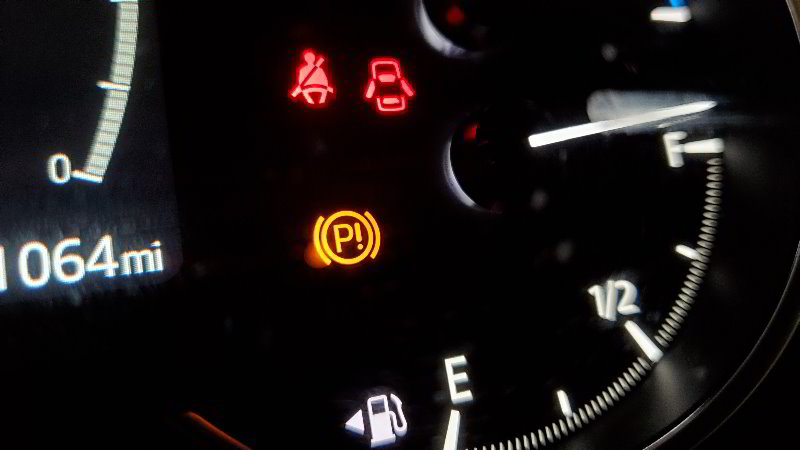
If you completed the procedure correctly, you will hear the EPB actuator motors make noise while they wind all the way back away from the piston for about a few seconds.

You will also see the yellow “(P!)” symbol with on the tachometer (RPM gauge) as shown in Picture # 2 in the row of pictures above.

Note – I will detail the procedure for ending / exiting maintenance mode at the end of this guide.

Alternative EPB Maintenance Mode Instructions In CX-5 Service Manual

The shop manual for the 2016, 2017, 2018 and 2019 Mazda CX-5 has slightly different instructions for placing the electric parking brake system into maintenance mode. I’m including those directions just in case the above steps do not work for your CX-5. Be sure to place wheel chocks on both sides of the front tires and keep the transmission in “Park” to prevent the vehicle from moving.

1. Switch the ignition ON (engine off).

2. Release the electric parking brake.

3. Switch the ignition to OFF and then switch the ignition to ON within 5 seconds while maintaining the following conditions:

Press down the EPB switch and fully depress the accelerator pedal at the same time.

4. Verify that the (P!) warning light is illuminated in an amber color and the mode is switched to maintenance mode.

5. Switch the ignition to OFF.

I will provide the instructions from the 2016-2019 CX-5 service manual for exiting / ending maintenance mode at the end of the guide.
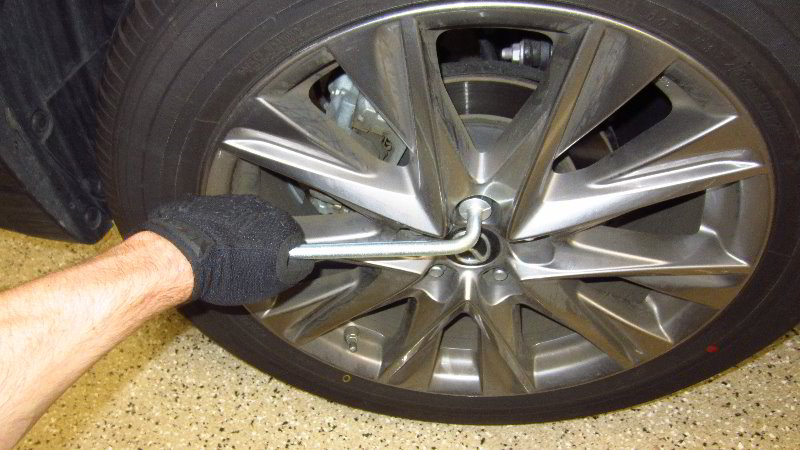
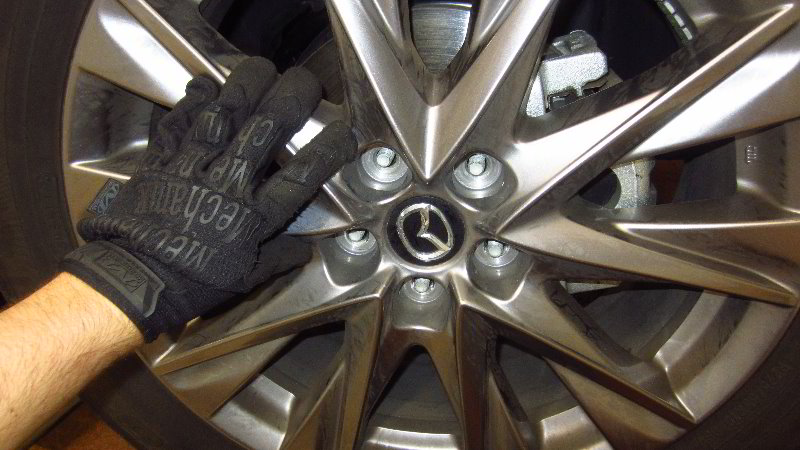
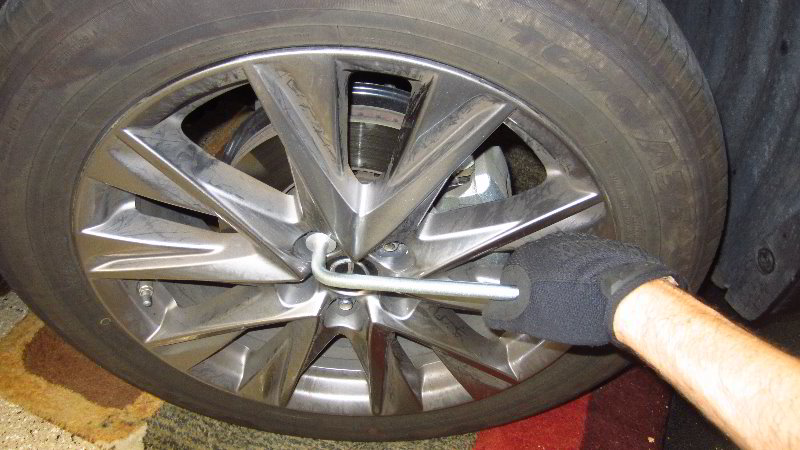
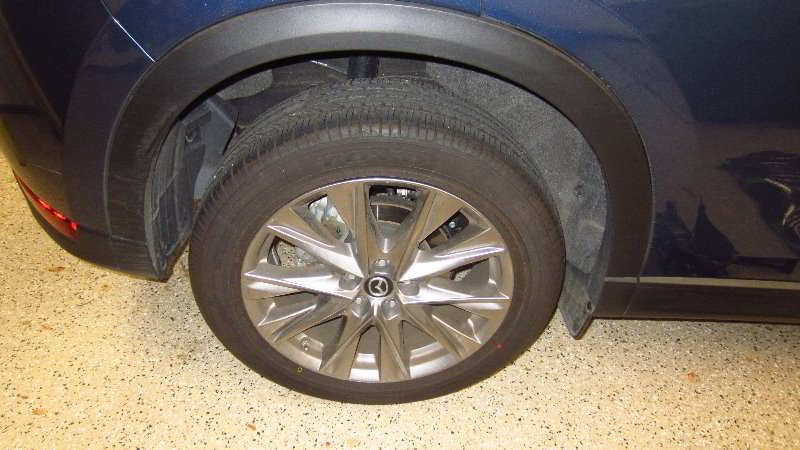
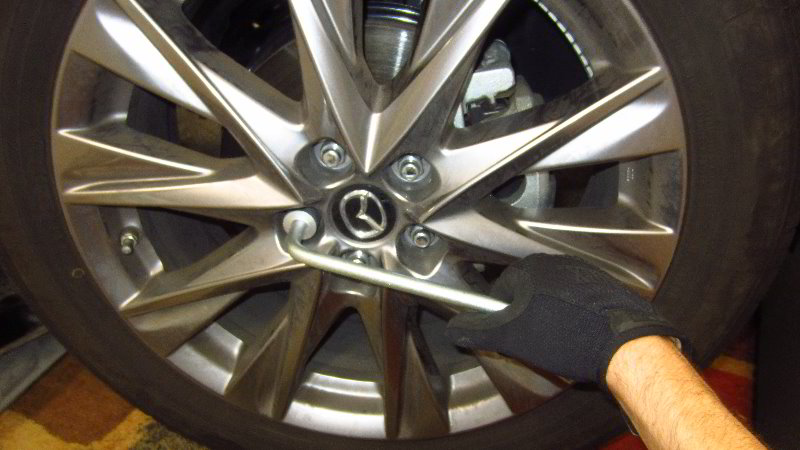
Slightly loosen the five lug nuts by turning them about 1/2 turn in the counterclockwise direction with the tire iron.

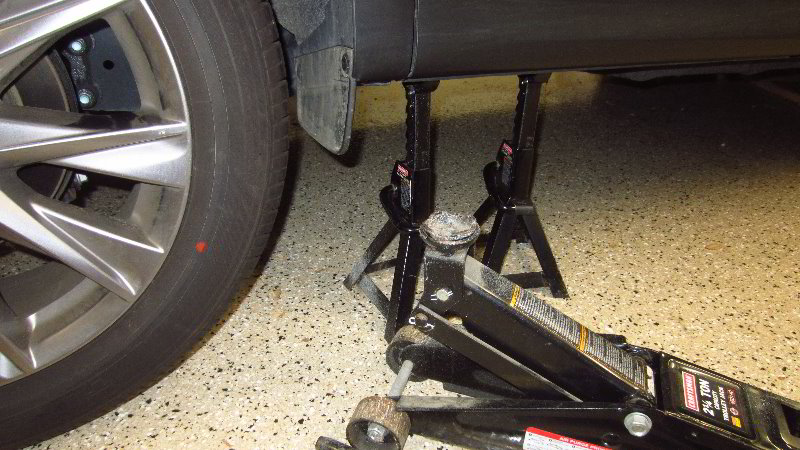
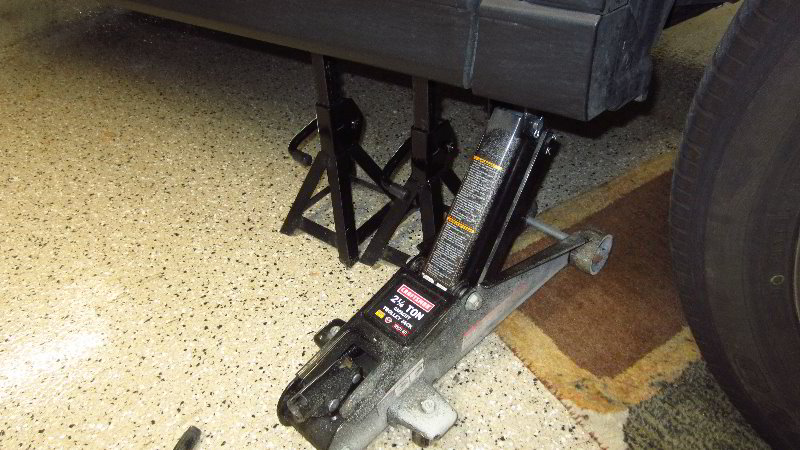
Carefully raise the rear of the SUV with the floor jack and securely support it with at least two jack stands.

Please do not solely rely on the floor jack to support the vehicle!

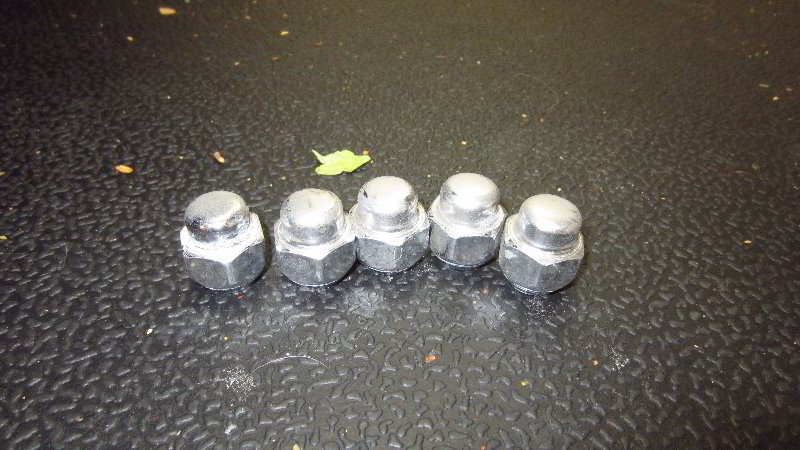
Spin off the five lug nuts in the counterclockwise direction and set them aside in a safe place.
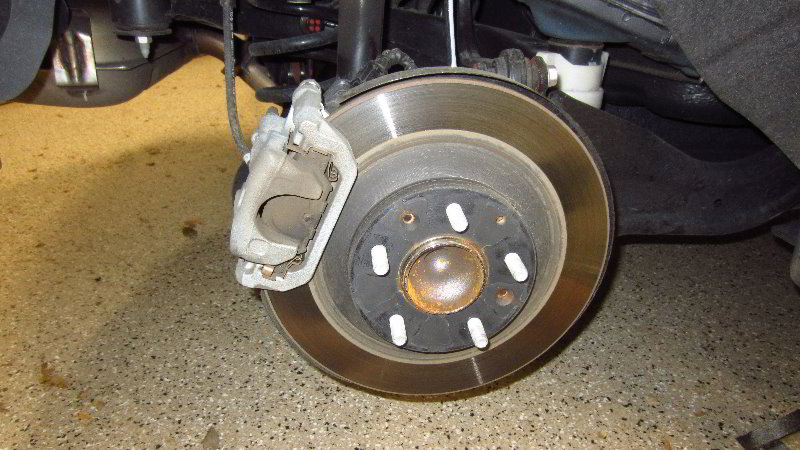
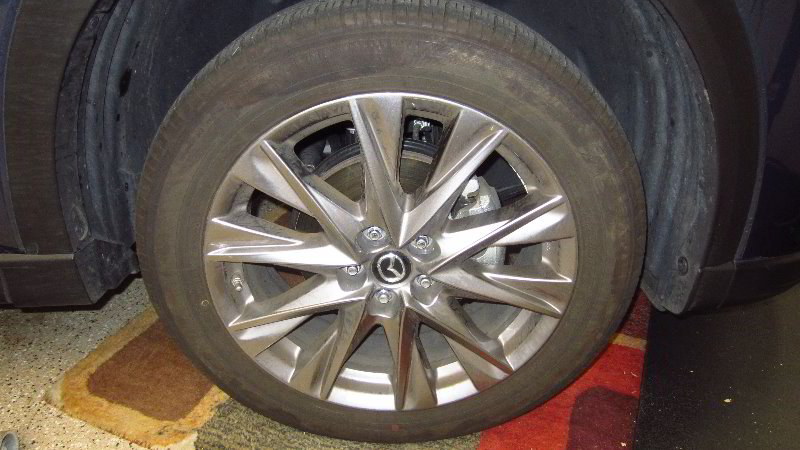
Carefully remove the rear wheel and tire.

Some home mechanics choose to place the wheel and tire under the frame rail as an extra support device just in case the vehicle falls off the jack stands.

Attention – If your vehicle is equipped with the EPB (electric parking brake), you should have already placed the system in “maintenance” or “service” mode by following the instructions at the top of the page.

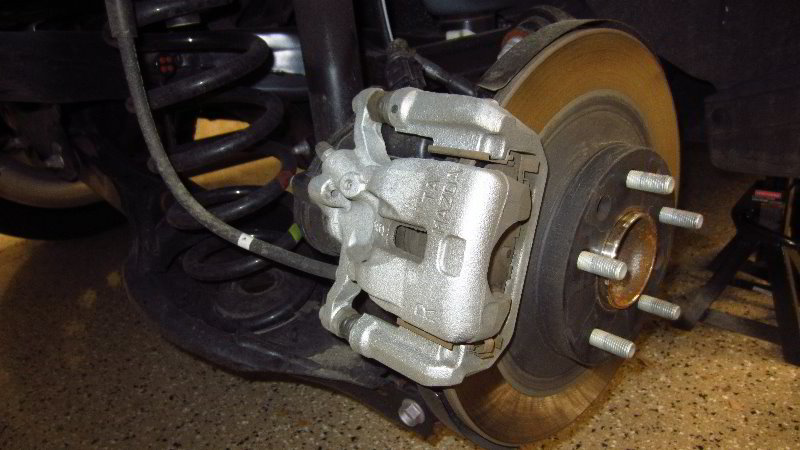
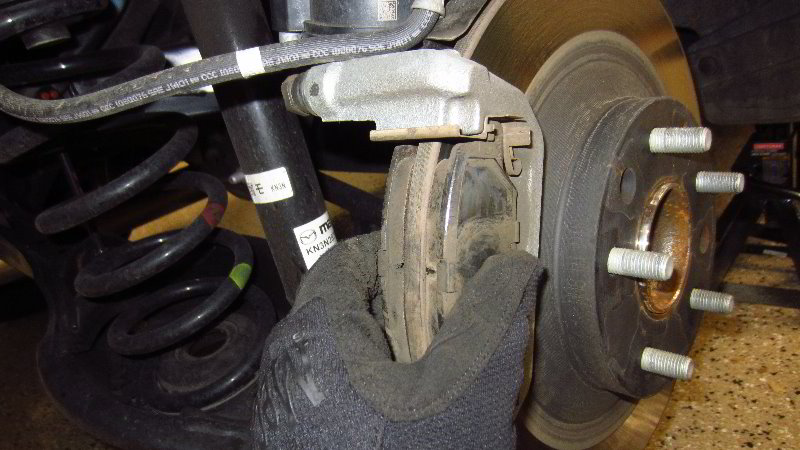
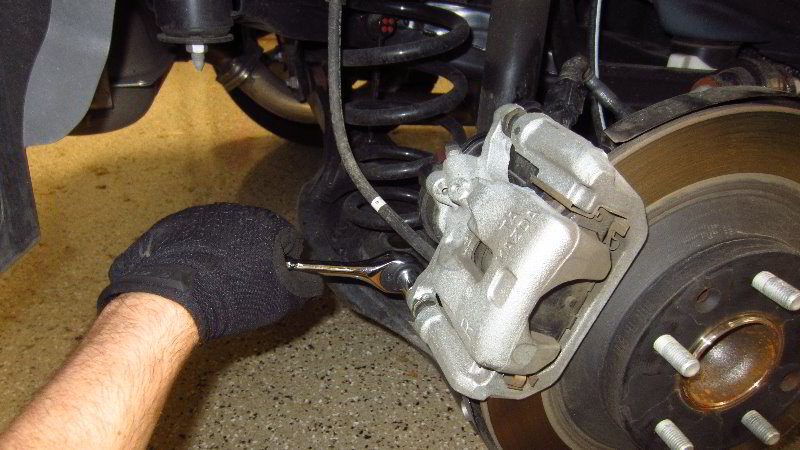
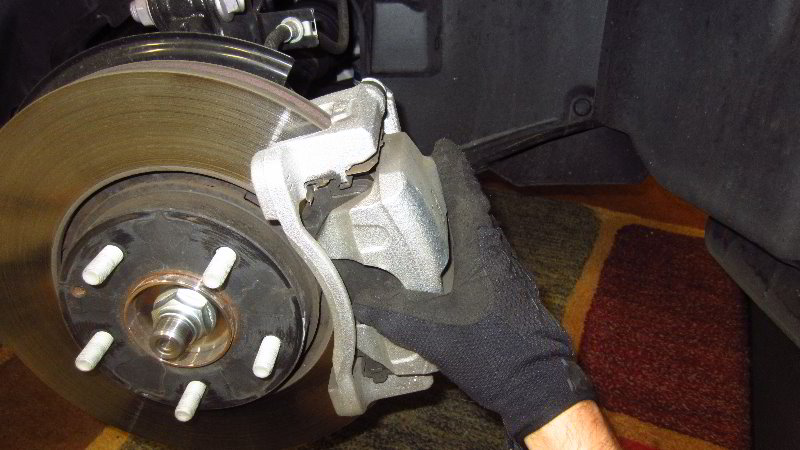
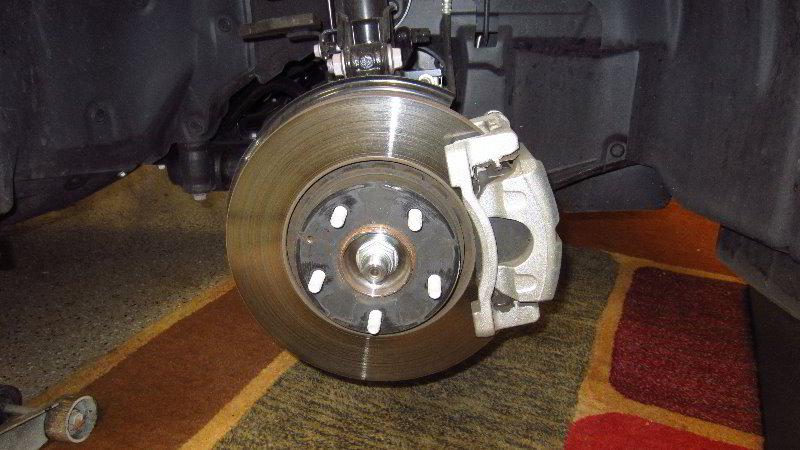
Once the wheel is off, you’ll be able to see the rear caliper, bracket, rotor, EPB actuator motor housing and the suspension.

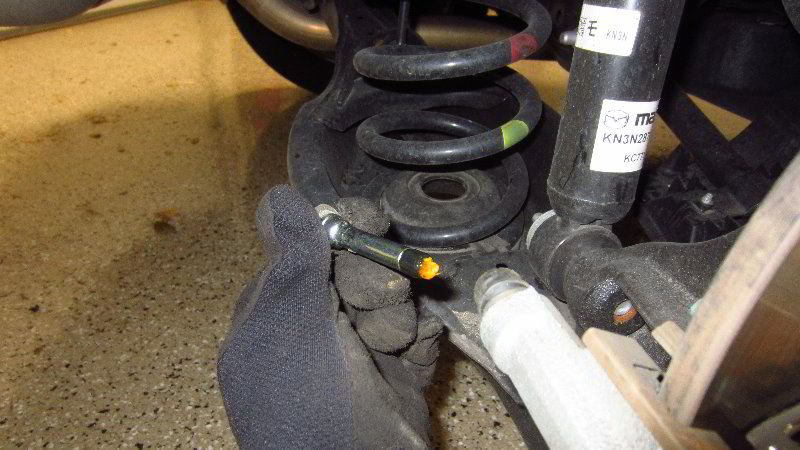
Note – Another CX-5 owner suggested that the power plug for the EPB motor should be disconnected first to make it easier to remove the caliper.

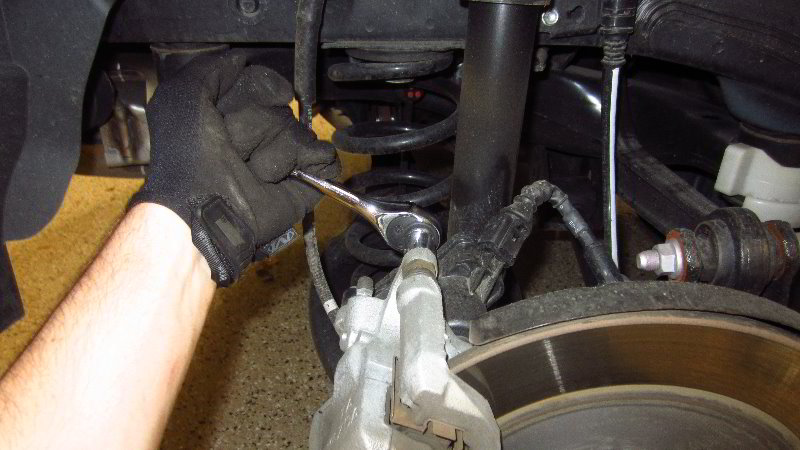
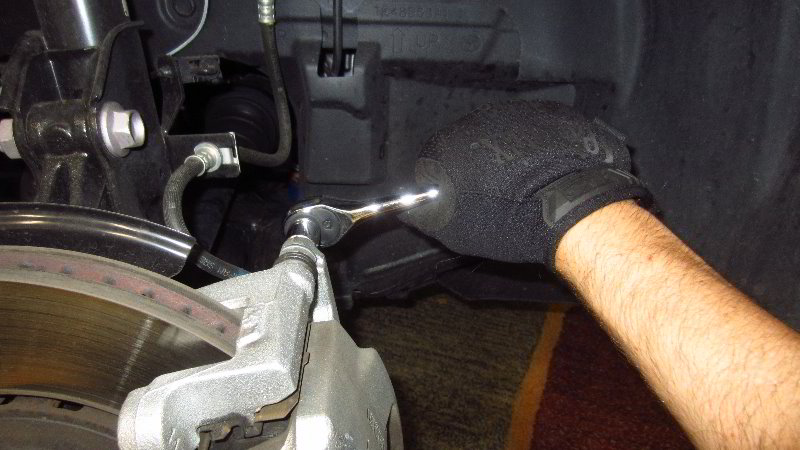
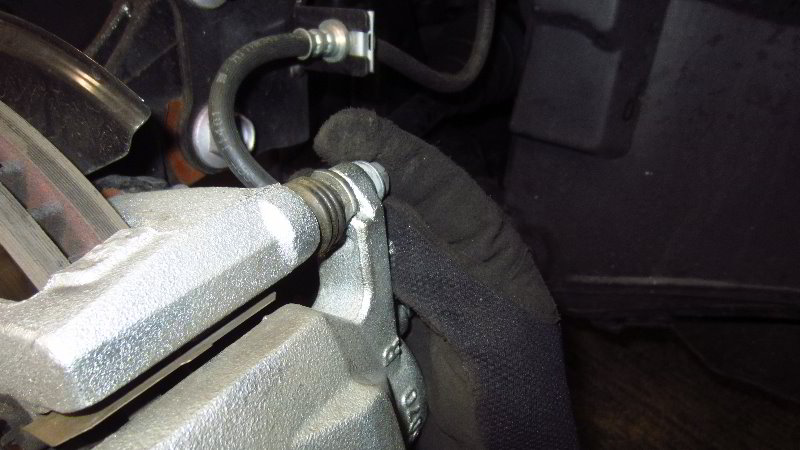
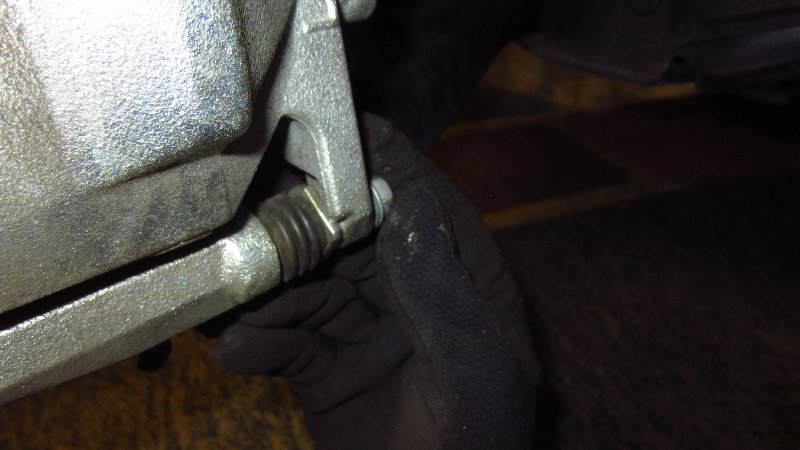
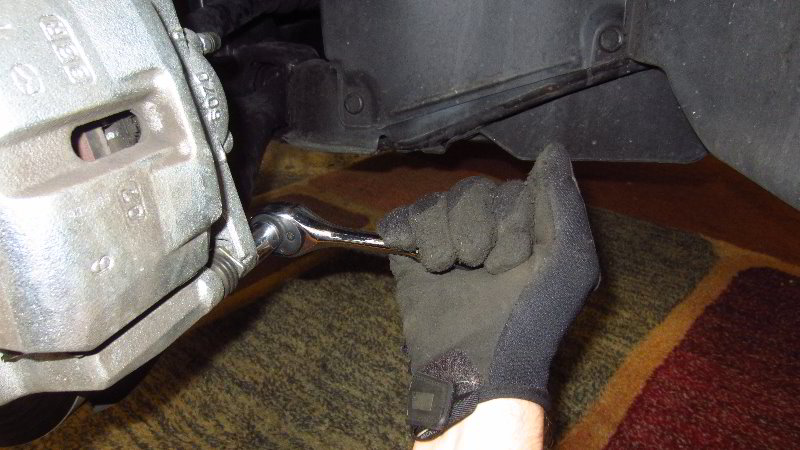
The rear brake caliper is held in place to the bracket by two bolts located on the back side. The bolt heads face in towards the cargo area of the SUV.

Loosen the top caliper bolt by turning it in the clockwise direction (as seen from the outside of the vehicle) with the 14mm socket and a 3/8″ drive ratchet.
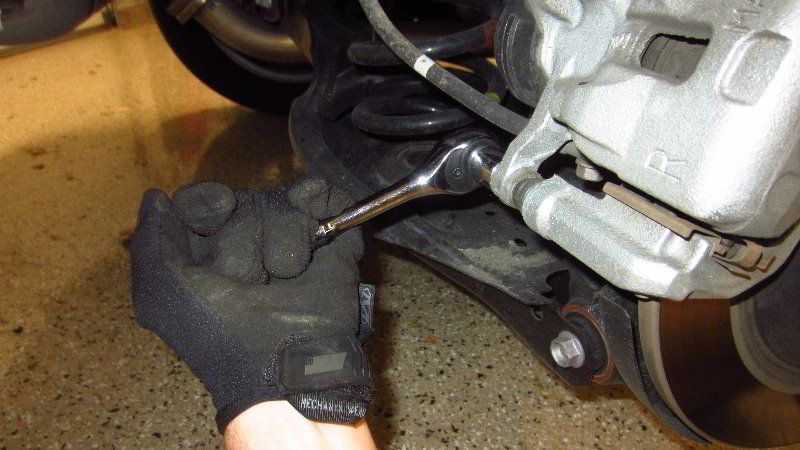
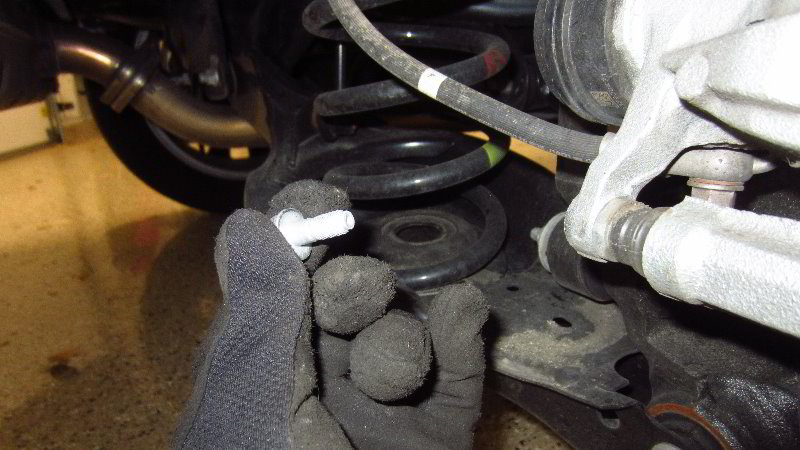
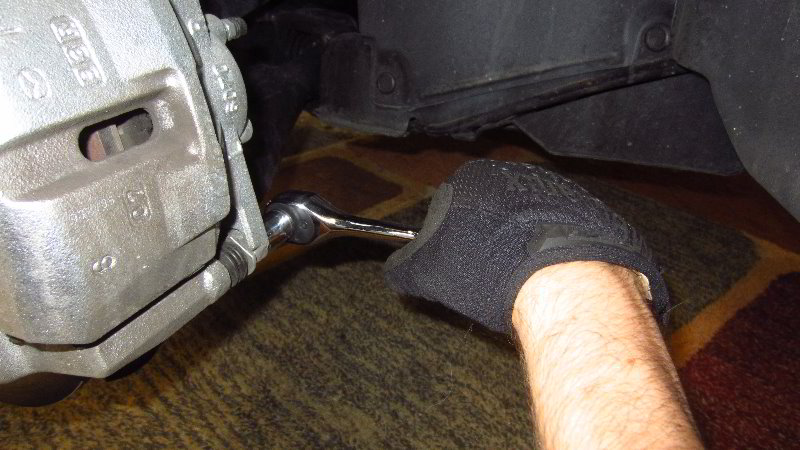
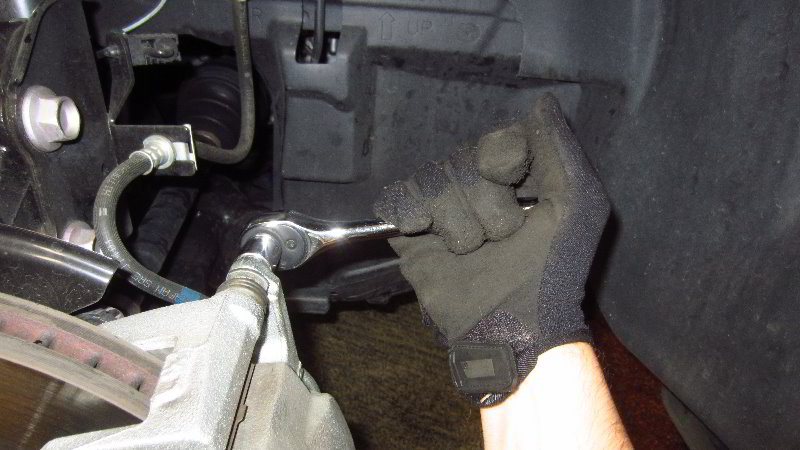
Then loosen the bottom caliper bolt by turning it in the clockwise direction (when viewed from the outside of the SUV) with the 14mm socket and a 3/8″ drive ratchet.

Note – If you were to slide under the vehicle and look at the back side of the rotor and caliper, you would loosen the caliper bolts in the “normal” counterclockwise direction.

Since we are sitting outside of the vehicle (as shown in these pictures), our orientation to the caliper bolts is reversed so we loosen them in the “opposite” clockwise direction.

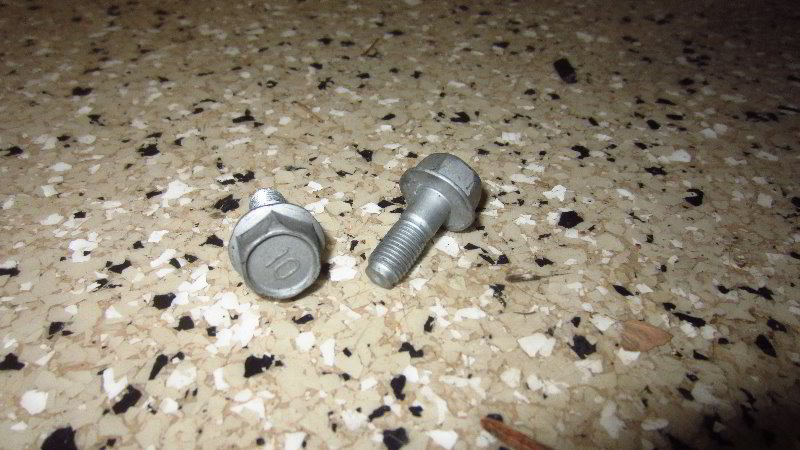
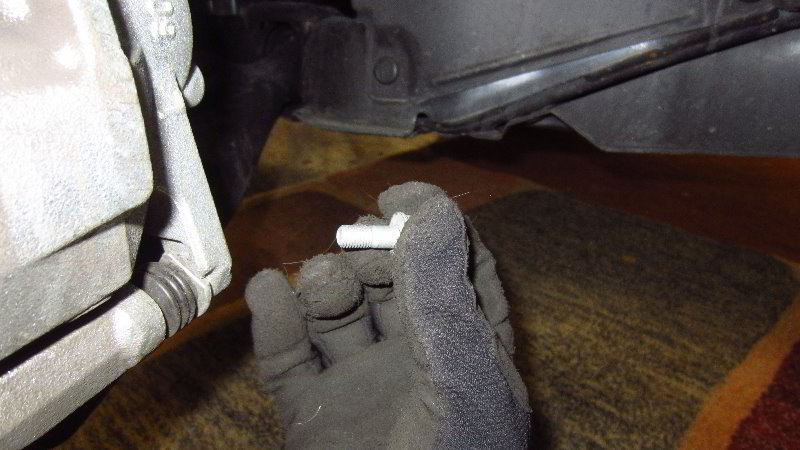
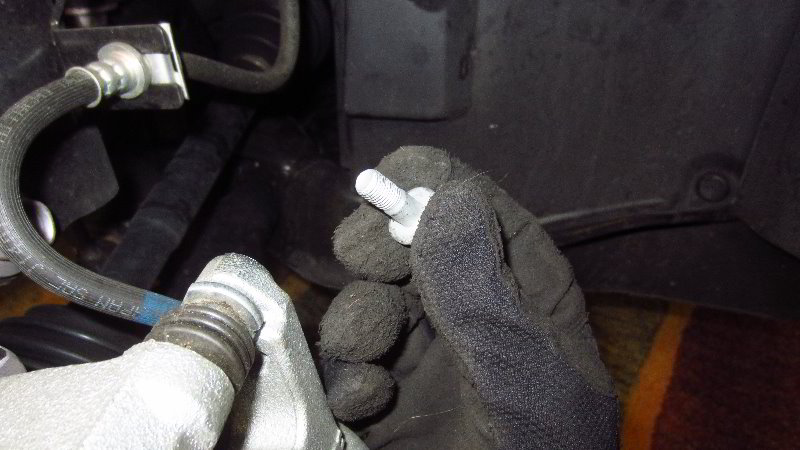
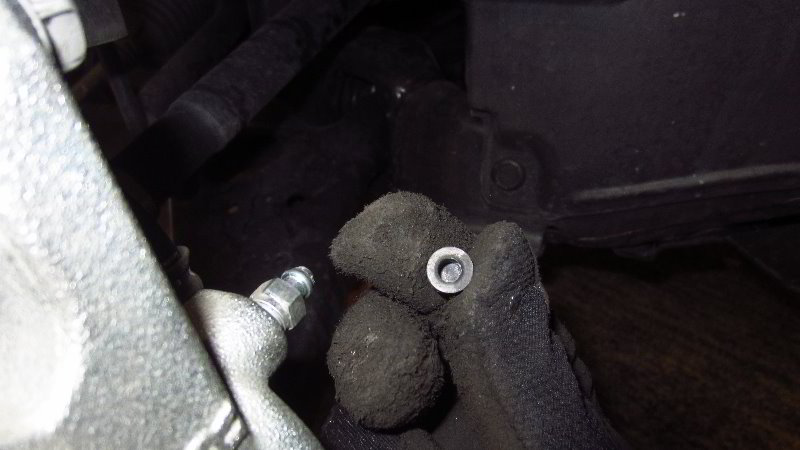
Spin out the two bolts the rest of the way by hand and set them aside in a safe place.
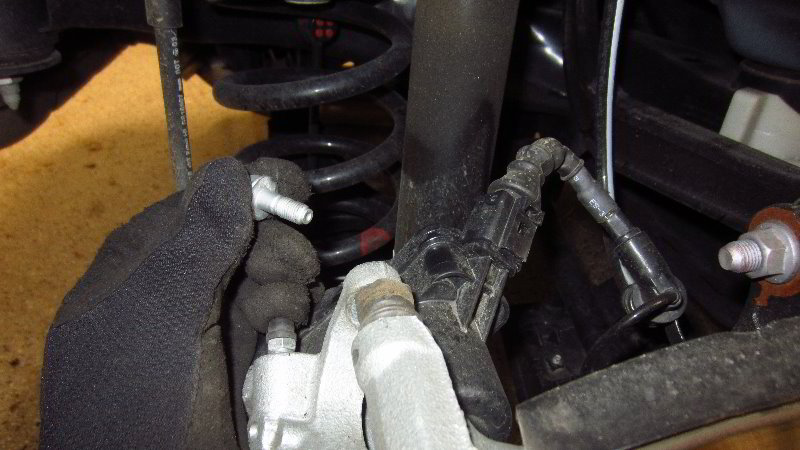
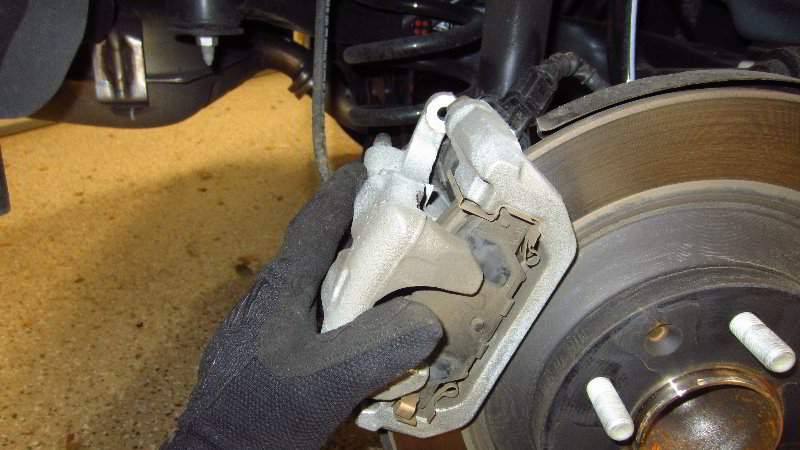
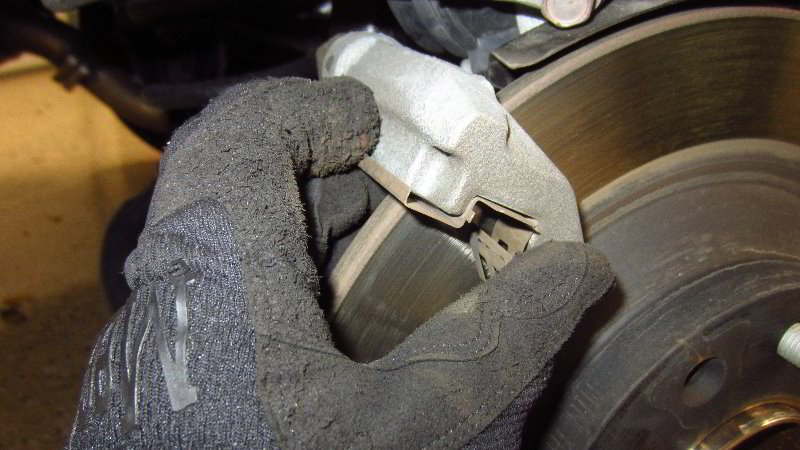
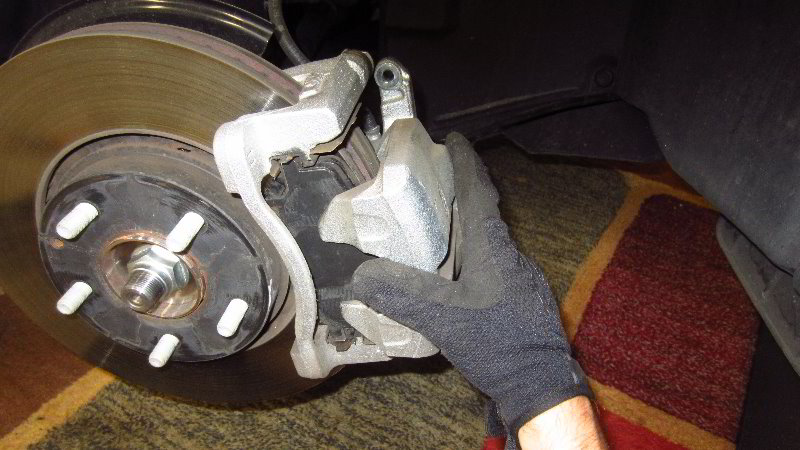
Carefully lift the caliper off the old pads and out of the bracket.

Rest the caliper on the rotor or suspend it from the suspension spring with a bungee cord or some twine.

Try to avoid stressing, pulling, kinking or bending the rubber brake fluid hose.

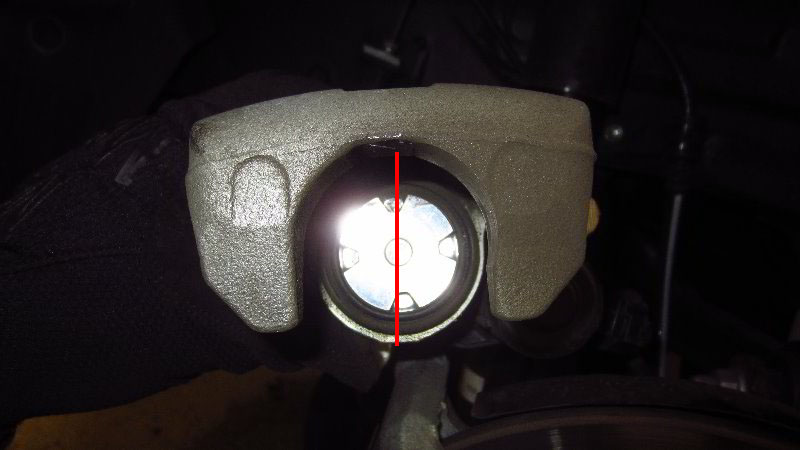
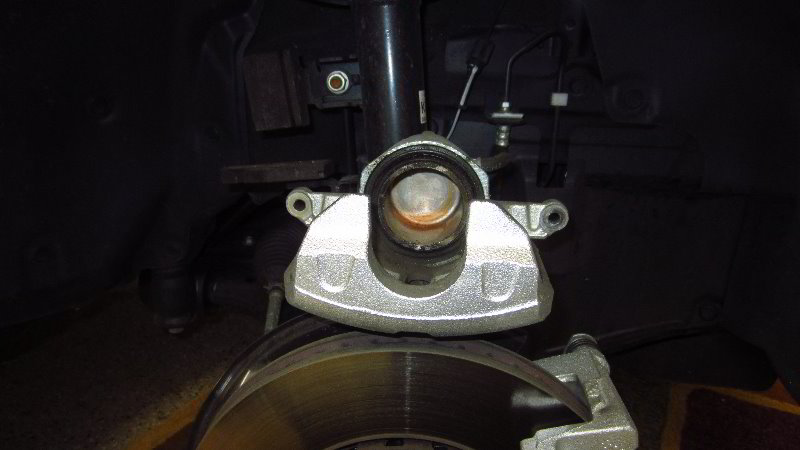
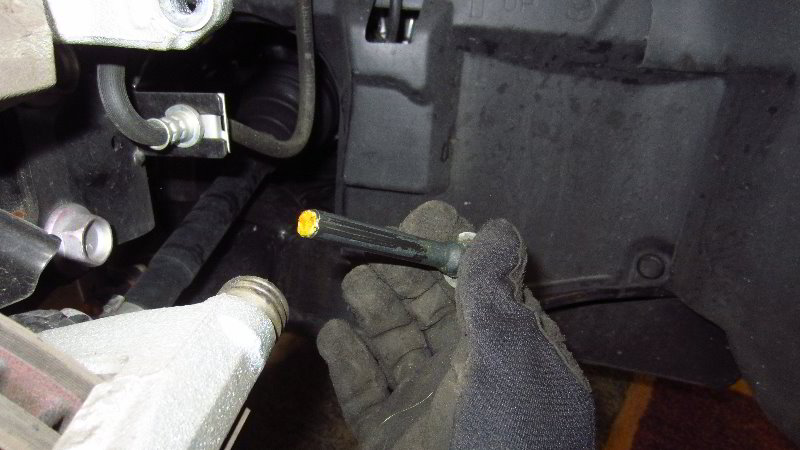
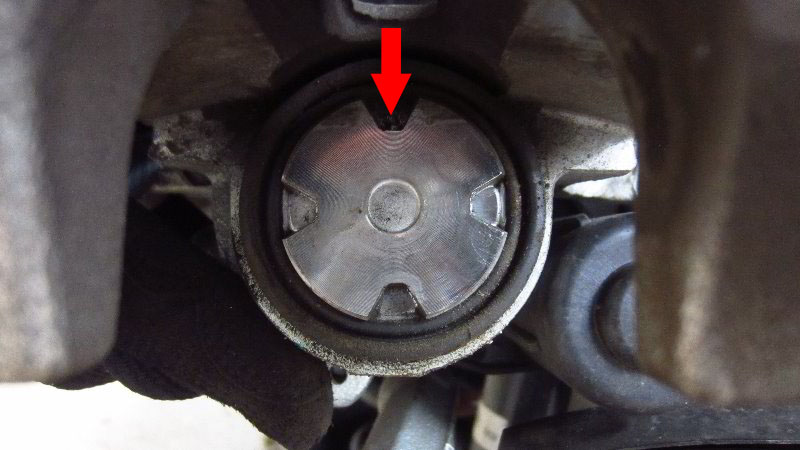
Your rear caliper piston should be aligned as shown in Picture # 15 in the row above.

The “grooves” (notches / cut out sections) on the piston must be lined up as shown above so that the piston fits securely over the peg at the middle of the inner brake pad.
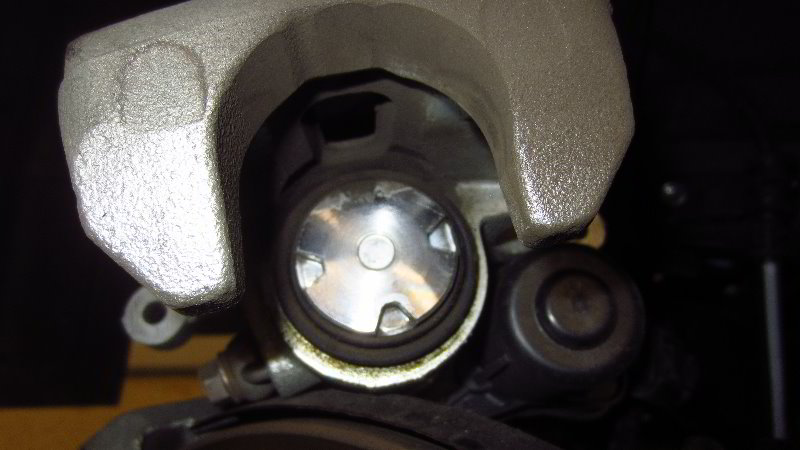
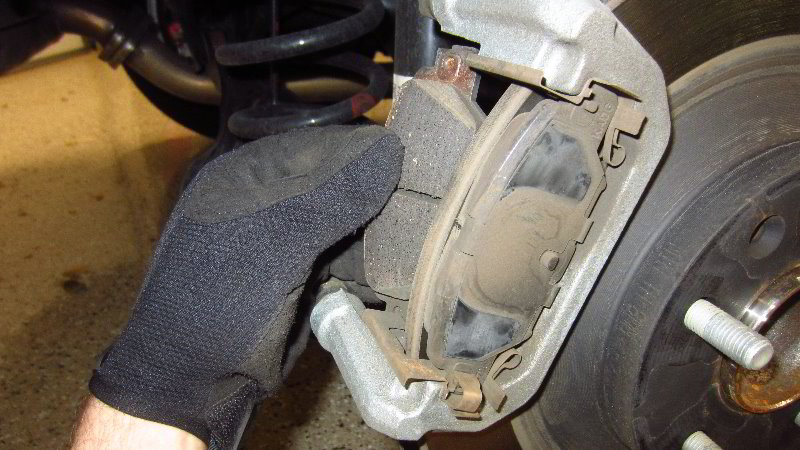
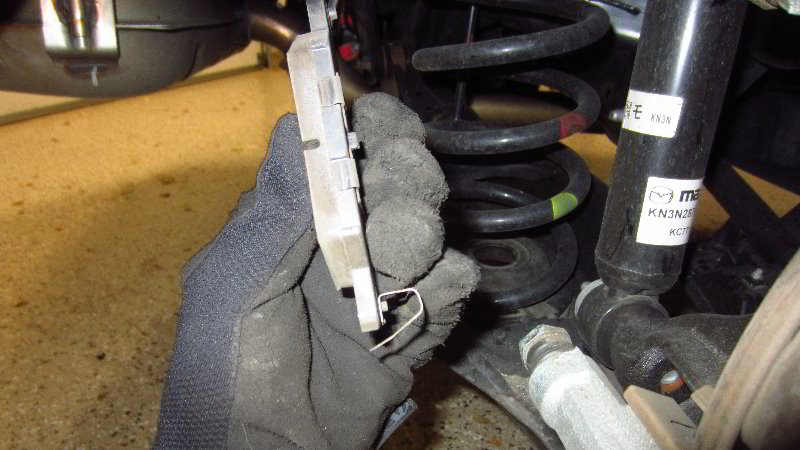
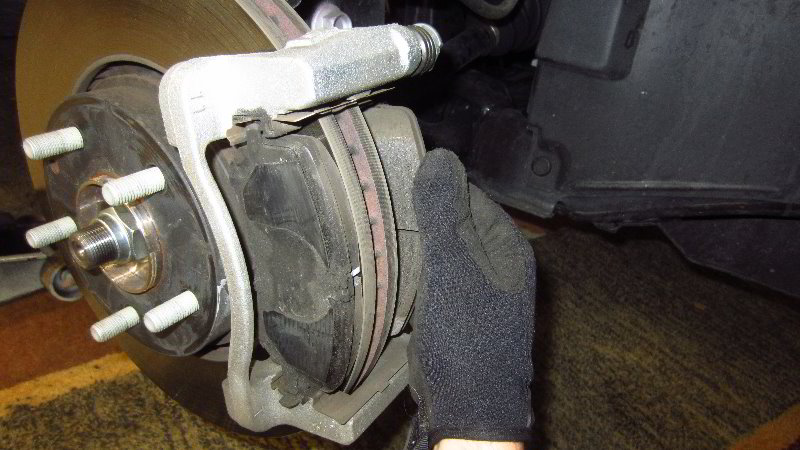
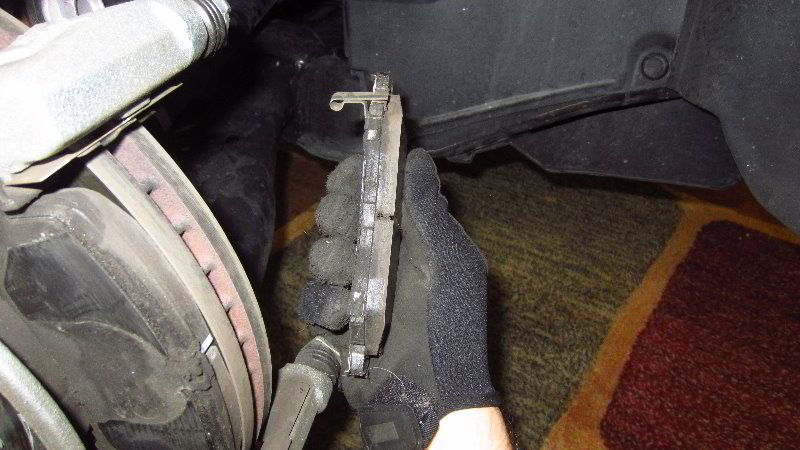
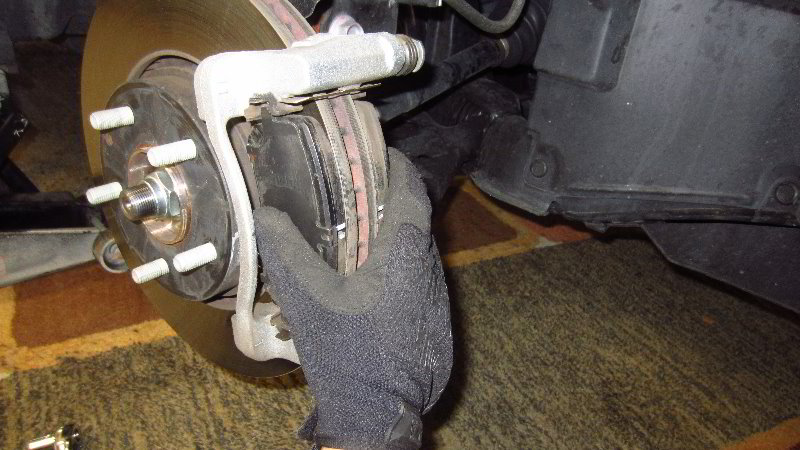
Remove the old inner and outer brake pads out of the bracket.

Make a mental note of where the wear indicator bars or “squeal” bar are situated on the old brake pads.

On this 2019 CX-5, the wear indicator bars were situated at the bottom of both the inner and outer brake pads.
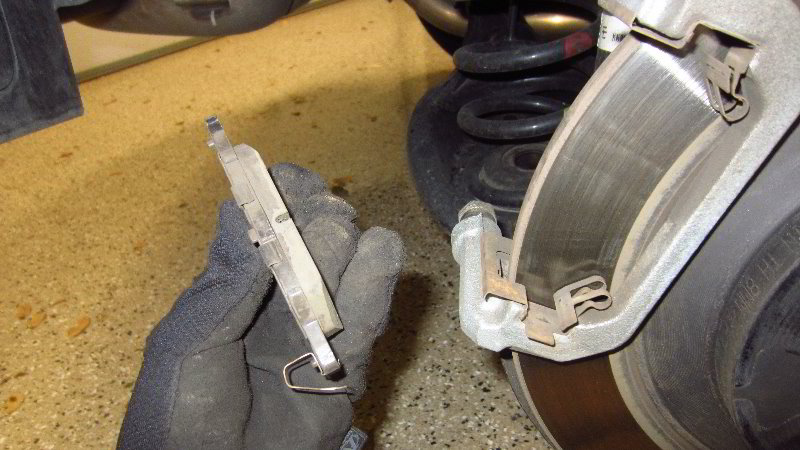
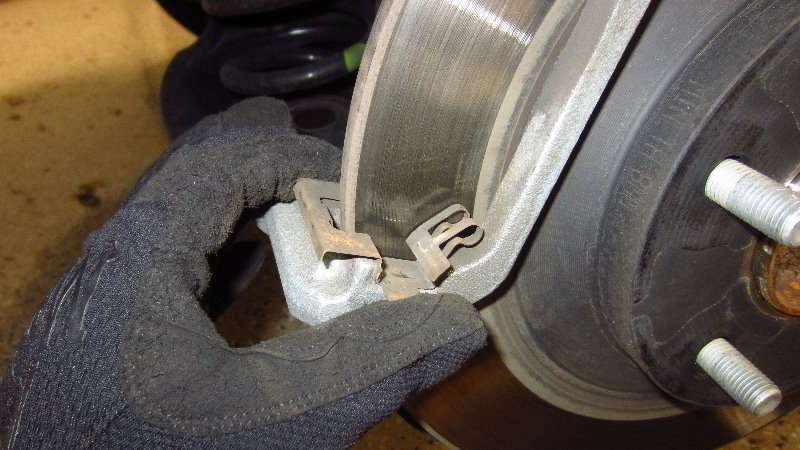
If your new set of rear pads includes a bag of replacement brake hardware, pull the old pad abutment clips or “anti-rattle” clips out of the top and bottom of the bracket.

Clean off the rotor, lug studs, caliper and bracket with brake parts cleaner spray.

Try to avoid breathing in the brake dust or the cleaning spray since they may be carcinogenic (cancer causing).

Apply a thin layer of brake parts lubricant grease to the pad abutment clips where they will come into contact with the bracket or the new pads.

Push the new pad abutment clips into the top and bottom of the bracket.

In order for the caliper to operate smoothly, the two slide pins (also known as the “slider” pins or “guide” pins) need to be well lubricated.

Do NOT mix up the top and bottom caliper slide pins since they are slightly different.

Pull out one slide pin at a time, apply a thin layer of caliper grease to the pin and push it back into its rubber dust boot attached to the bracket.
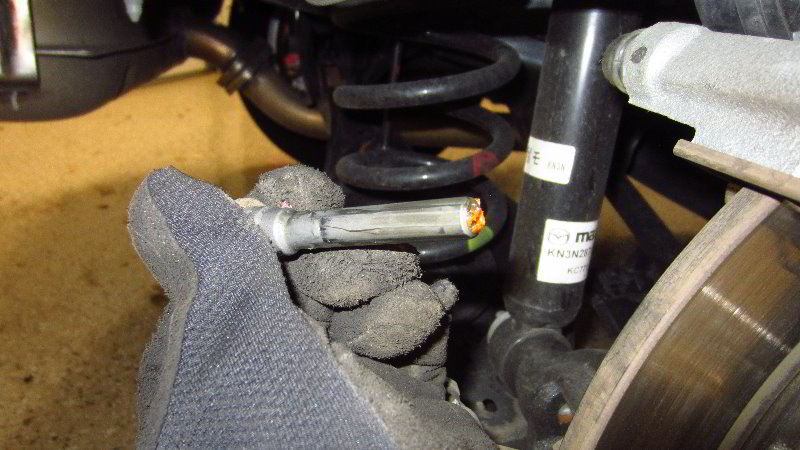
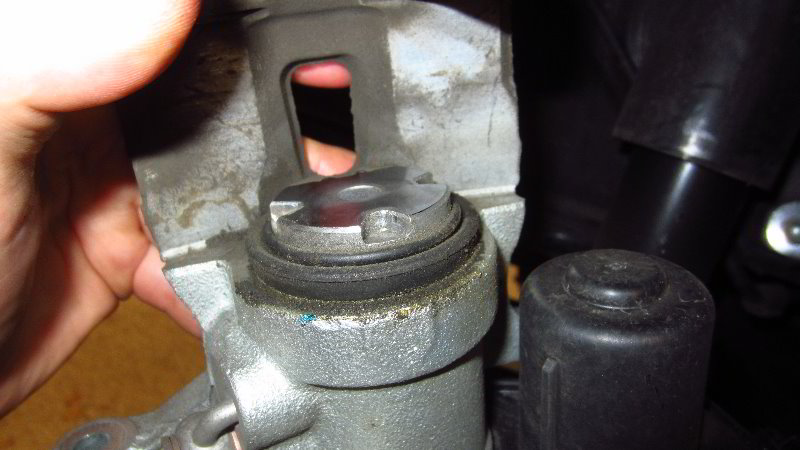
Repeat the process to lubricate the other caliper slide pin.

Attention – If your SUV is equipped with the EPB (electric parking brake), it MUST be placed in “maintenance” mode before completing the next steps.

If you correctly placed the EPB system in service mode, the actuator motors will be retracted (or “winded”) all the way back to allow the piston to easily be compressed into the caliper.

You should have heard the motors making a whirring electrical noise for a few seconds followed by a metallic clunk indicating that the actuator rods are fully retracted.

If your EPB is not in service mode, the actuator motors may be damaged when compressing the caliper pistons.

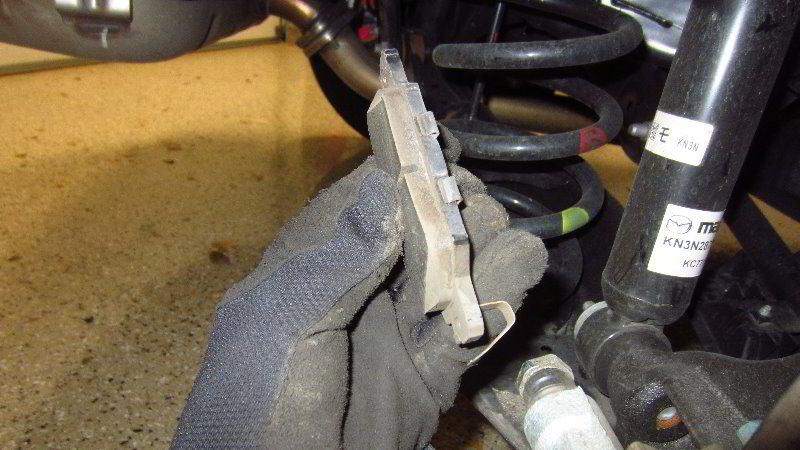
 Please proceed with caution and at your own risk! 

Attach the “F” clamp to the caliper and use the back of an old brake pad to evenly distribute the pressure across the piston.

Try to avoid turning / spinning / rotating the piston.

Slowly turn the “F” clamp handle in the clockwise direction to compress back the piston.

If you encounter any resistance, stop and make sure that the EPB system is in “maintenance mode”.

To make it easier to compress back the piston, remove the brake fluid reservoir cap.

Be sure to replace the reservoir cap as soon as you are done compressing the piston.

Continue compressing the piston until it is just about flush with the rubber dust boot that surrounds it.

Note – The service manual has this warning about turning or rotating the rear caliper piston while compressing it.

CAUTION – If the piston is pushed into caliper while rotating the piston, the caliper internal parts could be DAMAGED. Be careful NOT to rotate the piston when pushing the piston into the caliper.

The picture in the manual specifically shows them using a “disc brake expander tool” to push the piston straight back in.

The steps are listed as “Caliper Installation Note: 1. Clean the exposed area of the piston. 2. Press in the piston using a commercially available disc brake expander tool”.
Rear Rotor Replacement Instructions

If your CX-5 has been exhibiting shuddering, vibrations or shaking in the rear end while braking, the original rear brake rotors might be worn out or warped from excessive heat and should be replaced.

A few compatible rear brake rotor part numbers are as follows: DuraGo BR90119602Raybestos 981008R and ACDelco 18A2964AC.

To replace the rotors, remove the two 14mm bolts on the back side of the bracket. Pull off the bracket and set it aside in a safe place with the two 14mm bolts.

Some Mazda models have a set screw on the outer face of the rotor that must be removed.

Slide the old rotor straight off the lug studs. If the rotor is stuck due to rust or debris, firmly hit it a few times with a rubber mallet to loosen it.

Clean off the lug studs and wheel hub with brake parts cleaner spray.

Slide the new rotor over the lug studs. (If equipped, replace the set screw).

Lower the bracket into place and spin in the two 14mm bolts. Tighten the bolts until they are snug.

According to the 2016, 2017, 2018 and 2019 Mazda CX-5 service manual, the 14mm rear caliper bracket bolts should be tightened to 63 to 75 lb-ft (or 85 to 102 N-m) of torque.

The service manual for the 1st generation 2010, 2011, 2012, 2013, 2014 and 2015 Mazda CX-9 has a similar torque specification for the rear caliper bracket bolts of 57.9 to 75.1 lb-ft (or 78.4 to 101.9 N-m).
Install the new outer and inner brake pads into the bracket with the wear indicator bars situated at the bottom of both pads.

Push the two pads together until they are flush against the rotor.
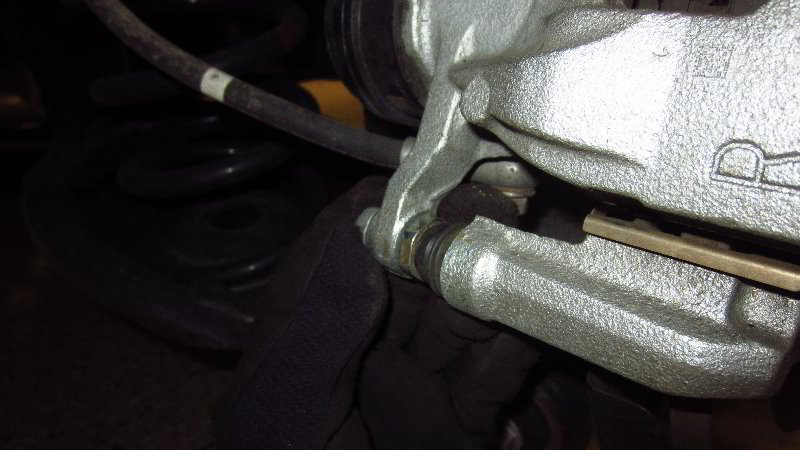
You may have noticed that the old OEM pads and the new pads are equipped with small pegs near the middle of each pad.

The rear caliper piston needs to be in the correct orientation in order for the “grooves” to fit over the peg on the inner brake pad.

If for some reason the piston is not correctly lined up, you can slowly and carefully rotate the piston in the clockwise direction with a disc brake piston tool like the Lisle 28600 or a pair of needle nose pliers would also work.

Double check that the caliper piston is in the correct position.

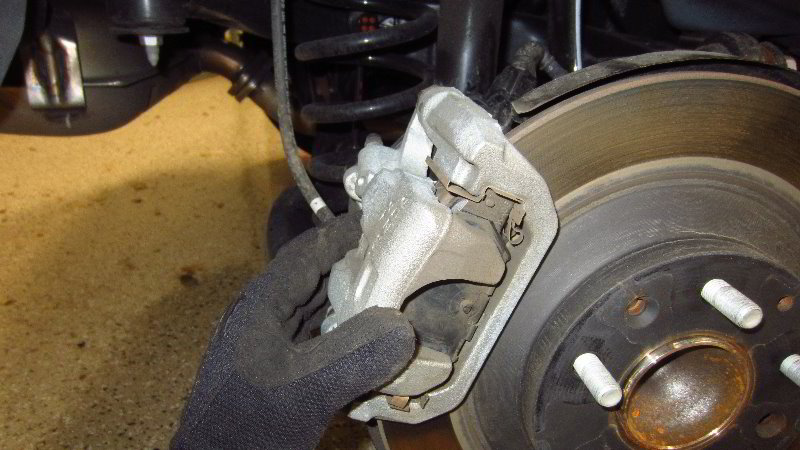
Lower the caliper over the new brake pads and into the bracket.

Line up the bolt holes in the caliper with their corresponding holes in the slide pins within the bracket.

Spin in the two caliper bolts a few turns by hand in the counterclockwise direction (as seen from the outside of the SUV) to help prevent them from becoming cross threaded.

Tighten the caliper bolts by tightening them in the counterclockwise direction (when viewed from the outside of the vehicle) with the 14mm socket and a 3/8″ drive ratchet until they are snug.

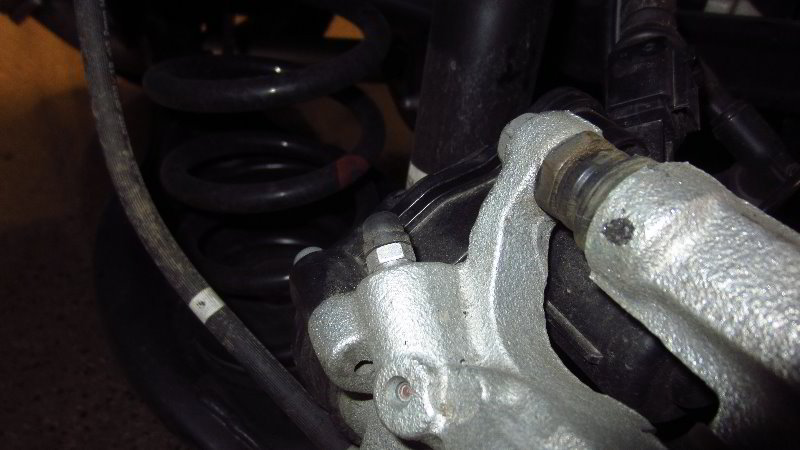
If you have a sensitive and reliable torque wrench, the 2016-2019 CX-5 service manual lists a torque specification of 17 to 22 lb-ft (or 22 to 31 N-m) for the 14mm caliper bolts.

Double check that the bracket bolts and caliper bolts are tight before moving on to the next steps.

If your brake pedal has been feeling soft or spongy, the brake fluid may contain some air bubbles or moisture.

It would be best to bleed the brake lines and flush out the old fluid with fresh DOT 3 brake fluid at this time.

I highly recommend using the Allstar Performance Bleeder Bottle to bleed the brake lines.

A bleeder bottle makes this procedure a very easy one-person job compared to having an assistant repeatedly pump the brake pedal as you manually open and close the valves. The bottle has a one way check valve so you can just pump the brake pedal yourself and not risk introducing any air into the system.

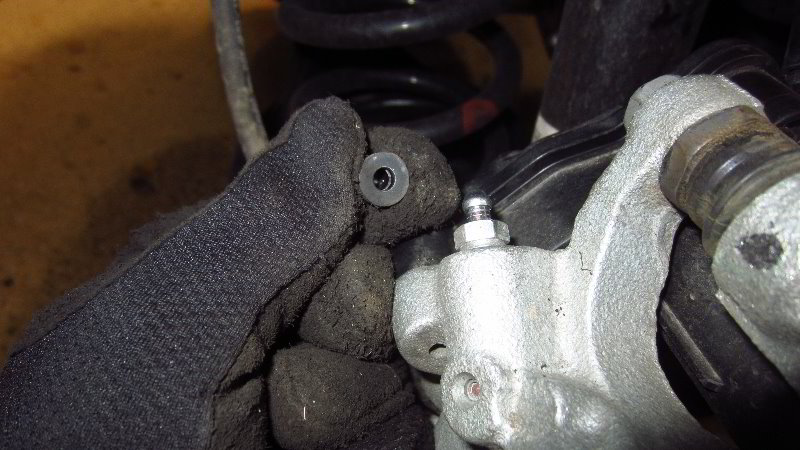
The brake fluid bleeder valve is located on the back side of the caliper just below the top bolt. To open and close the brake fluid bleeder valves, you’ll need a 10mm wrench.

In general, the brake line bleeding order for most vehicles is to start at the caliper furthest from the brake fluid reservoir and then work your way to the closest caliper. So the order most likely should be as follows: right rear, right left, front right and front left.

The torque specification in the 2010 to 2015 CX-9 shop manual for tightening the rear caliper bleeder valves is 61 to 86 in.lbf (or 6.9 to 9.8 N.m).

The 2016, 2017, 2018 and 2019 Mazda CX-5 shop manual lists the torque specification for tightening the rear bleeder valves as being a range of 62 to 86 in-lbf (or 6.9-9.8 N-m).

Try to avoid over tightening the bleeder valves to prevent from stripping the threads or damaging them which could lead to a brake fluid leak.

Note – I’ve never used a torque wrench to tighten bleeder valves. Just make sure they are snug and avoid over tightening them.

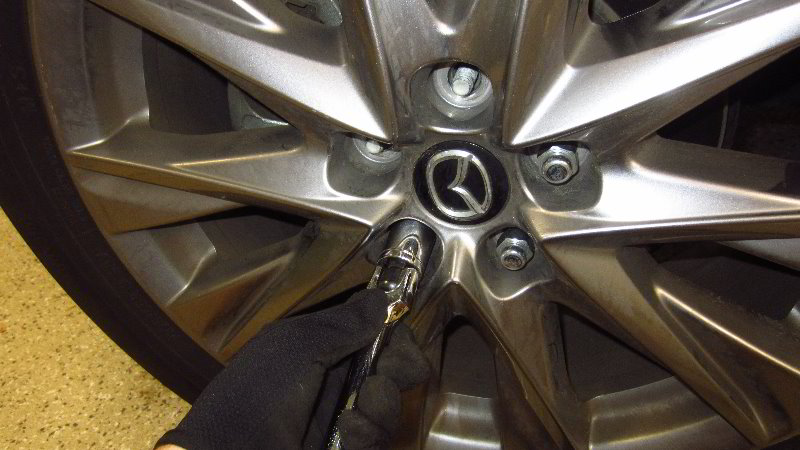
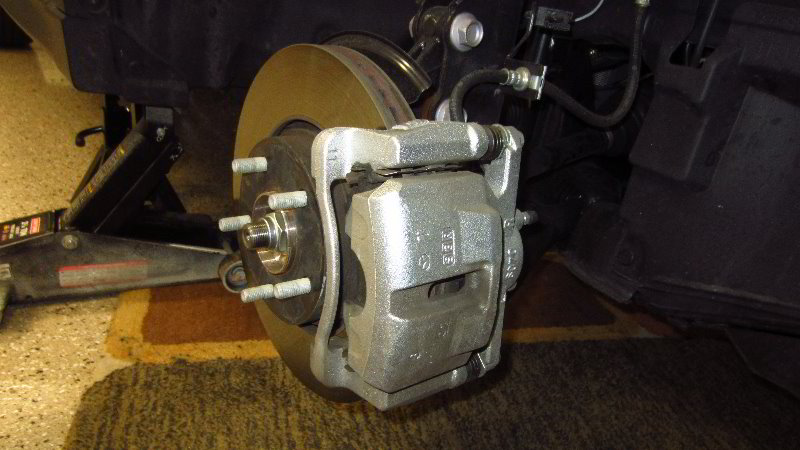
Carefully push the rear wheel back into place over the lug studs.

Spin on the five lug nuts a few turns by hand in the clockwise direction to help prevent them from becoming cross threaded.

Slightly tighten the lug nuts in a “criss-cross” or star pattern with the lug nut wrench.
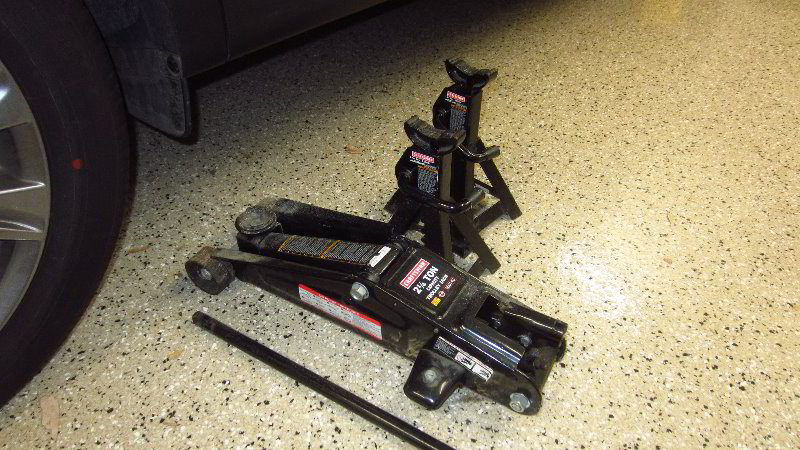
Carefully lower the SUV from the jack stands by using the floor jack.

Continue tightening the lug nuts in the clockwise direction in a “star” or criss-cross pattern with the lug nut wrench until they are snug.

It would be best to use a torque wrench to tighten the lug nuts to the owner’s manual specification of 80 to 108 lb-ft (or 108 to 147 N-m).

Sit in the driver’s seat of the car and firmly push down the brake pedal a few times to help restore the brake line pressure.

Check the brake fluid in the reservoir and verify that it is at the correct level. If it is low, add some DOT 3 brake fluid from a brand new bottle.

How To Exit EPB Maintenance Mode

The 2016 to 2019 Mazda CX-5 service manual has the following instructions for ending the electronic parking brake maintenance mode.

1. Switch the ignition to ON (engine off – keep your foot off the brake pedal)
2. Switch the ignition to OFF and then switch the ignition to ON within 5 seconds while maintaining the following two conditions – A. Pull up the electric parking brake switch. B. Depress the accelerator pedal fully.
3. Verify that the amber colored EPB warning light (P!) has turned off.
4. Switch the ignition back to OFF.

Here is another version of the instructions in case the above doesn’t work for you. –

1. Switch the ignition to “ON” – Press the “START” button twice. (Once to enter Accessory mode and again to turn the ignition system to “ON”.
2. Press the accelerator (gas) pedal all the way down and also pull up on the EPB switch. Continue pushing the accelerator pedal all the way down and hold up the EPB switch while completing the next step.
3. Press the “START” button three times rapidly.
4. You should hear the electric actuator motors moving out to meet the caliper pistons for a few seconds.
5. Check to see if the yellow (P!) warning light has turned off on the tachometer (RPM gauge).
6. Release the accelerator pedal and let go of the EPB switch.
7. Try setting the parking brake by pushing on the brake pedal and then lift up the EPB switch. The parking brake should activate and you’ll see the usual red “! BRAKE” indicator light on the speedometer gauge.
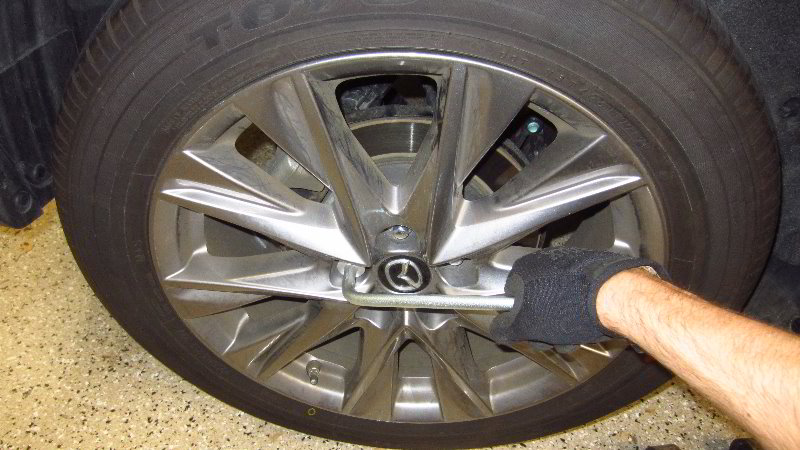
It would be best to use a torque wrench to tighten the lug nuts to the owner’s manual specification of 80 to 108 lb-ft (or 108 to 147 N-m).

To break in your new rear brake pads, just drive normally for the few hundred miles while trying to avoid any hard or “panic” stops which could glaze over the new pads and cause them to be noisy or not perform as well.

It’s also a good idea to regularly check your driveway for drops of fresh brake fluid which may indicate a leak from the reservoir or the bleeder valves, check the brake fluid level in the reservoir and also verify that the lug nuts are still tight.

Be sure to record the brake pad change in your vehicle’s service records.

Please check out all of my 2017-2022 Mazda CX-5 DIY Repair & Maintenance Guides.
2017, 2018, 2019, 2020, 2021, 2022, 2023, 2024 & 2025 Mazda CX-5 Front Brake Pads Replacement DIY Guide

This automotive maintenance tutorial was specifically written to assist owners of the second generation (2017, 2018, 2019, 2020, 2021 and 2022) Mazda CX-5 SUV in changing the front disc brake pads and lubricating the caliper slide pins. Plus directions for replacing the rotors if necessary.

Owners of other Mazda vehicles such as the CX-3, CX-30, CX-7, CX-9, Mazda3, Mazda6, MX-30, MX-5 Miata, Mazda2, CX-4, CX-8 and BT-50 may also find these DIY instructions to be helpful.

A few compatible replacement sets of new front brake pads with their part numbers are as follows: ACDelco 17D1623CHWagner ZD1623Power Stop Z23-1623Raybestos EHT1623H,

If you prefer to have the OEM (original equipment manufacturer) pads, the part number is Mazda K0Y1-33-28ZB (also known as K0Y13328ZB, K0Y1-33-28ZA or K0Y13328ZA).

The tools and other items needed to complete this procedure include a lug nut wrench, a floor jack, two jack stands, a 14mm socket with a 3/8″ drive ratchet, an “F” clamp and a tube of brake caliper grease.

The first few steps are to drive the SUV on to a level surface, shift the transmission into “Park” and turn off the ignition.

Engage the emergency / parking brake and place wheel chocks on both sides of the rear tires.

Slightly loosen the five lug nuts about 1/2 turn in the counterclockwise direction with the tire iron.

Carefully raise the front of the vehicle with the floor jack and securely support it with at least two jack stands.

Please do not solely rely on the floor jack to support the vehicle!

I prefer to only work on one side of the car at a time to keep three tires on the ground for extra safety.

Spin off the five lug nuts in the counterclockwise direction.

Set the lug nuts aside in a safe place.

Carefully remove the rear wheel and tire.

Some home mechanics choose to place the wheel under the vehicle’s frame rail as an backup support device just in case the car falls off the jack stands.

Once the wheel is removed, you’ll be able to see the rotor, bracket, caliper and suspension.

The front brake caliper is held in place to the bracket by two bolts situated on the back side of the caliper. The bolt heads face in towards the engine bay.

Loosen the top caliper bolt by turning it in the clockwise direction (as seen from the outside of the vehicle) with the 14mm socket and a 3/8″ drive ratchet.

Then loosen the bottom caliper bolt by also turning it in the clockwise direction (when viewed from the outside of the vehicle) with the 14mm socket and the 3/8″ drive ratchet.

Note – If you slide under the vehicle and look at the back side of the rotor and caliper, you would loosen the bolts in the “normal” counterclockwise (lefty loosey) direction.

Since we are looking at the outer face of the rotor and caliper, our orientation to the bolts are reversed, so we will loosen them in the “opposite” clockwise direction.

I do not recommend removing the bolts from underneath the vehicle since it is an unnecessary risk to your safety.

Spin out the two caliper bolts and set them aside in a safe place.


Carefully lift the caliper out of the bracket and off the old brake pads.

Try to avoid pulling, stressing, kinking or bending the rubber brake fluid hose.

Rest the caliper on the top of the rotor or suspend it from the suspension spring with a bungee cord or some twine.

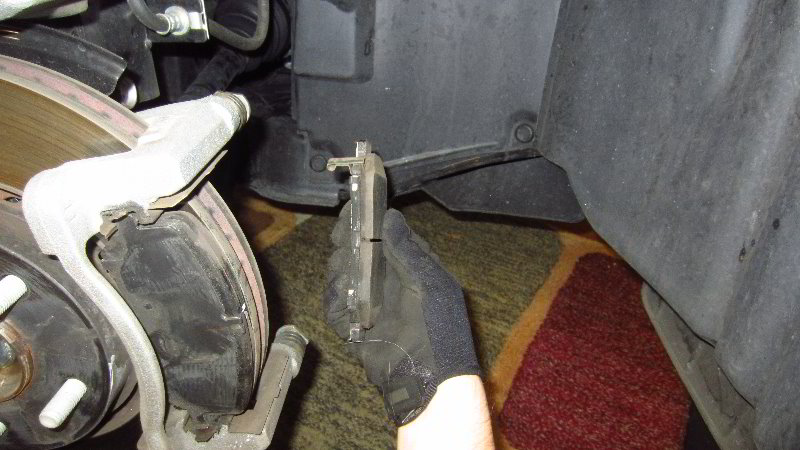
Remove the old inner and outer brake pads from the bracket.

Make a mental note of where the wear indicator bar or “squeal” bar is located.

On this 2019 CX-5, the wear indicator bar is situated at the top of the inner brake pad.

If your new set of front pads includes a bag of replacement brake hardware, pull the old pad abutment or “anti-rattle” clips out of the top and bottom of the bracket.

Clean off the rotor, lug studs, bracket and caliper with brake parts cleaner spray.

Try to avoid breathing in the cleaning spray or the brake dust since they may be carcinogenic (cancer causing).

Apply a thin layer of brake parts lubricant grease to the top and bottom of the new pad abutment clips.

Push the two pad abutment clips into the top and bottom of the bracket. Make sure the clips are fully seated in place.

In order for the caliper to operate smoothly, the two caliper slide pins (also known as guide pins or “slider pins”) need to be well lubricated.

Do NOT mix up the top and bottom caliper slide pins since they are slightly different.

Pull out one pin at a time from its rubber dust boot, apply a thin layer of brake caliper grease and then push it back into the bracket.

Repeat the process to lubricate the other slide pin.

In order for the caliper to fit over the thicker new brake pads, the piston needs to be compressed back.

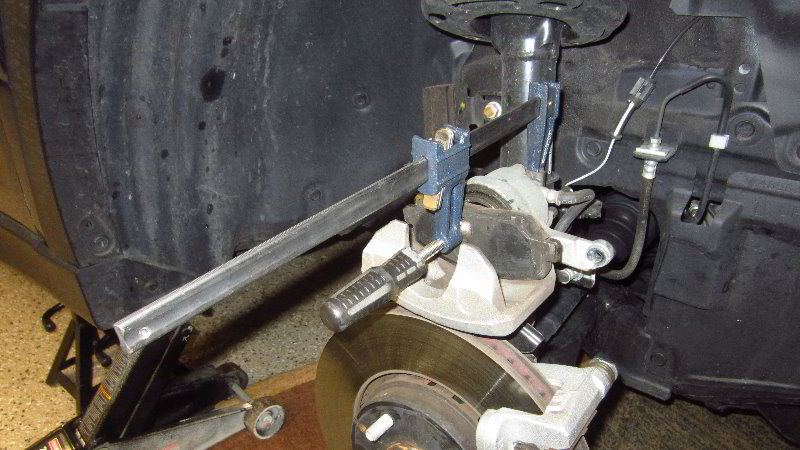
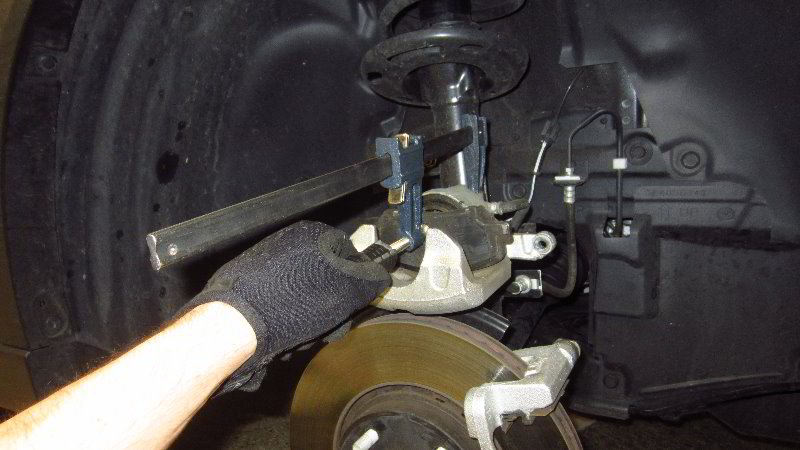
Attach the “F” clamp to the caliper and use the back of an old brake pad to help evenly distribute the pressure across the piston.

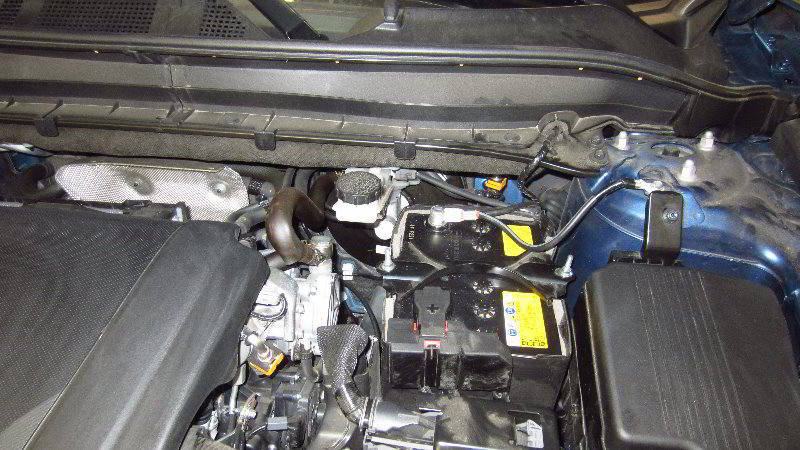
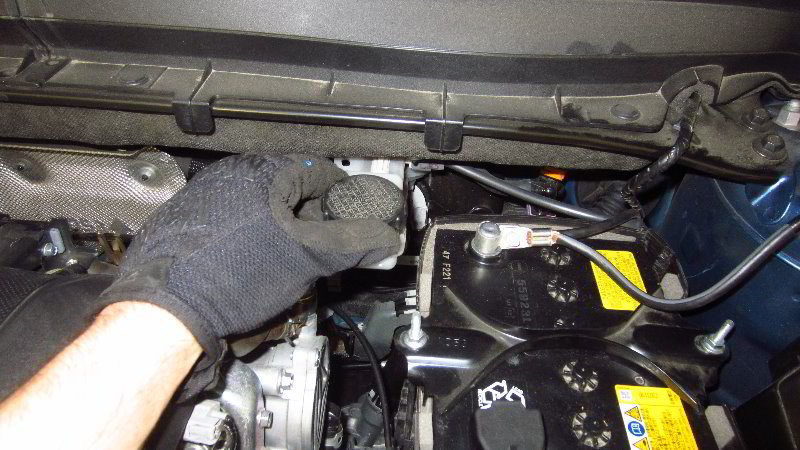
Move to the right rear area of the engine bay and locate the brake fluid reservoir situated to the left of the 12V automotive battery and in front of the cowl by the windshield.

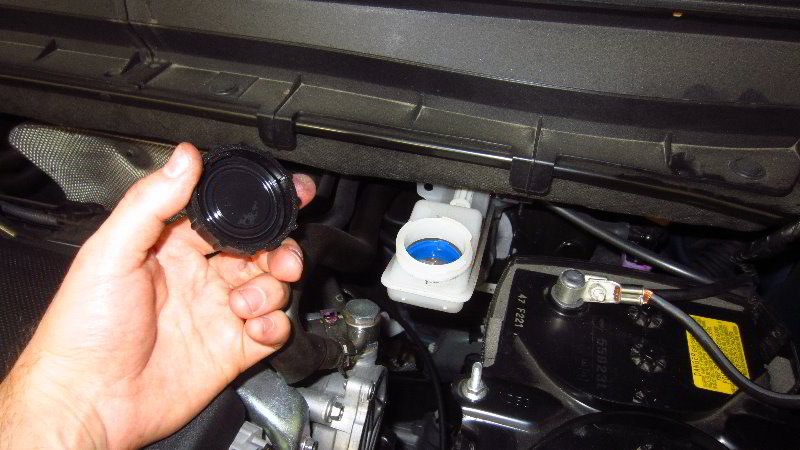
Twist off the cap on the reservoir bottle by turning it in the counterclockwise direction.

Set the cap aside in a safe place.

Removing the cap will allow the fluid to more easily travel back through the system when you compress the caliper piston.

Slowly turn the “F” clamp handle in the clockwise direction to retract back the caliper piston.

Make sure the piston is traveling straight back into the caliper and not at an angle.

If you encounter any resistance, stop and make sure the “F” clamp is lined up properly.

Continue compressing back the piston until is just about flush with the rubber dust boot that surrounds it.

As soon as you are done retracting the piston, replace the brake fluid reservoir cap.

Brake fluid is hygroscopic (absorbs moisture from the air) so the cap should not be left any longer than absolutely necessary.

If your CX-5 has been exhibiting shuddering, shaking or vibrations in the front end while braking, the OEM rotors might be worn out or warped and should be replaced.

Remove the two 17mm bolts on the back side of the bracket and set the bracket aside.

(If your rotor is equipped with a set screw, remove it.)

Slide the old rotor straight off the wheel hub and lug studs. If the old rotor is stuck in place due to corrosion, try hitting it a few times with a rubber mallet to loosen the rust.

Clean off the wheel hub and lug studs with brake parts cleaner spray.

A few compatible replacement front brake rotors with their part numbers are as follows: Centric 121.45094Raybestos 982264FZN and Mazda KD45-33-251.

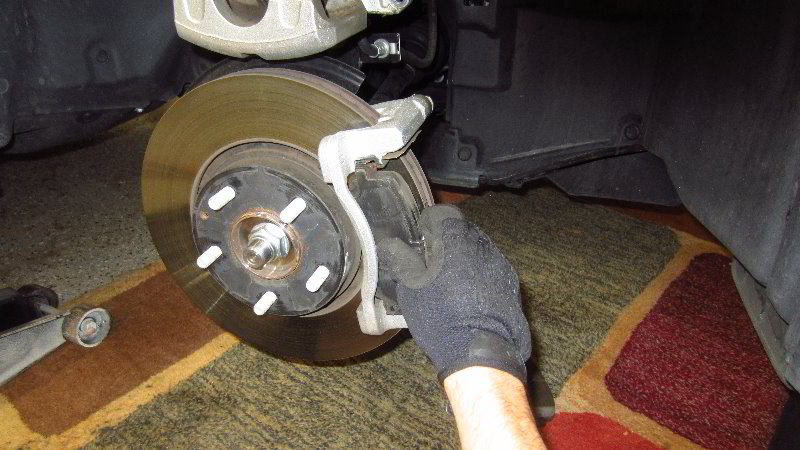
Slide the new rotor over the lug studs and against the wheel hub.

Reattach the bracket with the two 17mm bolts.

The CX-5 service manual specification for tightening the 17mm caliper bracket bolts is 68 to 81 lb-ft (or 92 to 110 N-m) of torque.

Orientate the wear bar at the top of the new inner brake pad.

Install the new inner and outer brake pads into the bracket.

Push the pads together until they are flush against the rotor.

Carefully lower the caliper over the new pads and into the bracket.

If the caliper won’t fit over the thicker new brake pads, you might need to compress the piston back a bit further.

Line up the bolt holes in the caliper with their corresponding holes in the slider pins within the bracket.

Spin in the two caliper bolts a few turns by hand in the counterclockwise direction (as seen from the outside of the vehicle) to help prevent them from becoming cross threaded.

Tighten the two bolts by turning them in the counterclockwise direction (when viewed from the outside of the SUV) with the 14mm socket and a 3/8″ drive ratchet.

If you have a sensitive and reliable torque wrench, the Mazda CX-5 shop manual specifies that the 14m caliper bolts should be tightened to between 23 to 28 lb-ft (or 30 to 39 N*m).

Double check that the bracket bolts and caliper bolts are properly tightened before moving on to the next steps.

If your brake pedal has been feeling soft, mushy or spongy, the brake fluid might be contaminated with some water or a few air bubbles.

It would be best to bleed the brake lines at this time in order to flush out the old fluid and replace it with fresh DOT 3 brake fluid.

The brake fluid bleeder valve is located on the back side of the caliper just below the top bolt.

For more on this topic, check out my Brake Line Fluid Bleeding With An Assistant DIY Guide or alternatively the Brake Line Fluid Bleeding With A Power Bleeder Guide.

The brake fluid bleeder valve is covered by a rubber cap and located just below the top caliper bolt.

The service manual specification for tightening the 10mm bleeder screws is 62 to 86 in-lb (or 6.9 to 9.8 N-m).

Carefully push the front wheel back into place over the lug studs.

Spin on the five lug nuts in the clockwise direction by hand to prevent them from becoming cross threaded.

Slightly tighten the lug nuts in the clockwise direction with the tire iron in a criss-cross or “star” pattern.

Carefully lower the SUV from the jack stands by using the floor jack.

Continue tightening the lug nuts in a criss cross or star pattern until they are snug.

If you have a torque wrench, the 2019 CX-5 owner’s manual specification for tightening the lug nuts is 80 to 108 lb-ft (or 108 to 147 N-m).

Sit in the driver’s seat of the SUV and push on the brake pedal a few times to help restore the brake line pressure. Check the brake fluid in the reservoir and verify that it is at the proper level. If it is low, add some fresh DOT 3 fluid

To break in your new front brake pads, just try to drive normally for the first few hundred miles while trying to avoid any very hard or “panic” stops which might glaze over the new pads and cause them to be noisy or not perform as well.

It’s also a good idea to regularly check your driveway, parking spot or garage for drops of fresh brake fluid which may indicate a leak from the bleeder valve or the reservoir. You should also check the brake fluid level in the reservoir, and also verify that the lug nuts are still tight.

Be sure to write down the procedure in your vehicle’s service records.

Please check out all of my 2017-2022 Mazda CX-5 DIY Repair & Maintenance Guides.
2017, 2018, 2019, 2020, 2021, 2022, 2023, 2024 & 2025 Mazda CX-5 Skyactiv-G 2.5L I4 Engine Engine Oil Change & Oil Filter Replacement DIY Guide

This automotive maintenance tutorial was specifically written to assist owners of the second generation (2017, 2018, 2019, 2020, 2021 and 2022) Mazda CX-5 SUV in changing the motor oil and replacing the oil filter on the Skyactiv-G 2.5 liter N/A (naturally aspirated) inline four cylinder engine.

(The procedure may be the same or very similar for the 2.0L N/A I4, 2.5L turbo I4 and the Skyactiv-D 2.2L twin turbocharged I4 diesel engine.)

Owners of other Mazda vehicles such as the CX-3, CX-30, CX-7, CX-9, Mazda3, Mazda6, MX-30, MX-5 Miata, Mazda2, CX-4, CX-8 and BT-50 may also find these DIY instructions to be helpful.

A few compatible replacement oil filters with their part numbers are as follows: Fram PH6607K&N HP-1008Purolator PL14612Bosch 3323Wix 57002 and Mobil 1 M1-108.

Please verify the correct oil filter part numbers for your vehicle before making a purchase.

The tools and other items needed to complete this procedure include a floor jack, two jack stands, an 8mm socket with a 1/4″ drive ratchet (or a Phillips head screwdriver), a flat head screwdriver, a 17mm socket, a 3/8″ drive ratchet, a used oil catch container, a Lisle 63600 oil filter wrench (optional) and an automotive funnel.

The recommended oil viscosity for this 2019 CX-5 is SAE 0W-20 and you’ll need to buy at least 5 quarts.

The Skyactiv-G 2.5L I4 engine’s total oil capacity specification for an oil change with a filter replacement is 4.8 U.S. quarts (or 4.5 liters).

Please double check your owner’s manual to verify the correct oil weight recommendation for your climate and the oil capacity specification.

The first step is to warm up the engine for a few minutes or perform this procedure after a short drive. Warming up the engine will help suspend any contaminants within the old oil and also allow it drain out more quickly.

Drive the SUV on to a level surface, shift the transmission into “Park” and turn off the ignition.

Engage the emergency / parking brake and place wheel chocks on both sides of the rear tires to help prevent the vehicle from moving.

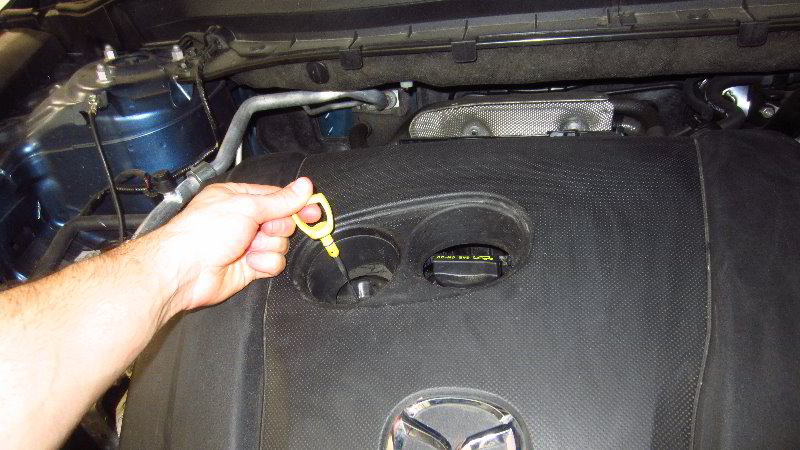
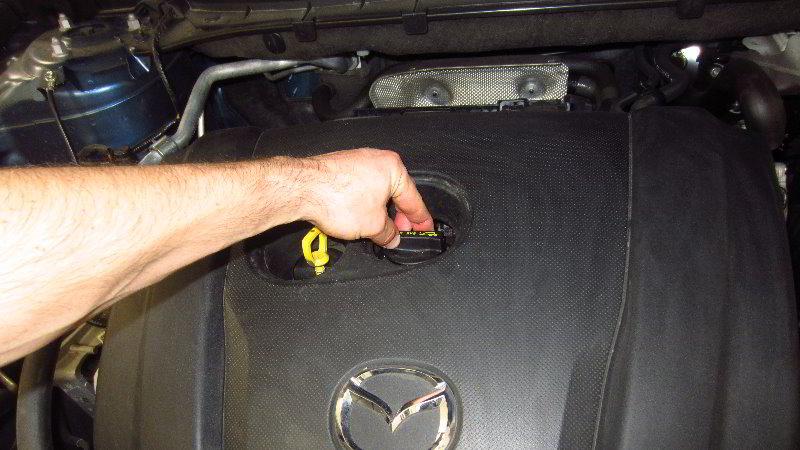
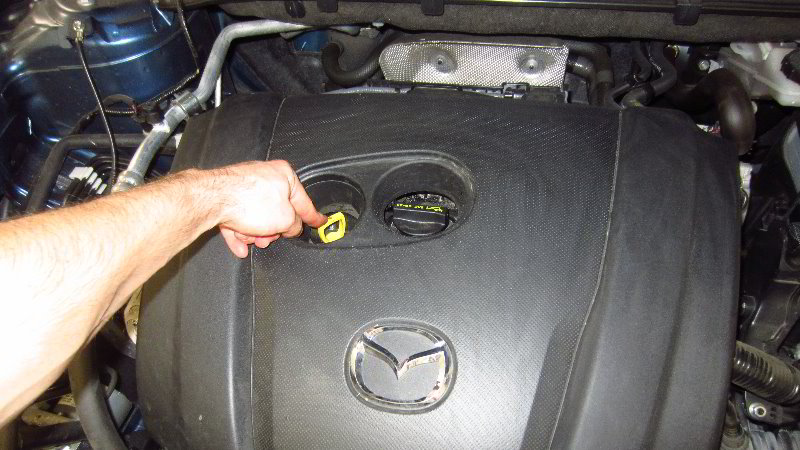
Then open the hood, partially remove the dipstick an inch or two and twist off the oil fill cap in the counterclockwise direction.

Set the oil fill cap aside in a safe place.

Removing the fill cap and lifting out the dipstick a bit will help prevent a vacuum from forming and also allow the old oil to drain out more quickly.

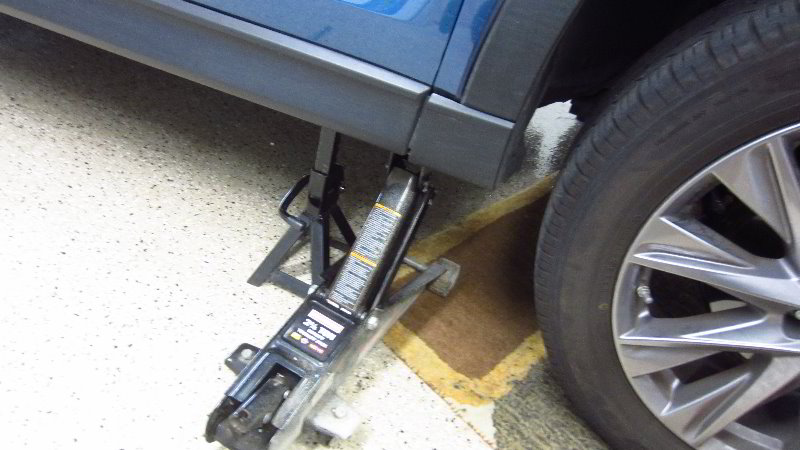
Carefully raise the front of the SUV with the floor jack and securely support it with at least two jack stands.

I just raised the front passenger side of the vehicle for easy access to the oil service access cover.

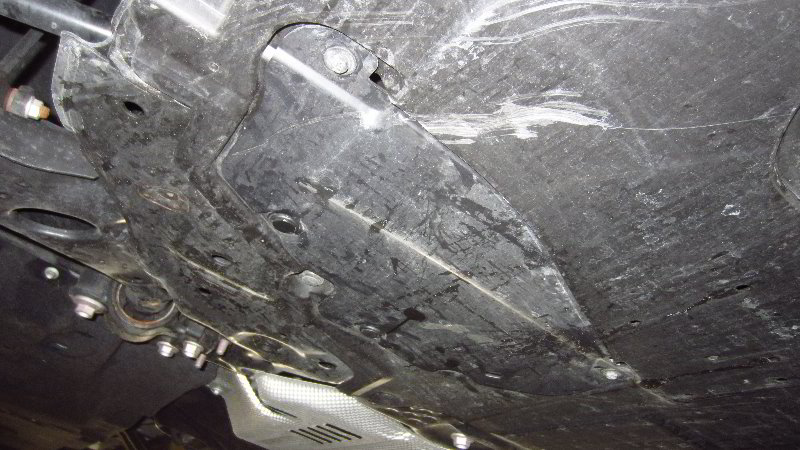
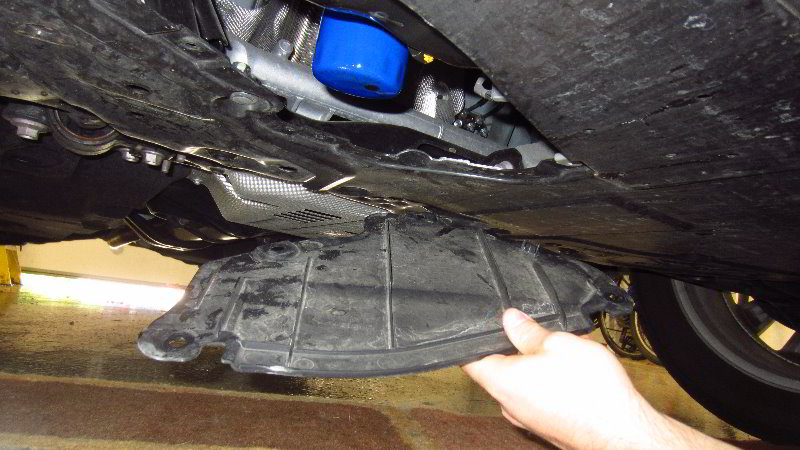
Locate the oddly shaped oil service access cover on the passenger side of the engine bay.

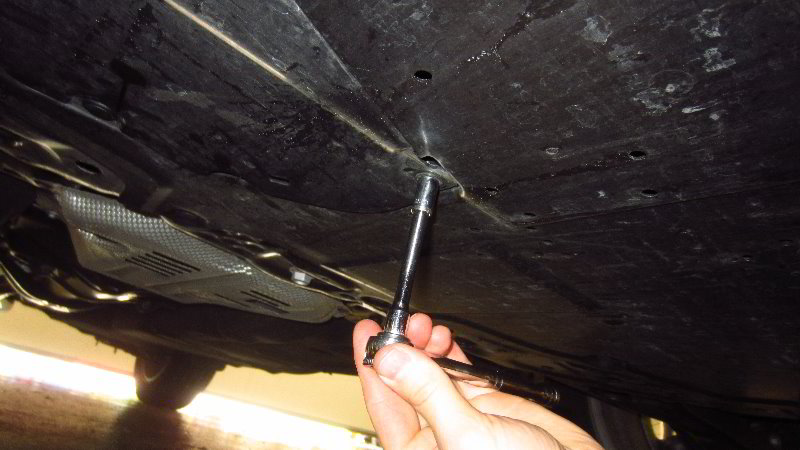
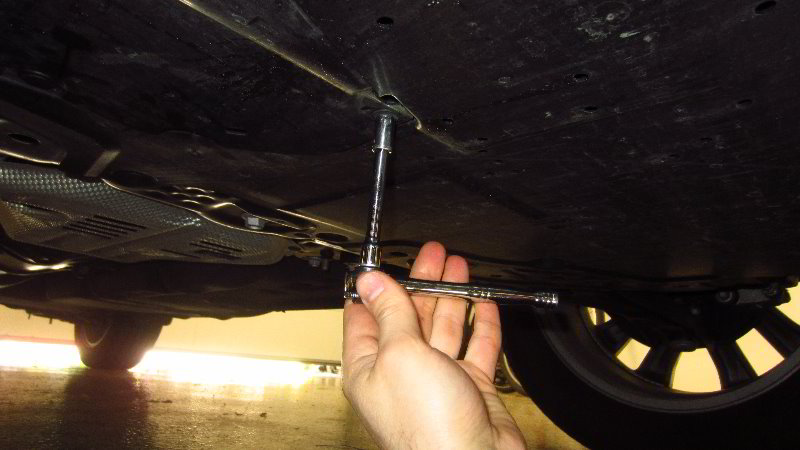
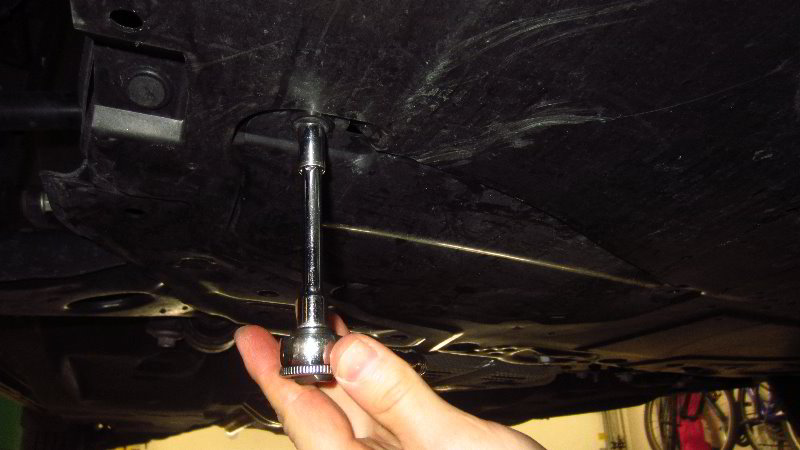
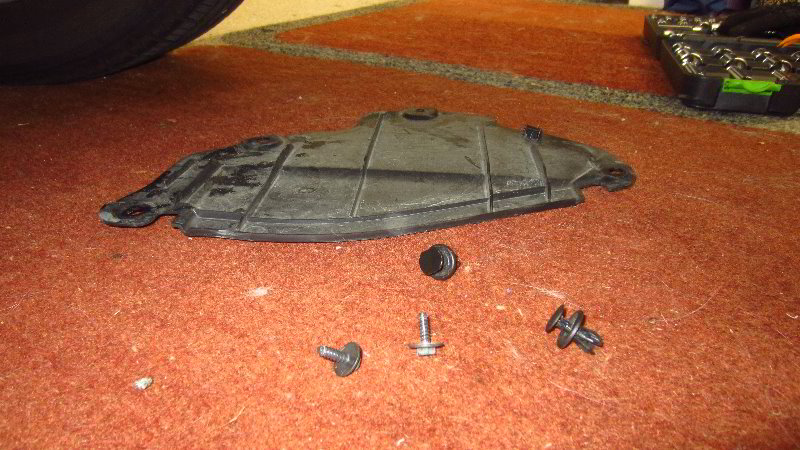
Loosen the two black metal screws by turning them in the counterclockwise direction with the 8mm socket and a 1/4″ drive ratchet (or a Phillips head screwdriver).

Set the two screws aside in a safe place.

There are also two black plastic pop rivets that secure the access cover in place.

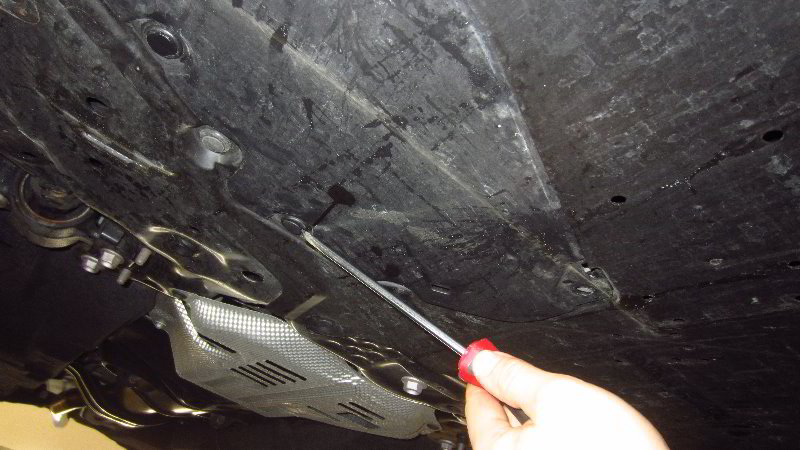
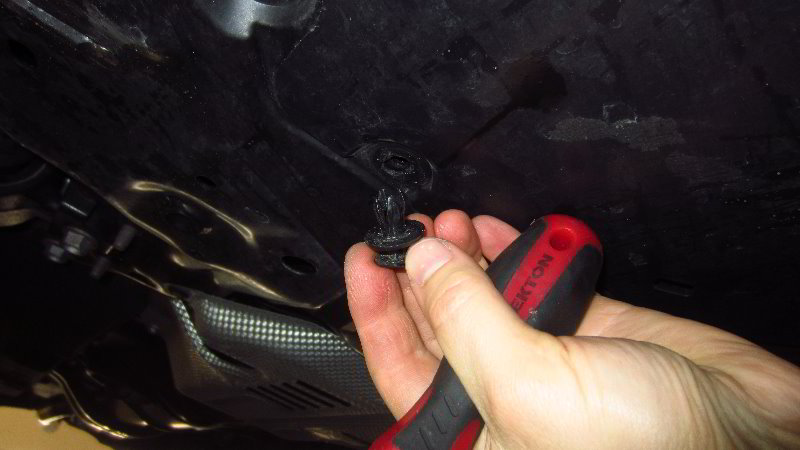
Use a flat head screwdriver to pry out the button head in the center of the pop rivet to unlock them.

Once the pop rivets are unlocked, you can pry out the base of the fastener.

Set the two pop rivets aside with the screws.

Slide the oil service access cover towards the rear of the vehicle to release the retaining tabs from the under engine cover (or splash guard).

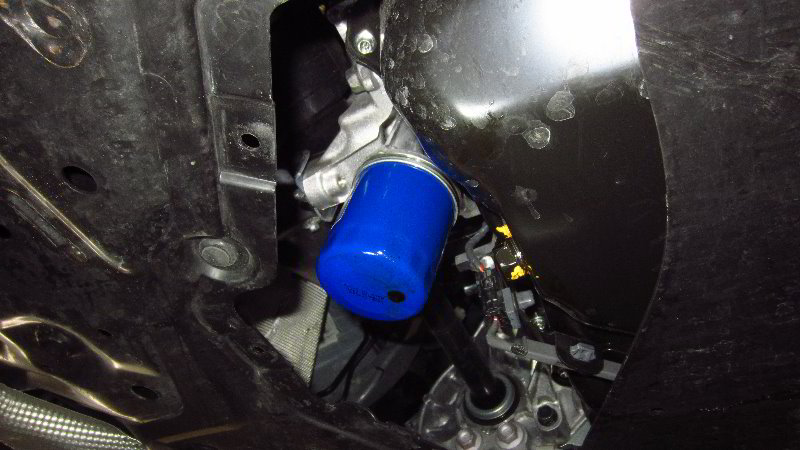
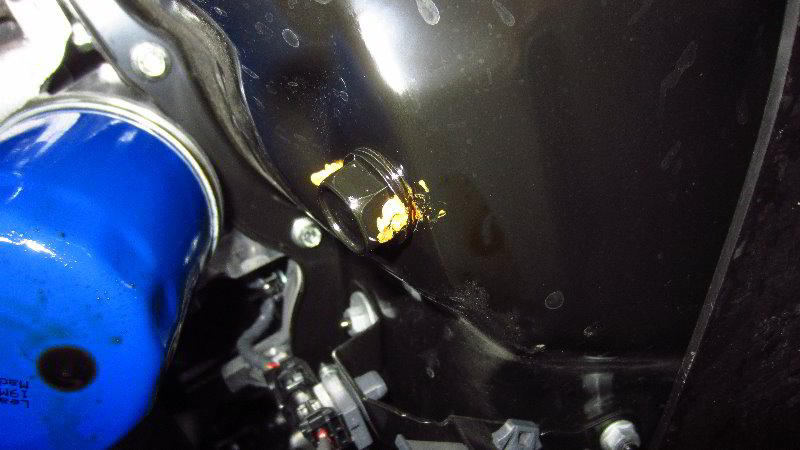
The black metal drain bolt is situated on the rear edge of the oil black metal oil pan.

The old oil filter is situated just behind the oil pan which is a bright blue color on this 2019 CX-5.

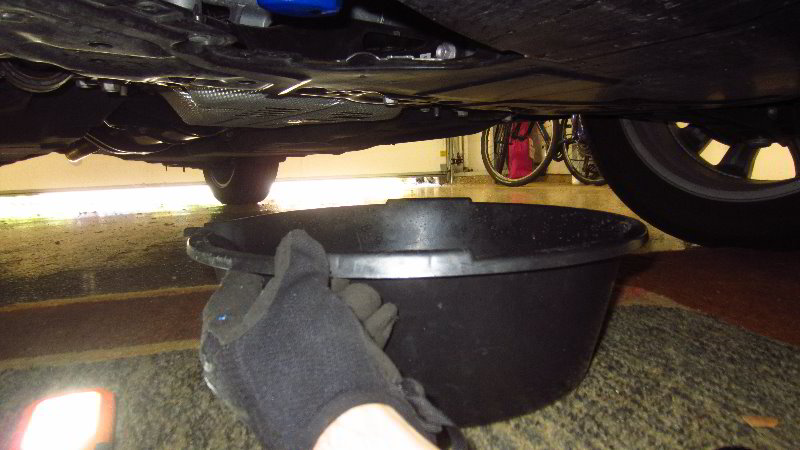
Slide the used oil catch basin to just below the drain bolt.

Loosen the oil drain bolt by turning it in the counterclockwise direction with the 17mm socket and a 3/8″ drive ratchet.

Be very careful when you remove the oil drain bolt. The old oil might still be hot enough to burn your fingers depending on how long you warmed up the engine.

Allow the old oil to drain out for at least a few minutes or until the flow slows down to just an occasional drip.

Inspect the old washer or “gasket” on the oil drain bolt for any damage or wear.

To help prevent oil leaks, I highly recommend changing the drain bolt washer at every oil change.

The OEM oil drain bolt washer part number is Mazda 9956-41-400 (also known as 995641400 or 9956 41 400).

Clean off the drain hole with a paper towel. Make sure the old washer is not still attached to the oil pan.

Spin in the oil drain bolt (with a new washer) a few turns by hand in the clockwise direction to help prevent it from becoming cross threaded.

Tighten the oil drain bolt by turning it in the clockwise direction with the 17mm socket and a 3/8″ drive ratchet until it is snug.

If you have a very reliable and sensitive torque wrench, the CX-5 and Mazda6 service manual specification for tightening the oil drain bolt is a range of 22 to 30 lb-ft (or 30 to 41 N-m).

Avoid over tightening the oil drain bolt to prevent from damaging the threads or cracking the aluminum oil pan.

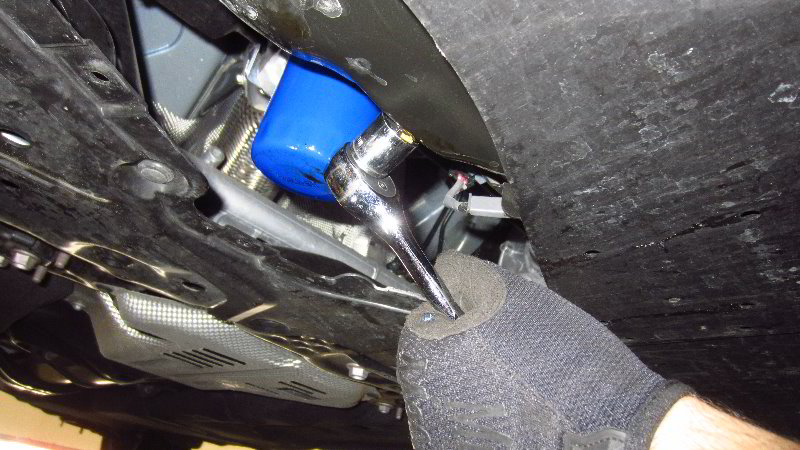
Carefully move the used oil catch basin to just below the old oil filter.

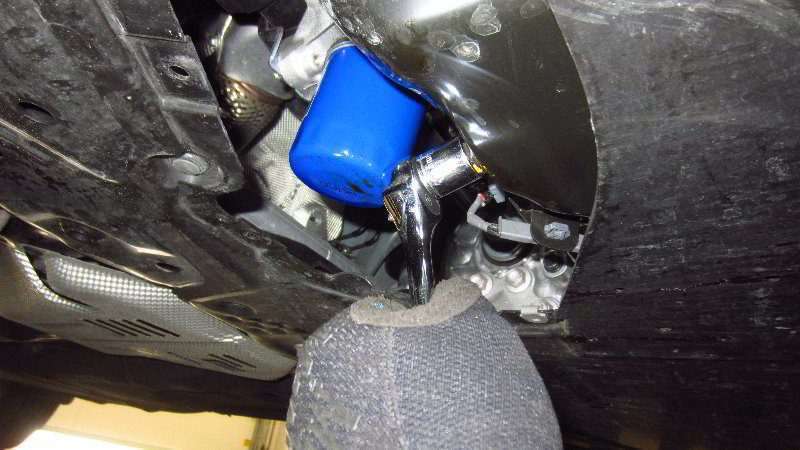
I highly recommend picking up a Lisle 63600 oil filter wrench. It makes removing stubborn and over tightened oil filters extremely easy.

If you have the oil filter wrench, attach it to a short 3/8″ drive extension bar and the ratchet.

Loosen the old oil filter by turning it in the counterclockwise direction.

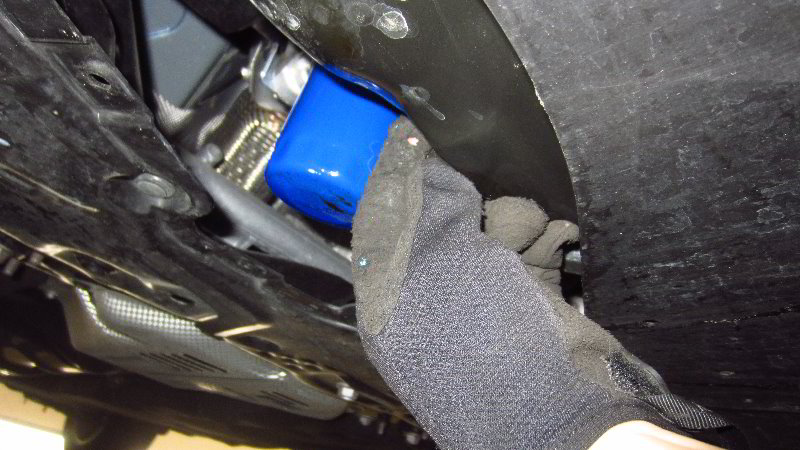
Carefully spin off the old filter and allow the old oil to drain out for at least a few minutes.

Dip your finger into some new oil and lightly lubricate the rubber o-ring gasket on the new filter.

Lubricating the o-ring on the new filter will help it form a better seal, prevent oil leaks and also make it easier to remove during the next oil change.

Make sure the o-ring gasket from the old filter is not still attached to the engine.

Clean off the oil filter receptacle with a paper towel.

Twist on the new oil filter in the clockwise direction until it is snug or about 1/2 to 3/4 of a turn past finger tight.

Try to avoid over tightening the new filter to prevent from damaging the o-ring gasket which could result in an oil leak.

Double check that the drain bolt and the new oil filter are tight before moving on to the next steps.

Reinsert the access cover back into the under engine cover.

Push in the two pop rivets to hold it in place. Make sure the pins in the center are in the fully pushed in and locked position.

Spin in the two screws a few turns with your fingers.

Then tighten them in the clockwise direction with the 8mm socket and a 1/4″ drive ratchet until they are snug.

Carefully lower the SUV from the jack stands by using the floor jack.

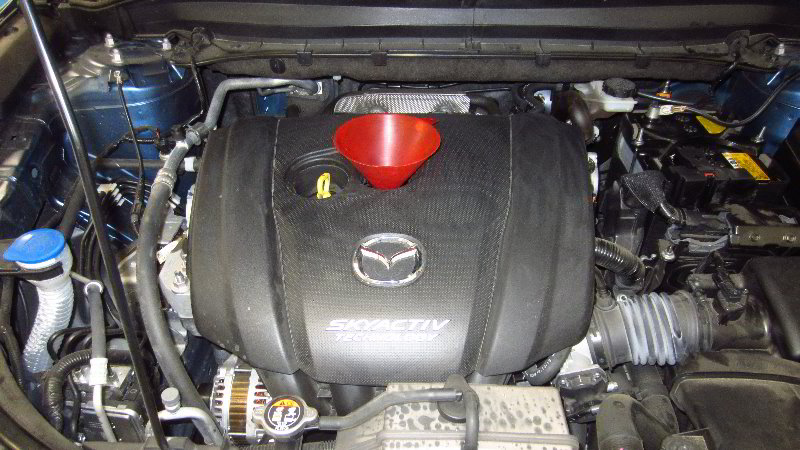
Insert the automotive funnel into the oil fill hole.

Please double check your owner’s manual for the correct oil capacity and oil type for your vehicle.

For this 2019 CX-5 with the Skyactiv-G 2.5L naturally aspirated I4 engine, the total oil capacity for an oil change with a filter change is 4.8 U.S. quarts (or 4.5L).

Since it is much better to have slightly less oil than necessary in an engine than to run an engine that has been overfilled with oil, I recommend only pouring in about 4.25 to 4.5 U.S. quarts of new SAE 0W-20 oil in at first.

Running an engine that has been overfilled with oil may cause damage to seals, gaskets or other components.

Replace the oil fill cap by twisting it on in the clockwise direction and push down the dipstick all the way in.

To properly check the oil level, start the engine and let it warm up to normal operating temperature.

Turn off the ignition and allow the new oil to drain down to the pan for at least 5 to 10 minutes.

Pull out the dipstick, wipe it clean with a paper towel, fully reinsert it and pull it out again to check the oil level.

If necessary, slowly pour in more oil (up to the 4.8 U.S. quarts total capacity) and repeatedly check the oil level on the dipstick until it reaches up to or just below the upper hole in the tip of the dipstick.

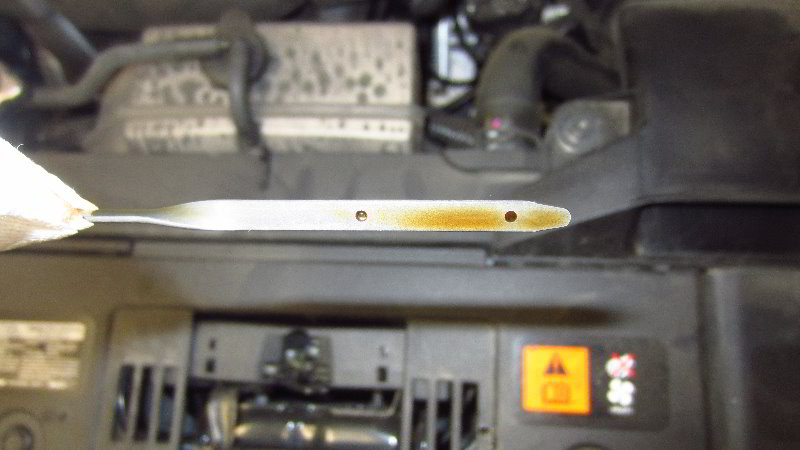
The upper hole indicates the “MAX (maximum) or “Full” line. The lower hole indicates the “MIN” (minimum) line.

Once the oil level is correct, replace the dipstick and tighten the oil fill cap until it is snug.

Make sure you record the oil change in your car’s service records.

It’s also a good idea to check your driveway, garage or parking spot for drops of fresh oil which may indicate a leak from the drain bolt or the new oil filter and check the oil level on the dipstick during the next few days.

To reset the oil life meter on the “Maintenance Monitor” system, follow these steps: 1. Select the “A” icon on the home screen to display the “Applications” screen. 2. Select “Vehicle Status Monitor”. 3. Select the “Maintenance” option to display the maintenance list screen. 4. Switch the tab to the “Oil Change” option. 5. Choose the “Reset” option.

If you don’t use the “Maintenance Monitor” system, the maximum oil and filter service interval specification on the “Scheduled Maintenance” chart in the owner’s manual is every 7,500 miles (12,000 km) or at least once a year (12 months).

Please check out all of my 2017-2022 Mazda CX-5 DIY Repair & Maintenance Guides.

2017, 2018, 2019, 2020, 2021, 2022, 2023, 2024 & 2025 Mazda CX-5 Skyactiv-G 2.5L I4 Engine Spark Plugs Replacement DIY Guide

This automotive maintenance tutorial was specifically written to assist owners of the second generation (2017, 2018, 2019, 2020, 2021 and 2022) Mazda CX-5 SUV equipped with the Skyactiv-G 2.5 liter naturally aspirated inline four cylinder engine in checking or changing the spark plugs.

The procedure may be the same or similar for the 2.0L N/A I4, 2.5L turbo I4 and the Skyactiv-D 2.2L twin turbocharged I4 diesel engines.

Owners of other Mazda vehicles such as the CX-3, CX-30, CX-7, CX-9, Mazda3, Mazda6, MX-30, MX-5 Miata, Mazda2, CX-4, CX-8 and BT-50 may also find these DIY instructions to be helpful.

The OEM (original equipment manufacturer) spark plugs in this 2019 CX-5 were marked as part number Denso ZC20HPR11 or Mazda PE5S 18 110 (also known as PE5S-18-110 or PE5S18110).

The new updated OEM spark plug part number is Mazda PE5R-18-110 (also known as PE5R18110 or PE5R 18 110).

A few compatible replacement aftermarket iridium spark plugs with their part numbers are as follows: Autolite XP5682Bosch 9621NGK 93501 (LKAR7BIX-11S) and Champion 9019.

The tools and other items needed to complete this procedure include an 8mm socket, a 1/4″ drive ratchet, a 14mm spark plug socket (or a 9/16″ spark plug socket would also work), a set of 3/8″ drive extension bars, a 3/8″ drive ratchet and a small tube of dielectric grease.

If the engine is very hot, allow it to cool off for an hour or two before completing this procedure.

 Please proceed with caution and at your own risk!

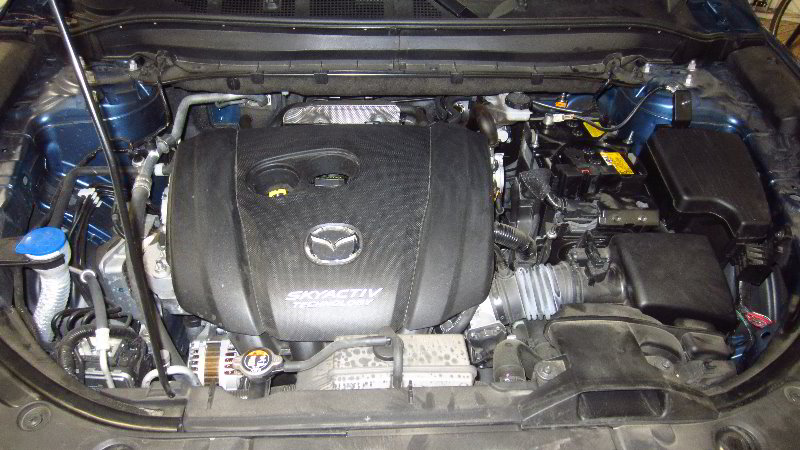
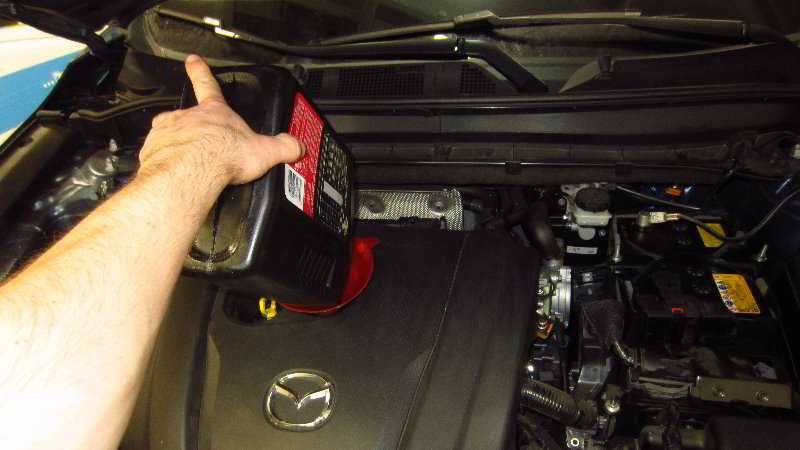
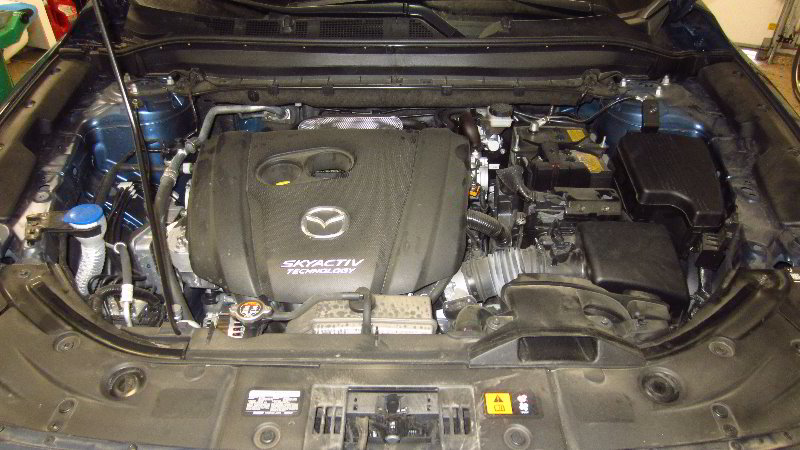
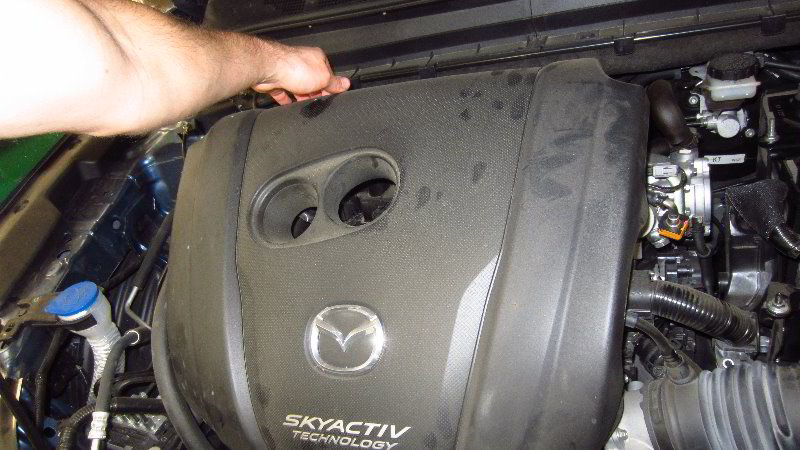
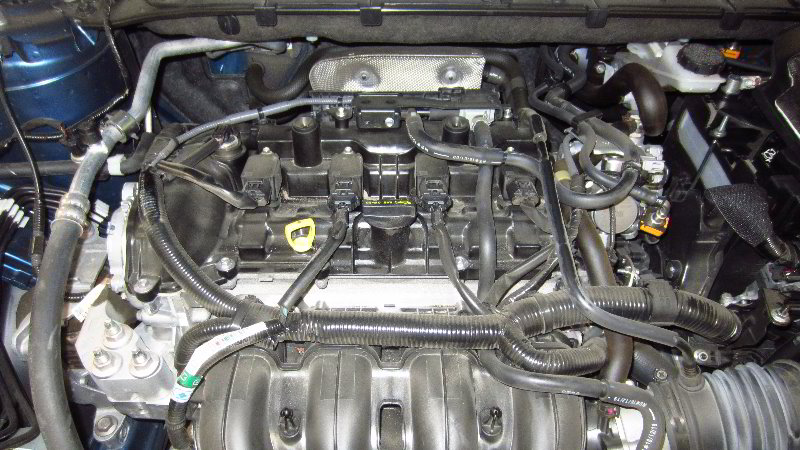
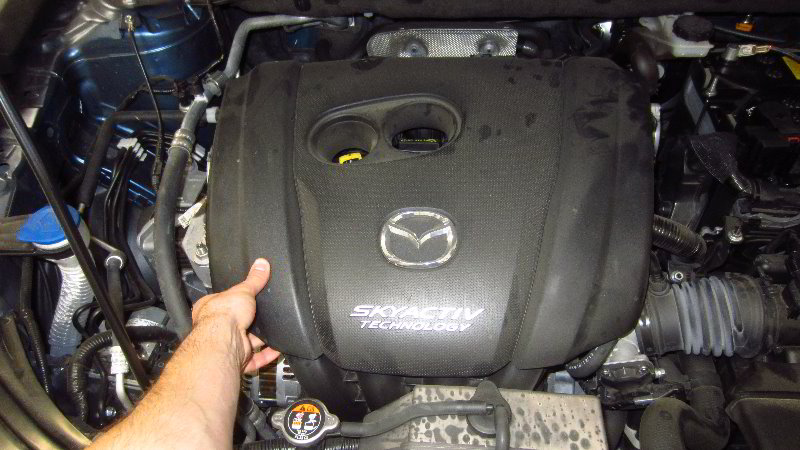
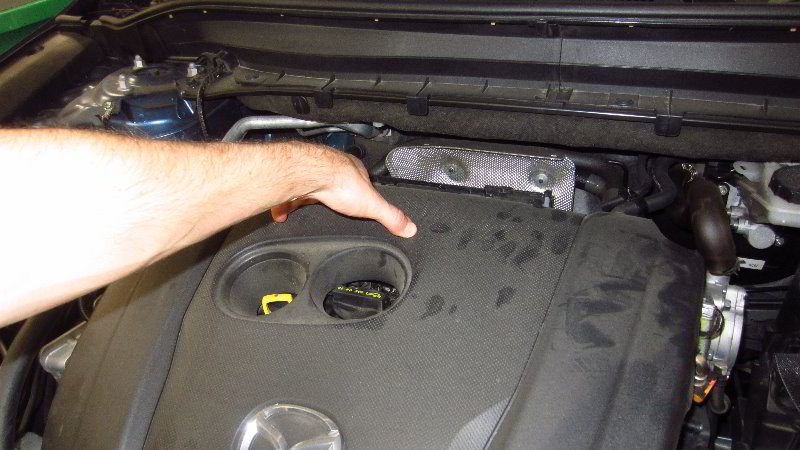
The first two steps are to open the hood and gently pull off the plastic engine cover.

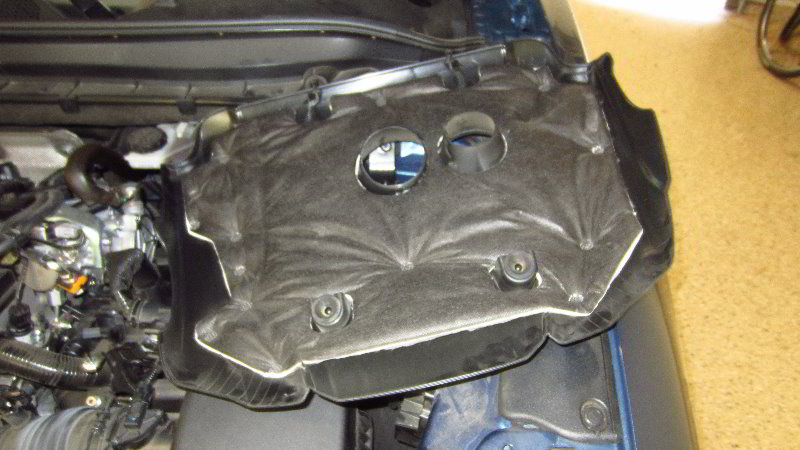
It is held in place a set of four rubber friction fasteners and four pegs (or “spikes”).

Set the plastic engine cover aside in a safe place.

If you have access to compressed air or a wet/dry shop vacuum, thoroughly clean off the top of the engine to help reduce the risk of having debris fall down into the spark plug well.

To further reduce the chance of having something fall down into the cylinder, I recommend only checking or changing one spark plug at a time.

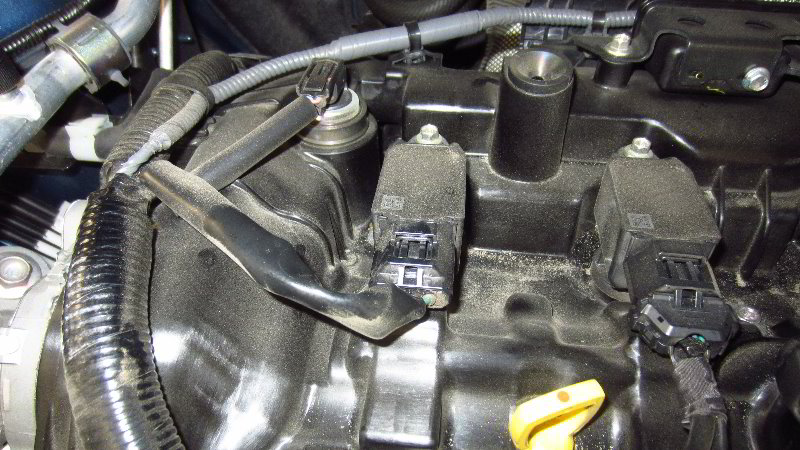
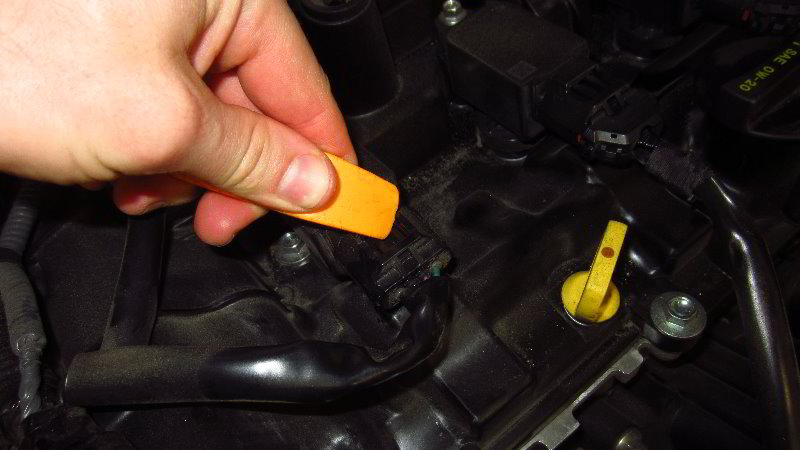
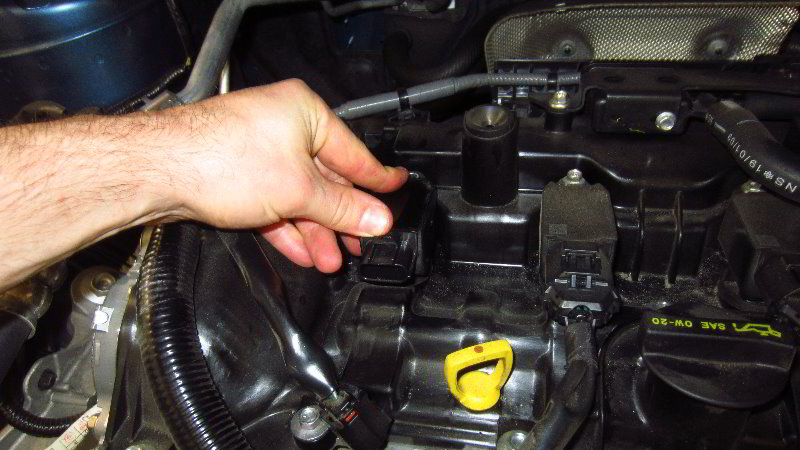
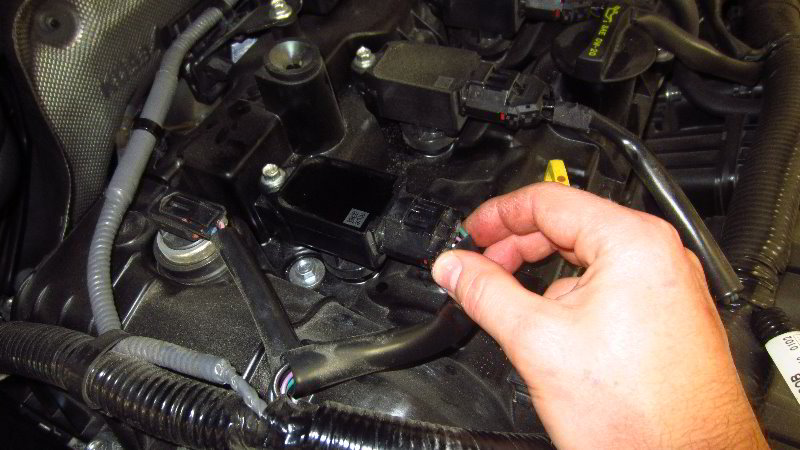
Push in the release tab on the electrical connector before sliding it straight off the base of the ignition coil.

If you have trouble pushing down the release tab, carefully use a plastic pry bar tool or a flat head screwdriver.

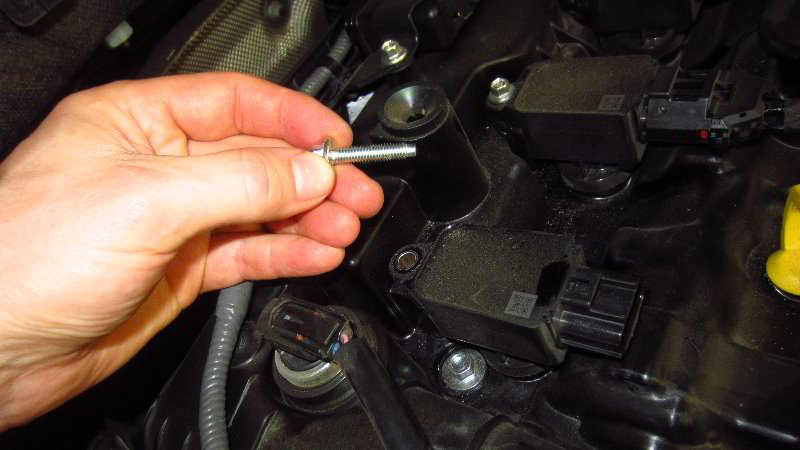
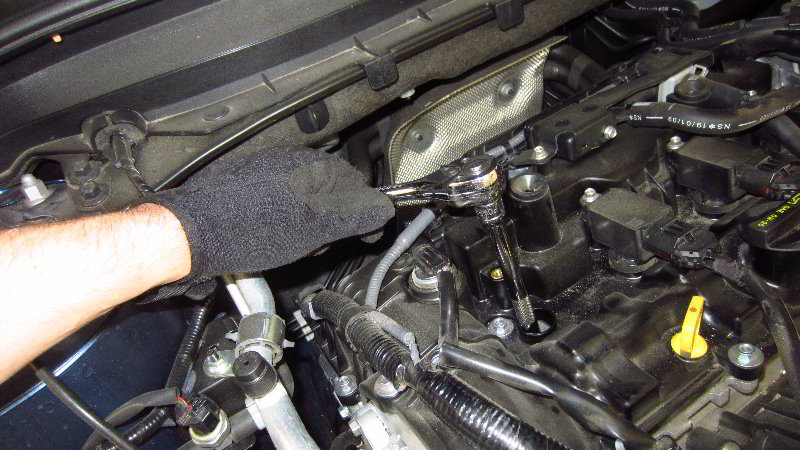
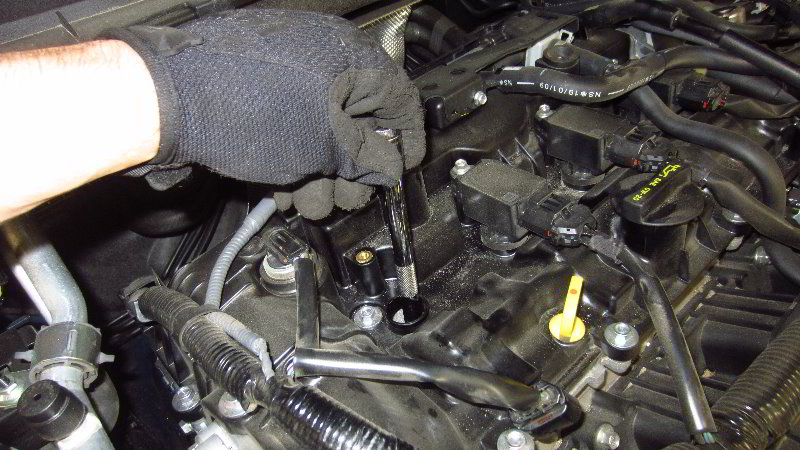
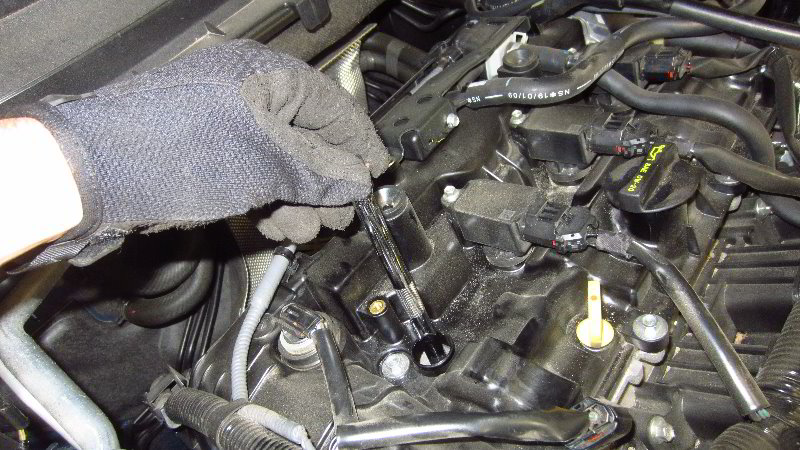
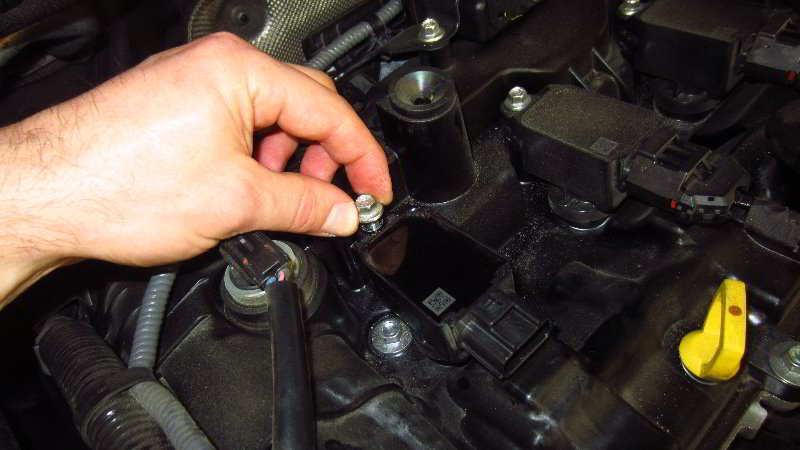
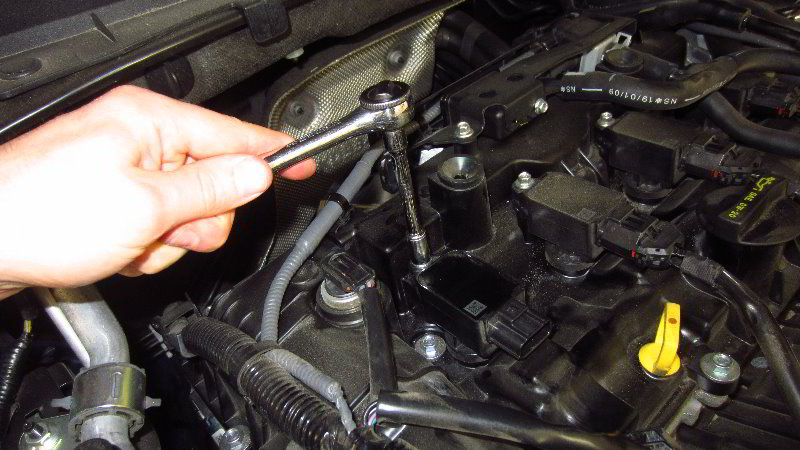
Loosen the single bolt that secures the ignition coil to the valve cover by turning it in the counterclockwise direction with the 8mm socket and a 1/4″ drive ratchet.

Set the 8mm bolt aside in a safe place.

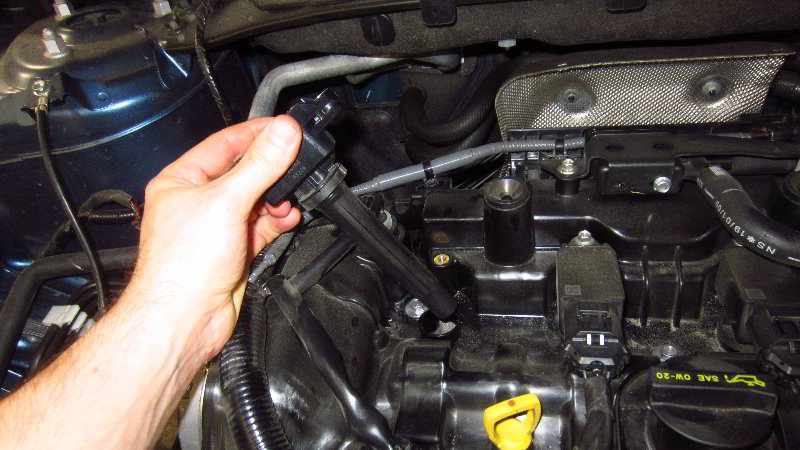
Gently rotate the ignition coil back and forth a few times to make sure the rubber dust boot is not stuck or “frozen” to the top of the old spark plug.

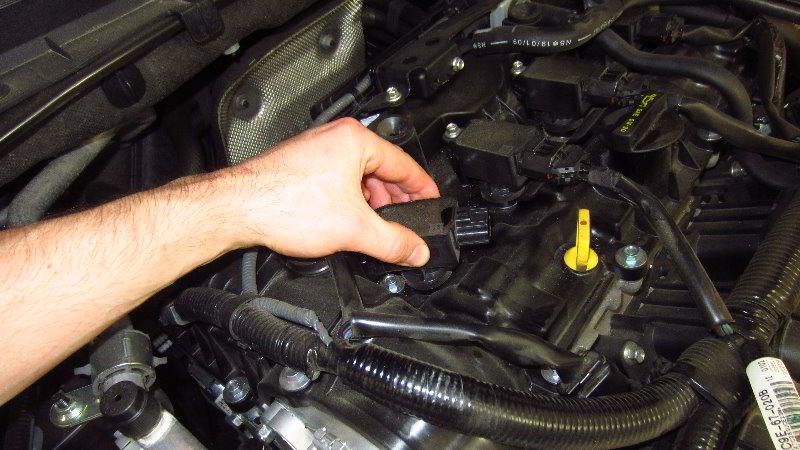
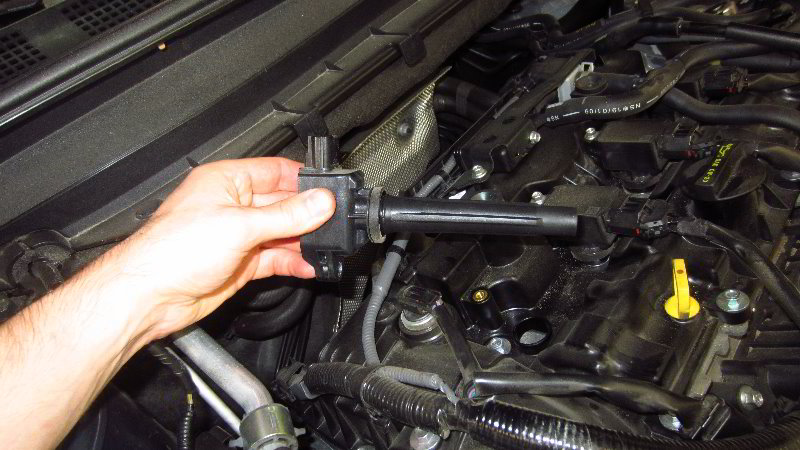
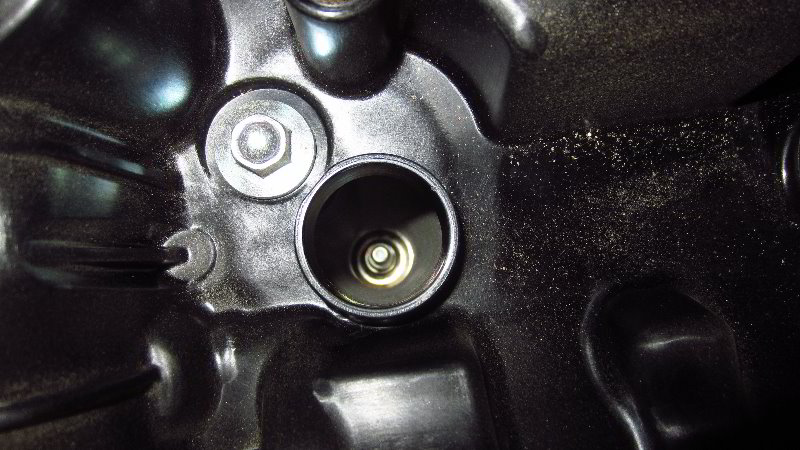
Lift the ignition coil assembly straight out of the spark plug well and set it aside in a safe place.

Inspect the old ignition coil for any damage or wear.

If you see a CEL (check engine light) or SES (service engine soon) warning indicator on your car’s gauge cluster, use an OBDII scanner (also known as an OBD2 scan tool) to check for an ignition coil related DTC (diagnostic trouble code) including P0350, P0351, P0352, P0353 and P0354.

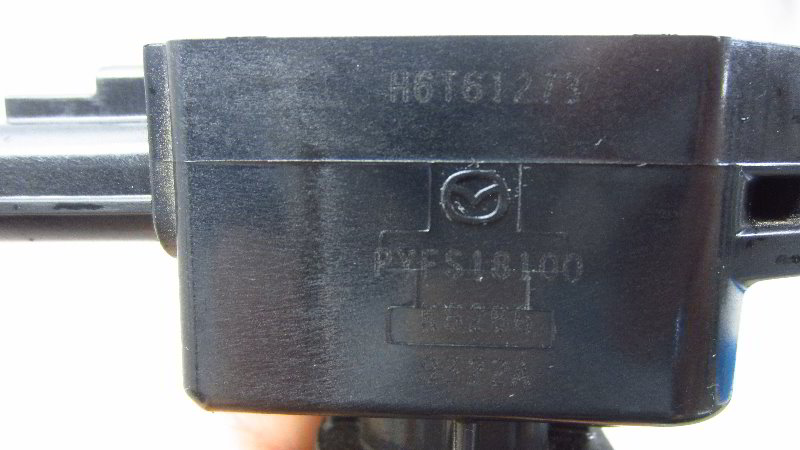
If you need to replace a faulty ignition coil, the OEM part number is Mazda PYFS18100 or PYFS-18-100 (other numbers on the OEM part were H6T61273 K6266 9322A).

A few compatible replacement aftermarket ignition coils part numbers are as follows: Beck/Arnley 178-8527Delphi GN10625 and Standard Motor Products UF-656.

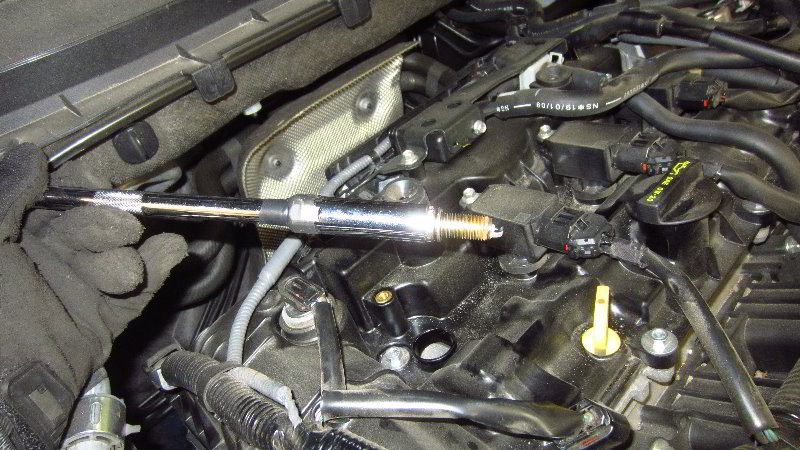
Attach your 14mm spark plug socket to a long extension bar and a 3/8″ drive ratchet.

I always secure the spark plug socket to the extension bar with some electrical tape to keep it from popping off at the bottom of the well.

Lower the socket down into the well and push it on to the top of the old spark plug.

Carefully loosen the old spark plug by turning it in the counterclockwise direction.

If you have trouble loosening the old spark plug due to corrosion (rust), sand or debris, try spraying a very small amount of penetrating oil down into the well.

Allow the penetrating oil to seep into the threads for at least 10 to 15 minutes before attempting to loosen the old plug again.

Once the old spark plug is loose, detach the ratchet.

Spin out the plug the rest of the way by just using the extension bar.

Carefully lift the old spark plug out of the well.

(Your socket should have a rubber piece or a strong magnet to hold the plug securely in place.)

Detach the old spark plug from the socket.

Inspect the old spark plug for any damage, soot, sludge or white ash.

If the end of the old spark plug looks ashy white, the plugs may have been exposed to high temperatures such as engine overheating or they are the incorrect heat range for your driving conditions and/or environment.

If the old spark plugs are dark grey or covered in black soot, the engine might be burning oil and should be checked out by a professional mechanic.

If possible, I recommend buying the OEM iridium tipped spark plugs which are part number Mazda PE5R-18-110 (also known as PE5R18110 or PE5R 18 110).

(Attention – Most spark plug manufacturers recommend that you do NOT use anti-seize lubricant grease on the threads of the new spark plugs since it can easily lead to over tightening.)

If you have a spark plug gap gauge tool, check the gap on the new spark plugs to ensure that they match the manufacturer’s specifications on the box.

According to the Mazda CX-5 service manual, the OEM Mazda spark plug gap should be between 0.75mm to 1.10mm (or 0.030″ to 0.043″).

The shop manual also states that a brand new spark plug should have a gap specification in the narrower range of 0.75mm to 0.85mm (or 0.030″ to 0.033″).

Push a new spark plug into the socket. (The socket should have a rubber insert or a strong magnet to hold the plug in place.)

Carefully lower the new plug down into the well. Try to avoid hitting the electrode tip on the side walls or the top of the cylinder head.

Spin in the new spark plug in the clockwise direction with just the extension bar until it makes contact with the cylinder head.

I always recommend spinning in the new spark plug by hand to help prevent it from becoming cross threaded.

Continue tightening the new spark plug until it is snug.

If you have a very sensitive and reliable torque wrench, the CX-5 and Mazda6 service manuals list a spark plug torque specification of 12 to 14 lb-ft (or 15 to 20 N-m).

Try to avoid over tightening the spark plugs to prevent from cracking the ceramic portion of the plug or damaging the threads.

Apply a small amount of dielectric grease to the opening at the bottom of the rubber dust boot.

The dielectric grease will help keep out moisture or any debris to ensure a reliable electrical connection.

Lower the ignition coil in to the spark plug well.

Rotate the ignition coil housing back and forth a few times to help spread the dielectric grease.

Line up the bolt hole in the ignition coil with the bolt hole in the valve cover.

Re-insert the bolt and tighten it in the clockwise direction with the 8mm socket and a 1/4″ drive ratchet until it is snug.

Try to avoid over tightening the bolt to prevent from cracking the plastic ignition coil housing.

Push the electrical connector straight on to the ignition coil.

You should feel or hear the power plug “click” securely into place.

Lower the plastic cover down into place over the top of the engine.

Push on the cover to secure the four rubber sockets on to their corresponding pegs.

To test the new spark plugs, start the engine and listen closely for any strange sounds.

If you do hear a weird noise or notice any vibrations, immediately turn off the ignition and double check your work.

Be sure to write down the procedure in your vehicle’s service records.

According to the “Schedule Maintenance” chart in the owner’s manual the service interval specification for changing the spark plugs is every 75,000 miles (or 120,000 km) for the naturally aspirated Skyactiv-G 2.5L I4 engine.

(If you have the Skyactiv-G 2.5 turbocharged I4 engine, the spark plugs should be changed every 40,000 miles or 64,000 km.)

Please check out all of my 2017-2022 Mazda CX-5 DIY Repair & Maintenance Guides.

2017, 2018, 2019, 2020, 2021, 2022, 2023, 2024 & 2025 Mazda CX-5 Front Turn Signal Light Bulb Replacement DIY Guide

This automotive maintenance tutorial was specifically written to assist owners of the second generation (2017, 2018, 2019, 2020, 2021 and 2022) Mazda CX-5 SUV in changing a burnt out front turn signal light bulb.

Owners of other Mazda vehicles such as the CX-3, CX-30, CX-7, CX-9, Mazda3, Mazda6, MX-30, MX-5 Miata, Mazda2, CX-4, CX-8 and BT-50 may also find these DIY instructions to be helpful.

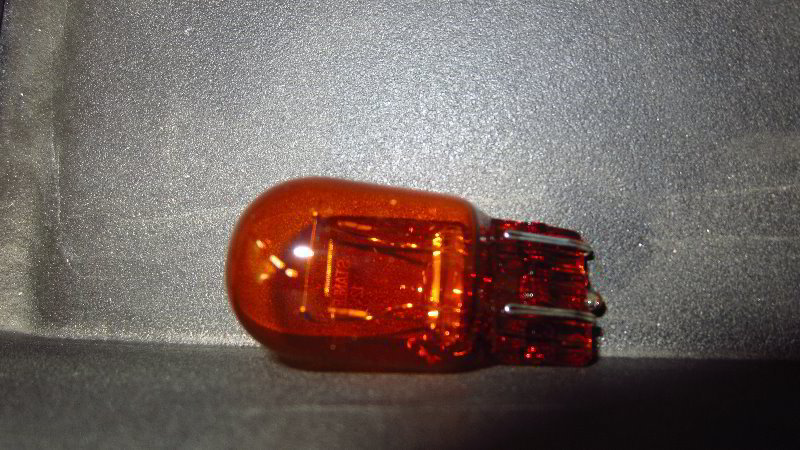
The compatible replacement wedge base light bulb part number is 7444NA which is available from various manufacturers such as Sylvania, Philips, Bosch, GE, Eiko and PIAA.

If you’d like to have brighter front turn signal lights that will also last much longer before burning out like the traditional incandescent bulbs, install some 7444NA LED units.

No tools are needed to access and replace the light bulbs.

The first two steps are to open the hood and then move to the side of the vehicle with the burnt out light bulb. The steps for changing the driver side and passenger side bulbs are the same.

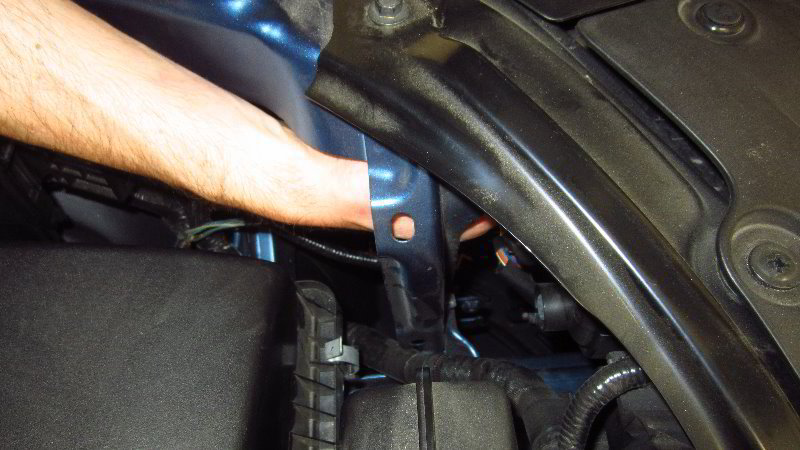
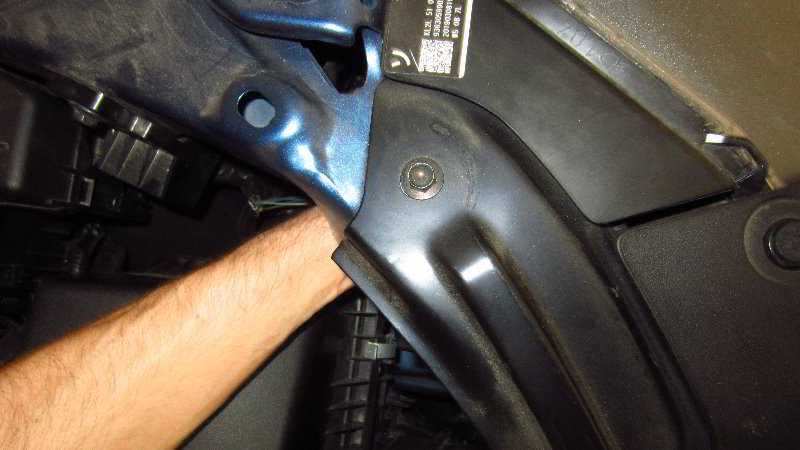
The front turn signal light is located close to the inner edge of the headlight assembly.

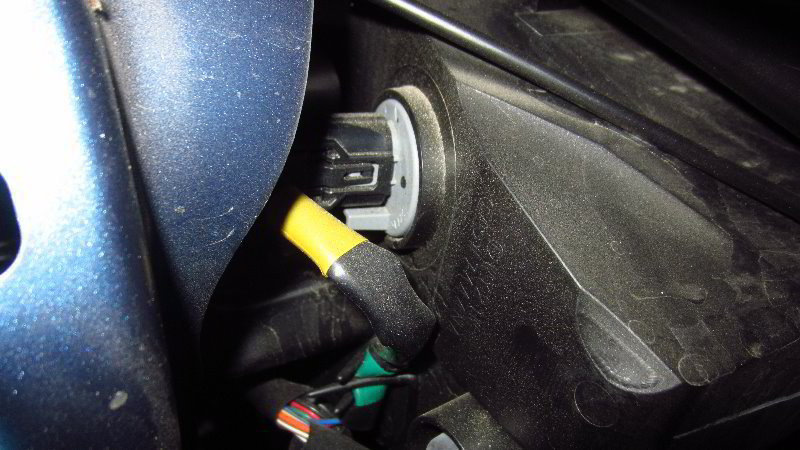
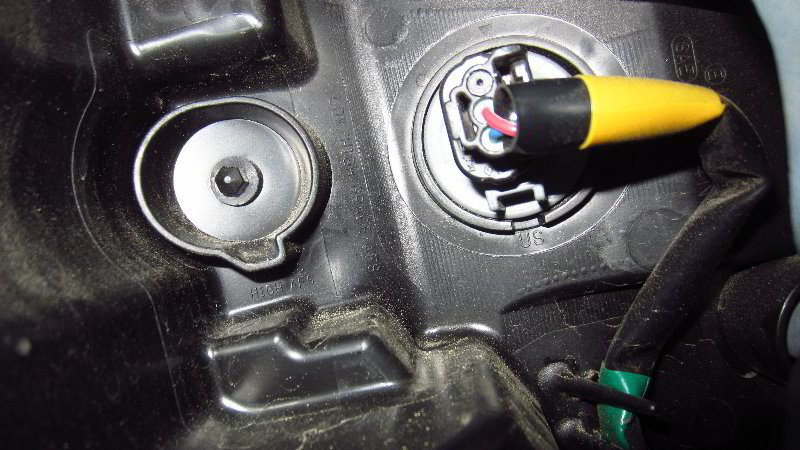
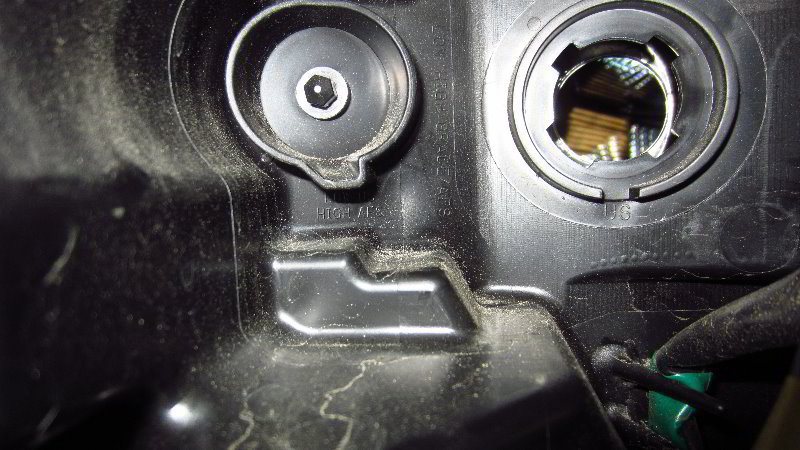
Look behind the headlight housing and locate the round gray plastic front turn signal bulb socket.

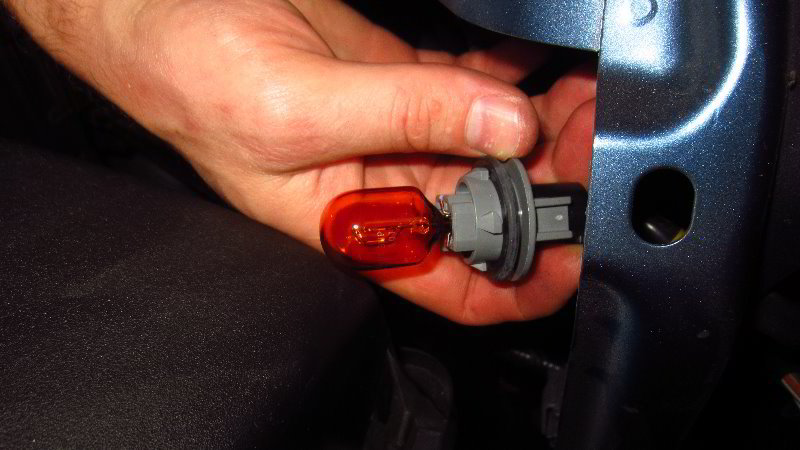
Rotate the bulb socket 1/4 turn in the counterclockwise direction to unlock it.

Pull the bulb socket straight out of the housing.

If the old light bulb was recently turned on, be careful when you remove it. The old bulb might still be hot enough to burn your fingers.

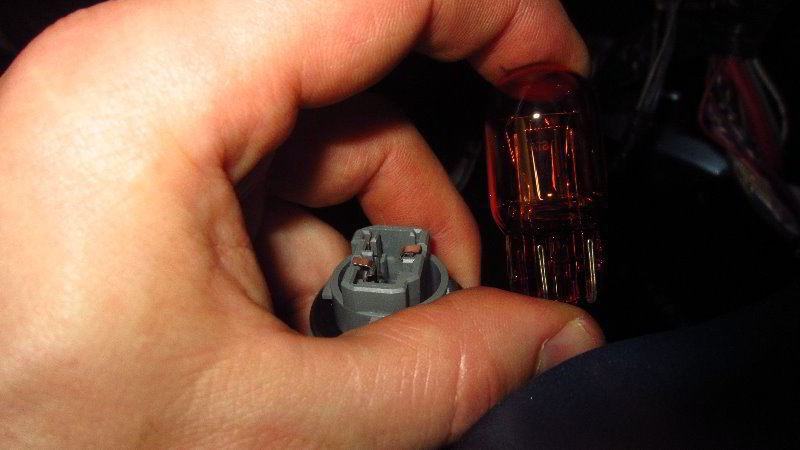
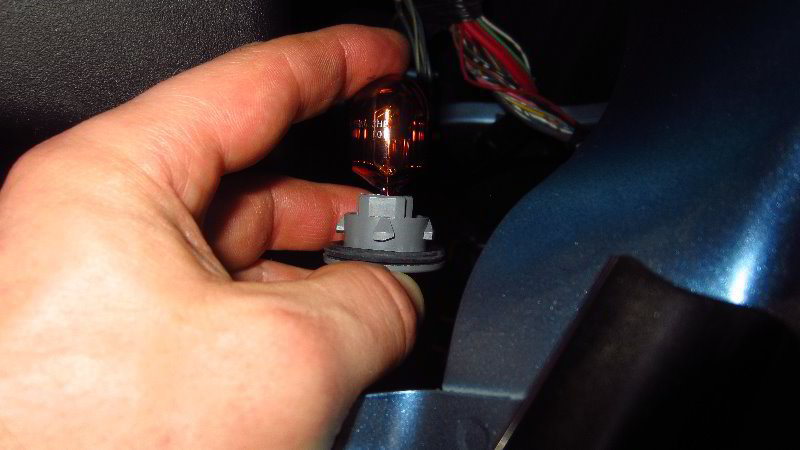
Carefully pull the old light bulb straight out of the socket.

If you have trouble removing the old light bulb due to corrosion (rust), sand or other debris, put on some protective gloves and try gently wiggling the bulb back and forth while pulling it straight out.

Push a new amber colored number 7444NA wedge base light bulb straight into the socket.

If you’d like to have brighter front turn signal lights, install some compatible replacement 7444NA LED units.

Clean off any oil, grease or dirt on the new incandescent bulb with a paper towel and some rubbing alcohol.

Any oil on the new bulb could cause a hot spot which may reduce the lifespan of the bulb.

Reinsert the bulb socket into the housing and rotate it 1/4 turn in the clockwise direction to secure it into place.

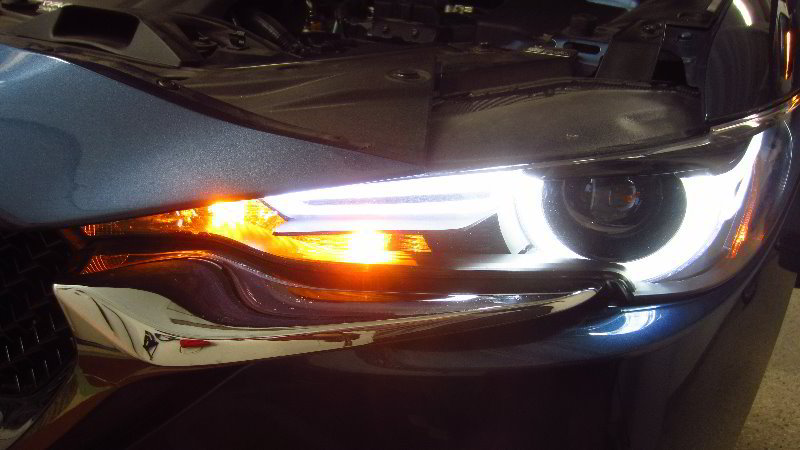
To test the new light bulb, activate the hazard signals.

Tip – If you installed an LED bulb and it doesn’t work, try removing it from the socket, rotate it 180 degrees and then push it back into the socket. Some LED bulbs are “polarized” and will only work when the “+” positive and “-” negative electrical contacts are in the correct orientation.

Be sure to write down the bulb change in your vehicle’s service records.

Please check out all of my 2017-2022 Mazda CX-5 DIY Repair & Maintenance Guides.
2017, 2018, 2019, 2020, 2021, 2022, 2023, 2024 & 2025 Mazda CX-5 12V Car Battery Replacement DIY Guide

This automotive maintenance tutorial was specifically written to assist owners of the second generation (2017, 2018, 2019, 2020, 2021 and 2022) Mazda CX-5 SUV equipped with the SkyActiv-G 2.5L I4 engine in changing a weak or dead 12V automotive battery.

(The procedure should be the same or very similar for models equipped with the 2.0L I4, the 2.5L turbo I4 and the SkyActiv-D 2.2L twin turbocharged diesel engine.)

Owners of other Mazda vehicles such as the CX-3, CX-30, CX-7, CX-9, Mazda3, Mazda6, MX-30, MX-5 Miata, Mazda2, CX-4, CX-8 and BT-50 may also find these DIY instructions to be helpful.

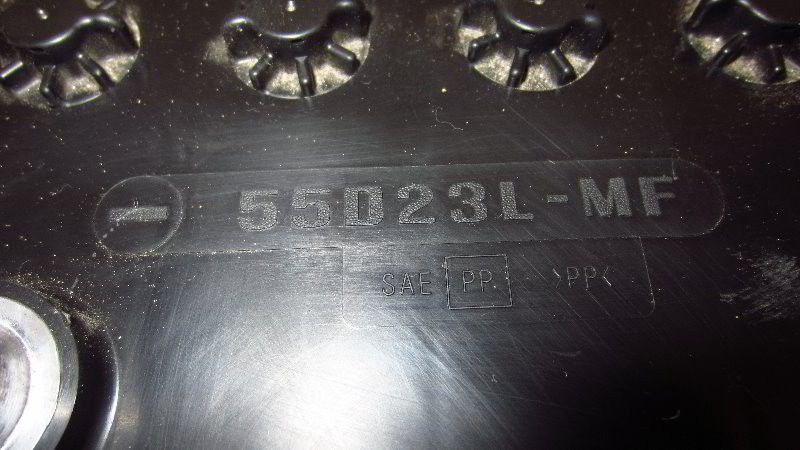
The OEM (original equipment manufacturer) battery is a “Group Size” 35 and the part number is Panasonic 55D23L-MF (also known as 55D23LMF or 55D23L MF).

A few compatible replacement aftermarket group size 35 12 volt car batteries with their part numbers include the following: Optima 8020-164 35 RedTopDelphi BU9035, EverStart MAXX-35N (Walmart) and Interstate Batteries 8850242 (Costco).

The tools needed to complete this procedure include a deep well 10mm socket with a 1/4″ or 3/8″ drive ratchet or a standard 10mm wrench.

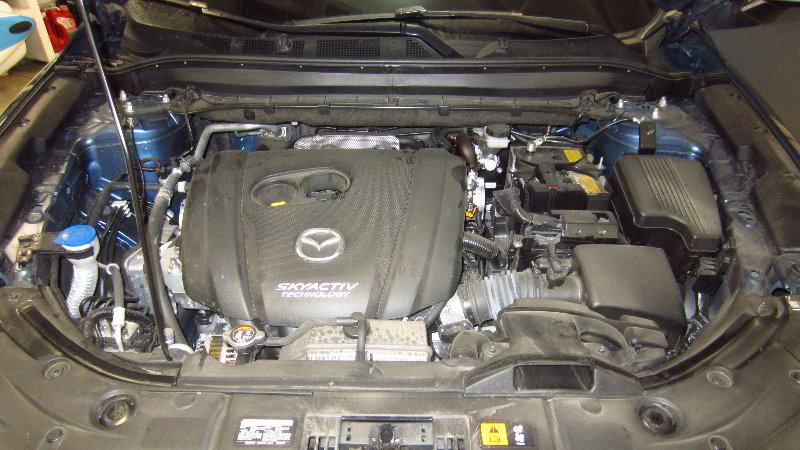
The first two steps are to open the hood and move to the right (driver) side of the engine bay.

Attention – Please proceed with caution and at your own risk!

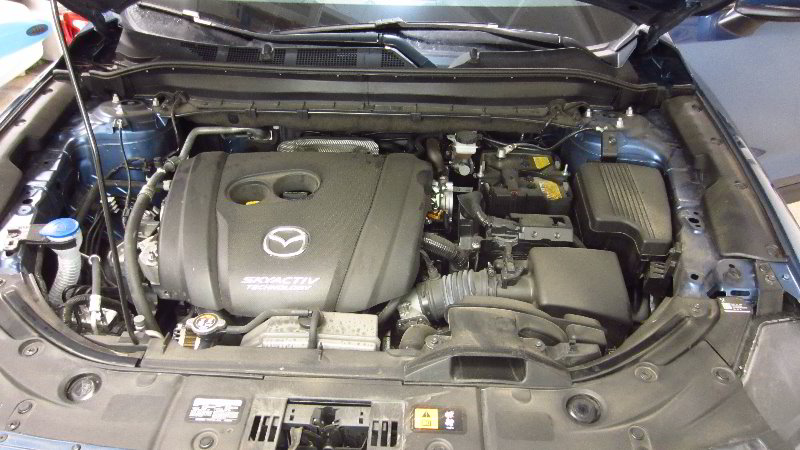
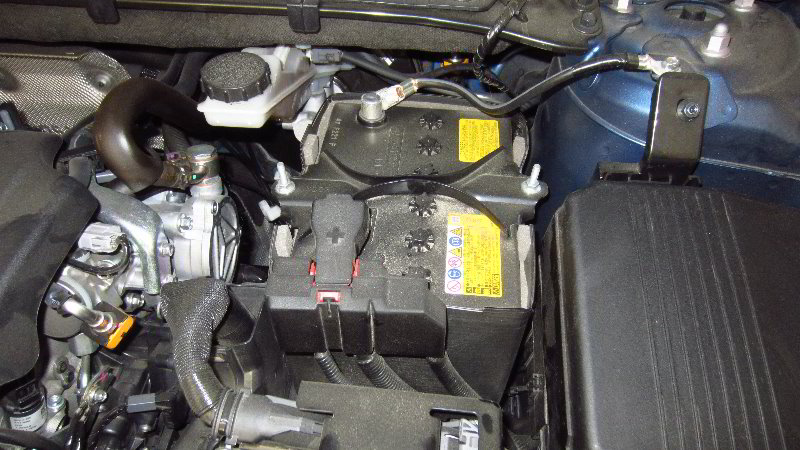
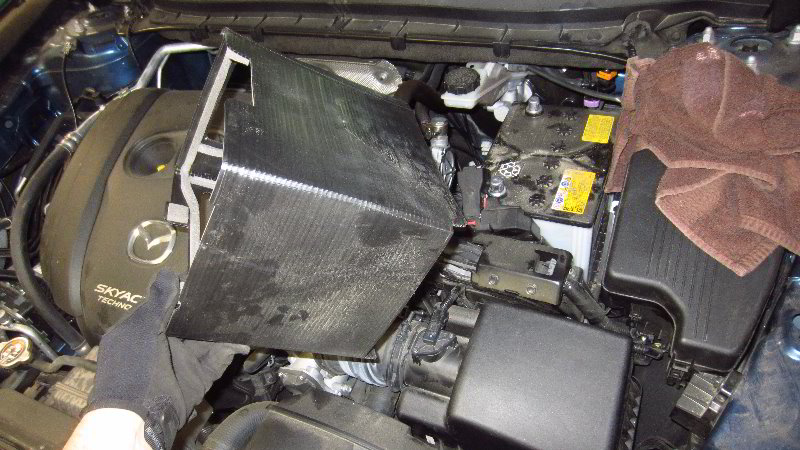
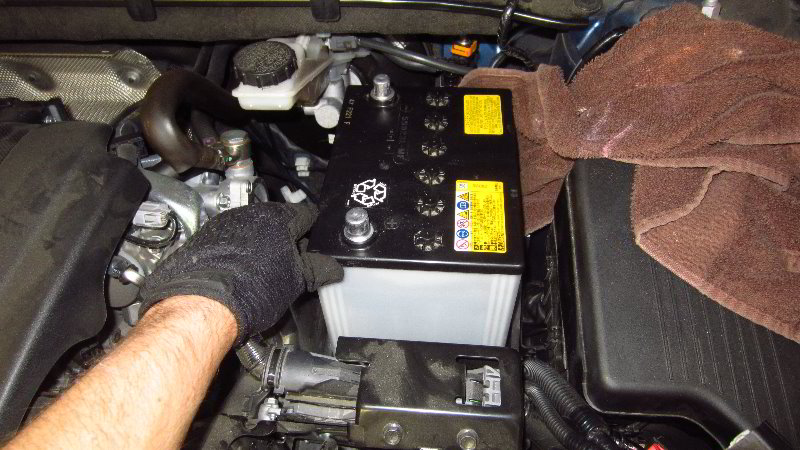
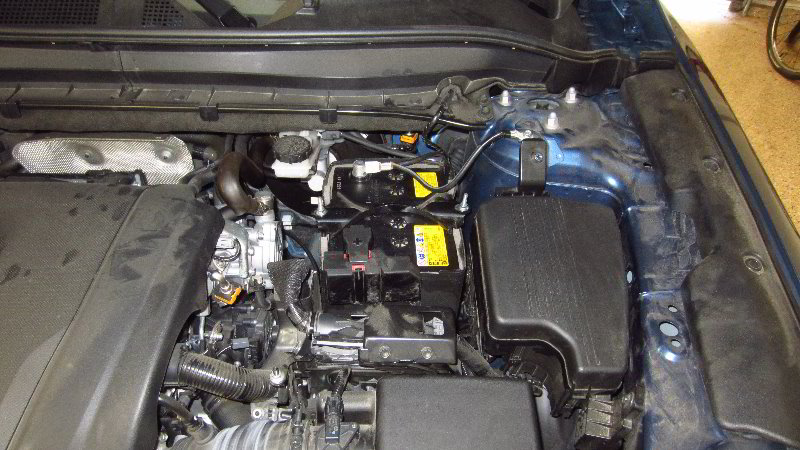
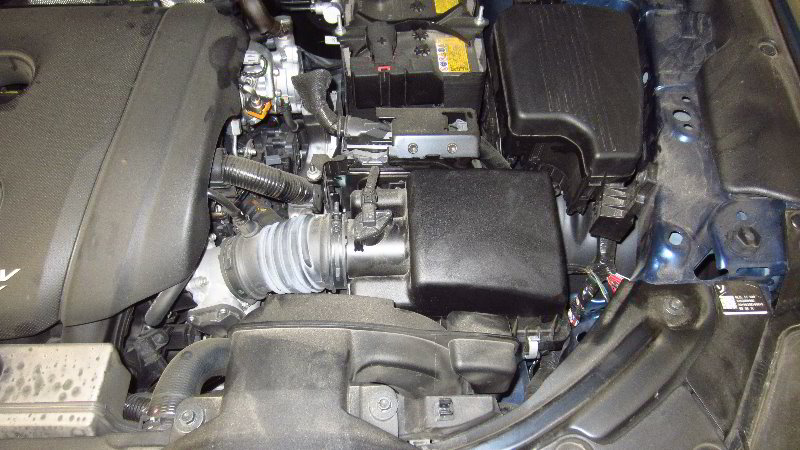
The 12V automotive battery is located to the left of the primary electrical fuse / relay box, to the right of the brake fluid reservoir and right behind the engine air filter housing.

Do NOT touch both of the terminals or battery posts at the same time to avoid being electrocuted. It would be best to wear gloves and safety glasses while completing this procedure.

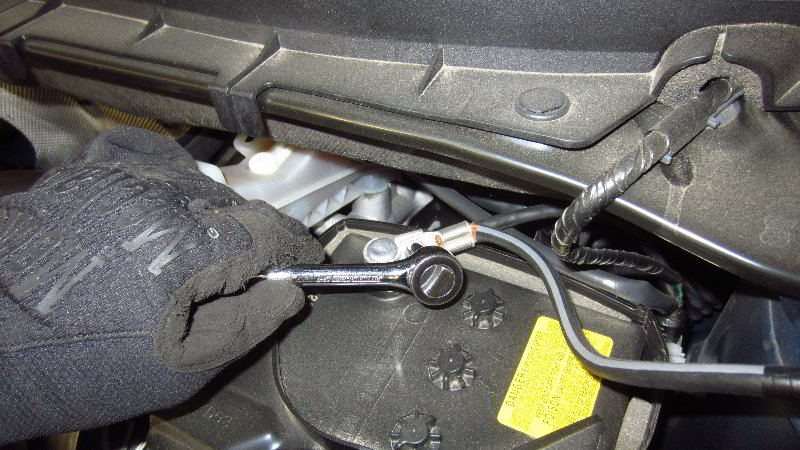
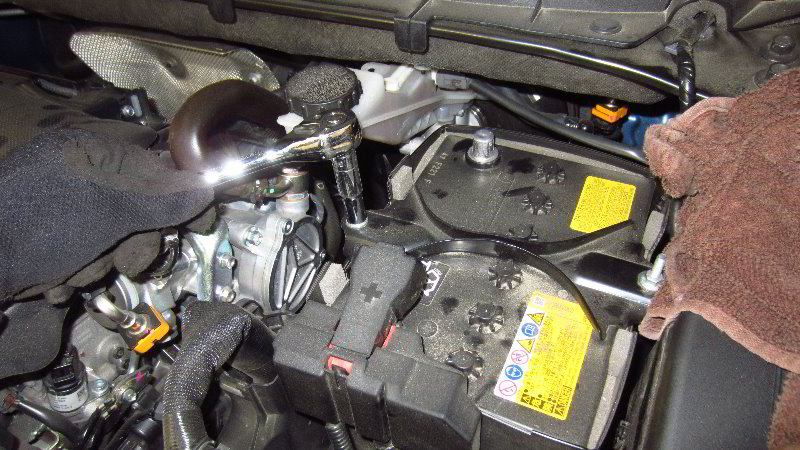
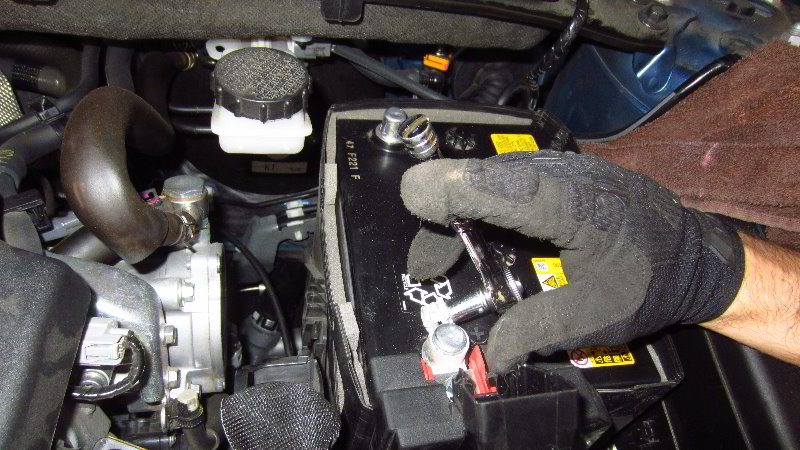
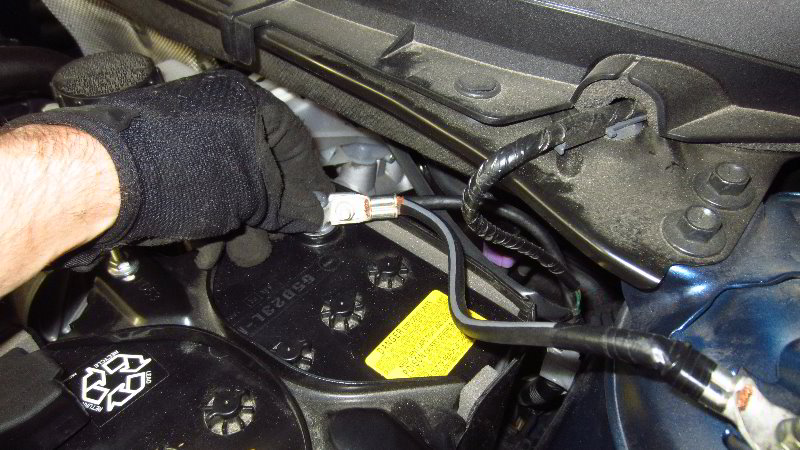
First, loosen the “-” negative terminal nut by turning it in the counterclockwise direction with a 10mm socket and a 1/4″ drive ratchet.

You do not need to remove the terminal nut, just loosen it a few turns.

Carefully pull the negative terminal off the “-” battery post.

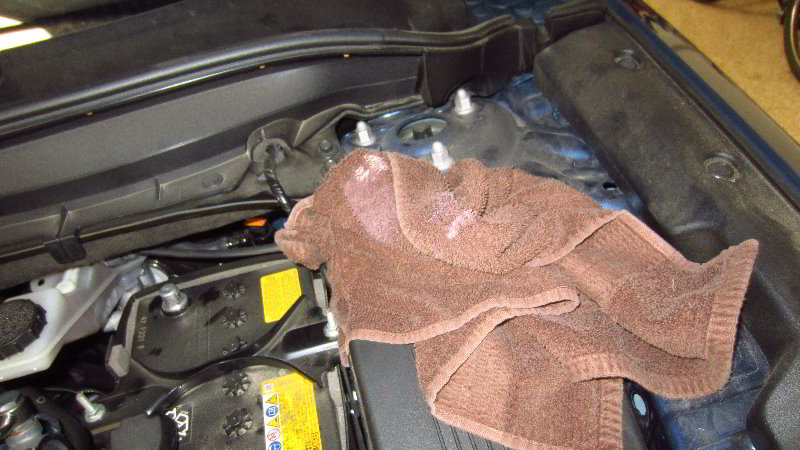
Wrap the terminal in a small towel and tuck it away on the right to help prevent accidental electrical contact.

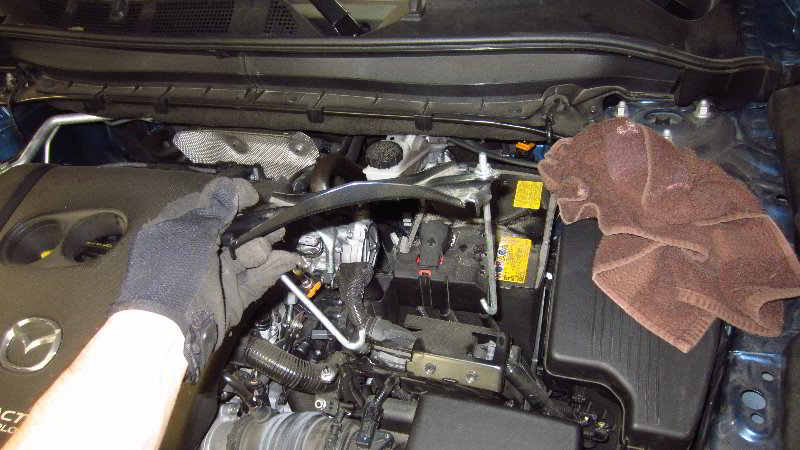
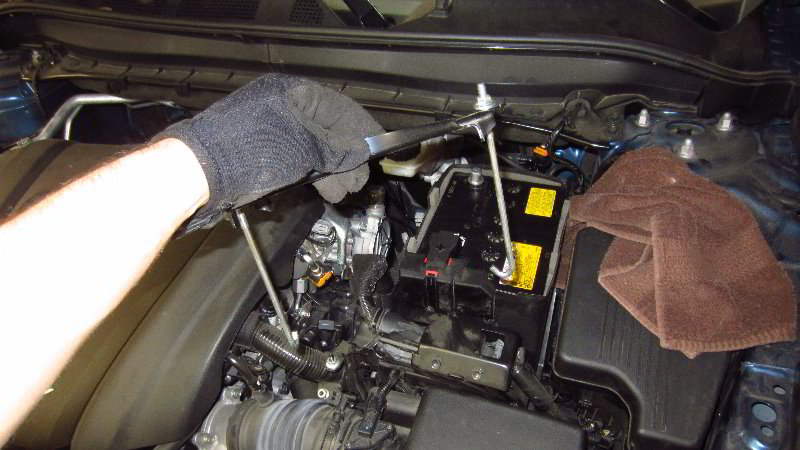
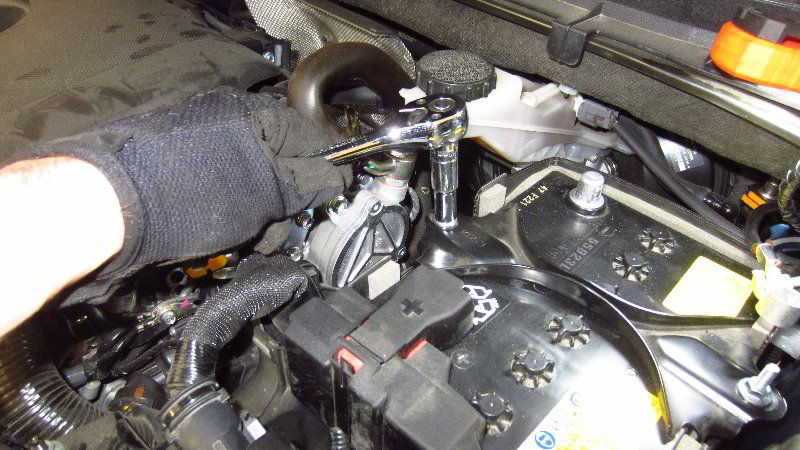
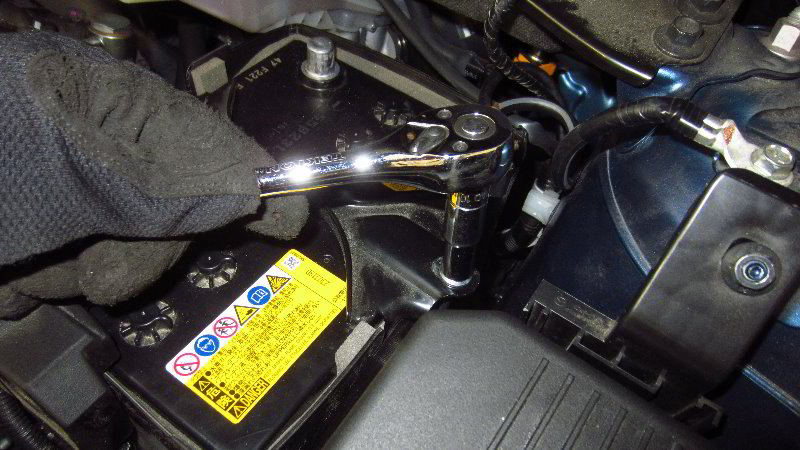
Then loosen the two nuts on the top of the battery hold down bar or “clamp” by turning them in the counterclockwise direction with a deep well 10mm socket and a ratchet or a 10mm wrench.

You don’t need to fully remove the two nuts on the hold down clamp.

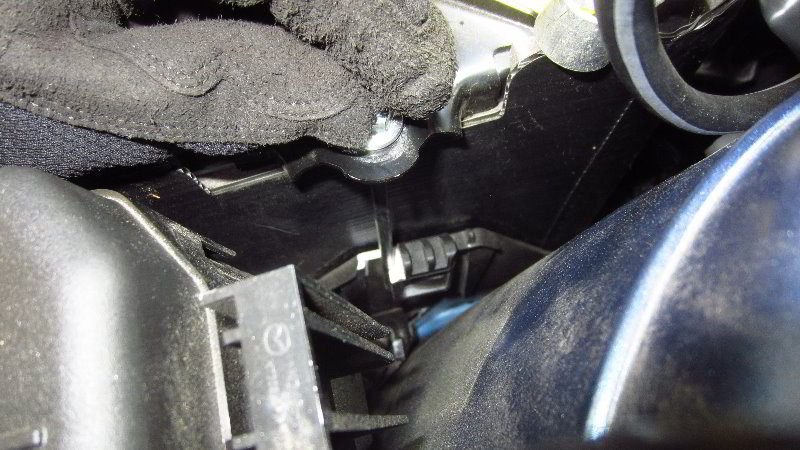
Once the nuts are loose enough, detach the hooks at the bottom of the two “J” shaped metal bars from their mounting brackets at the bottom of the battery tray.

Set the hold down clamp and two “J” bars aside in a safe place.

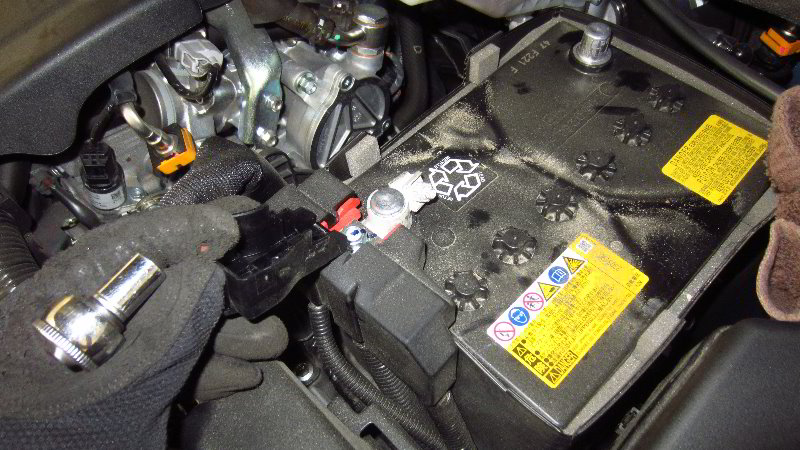
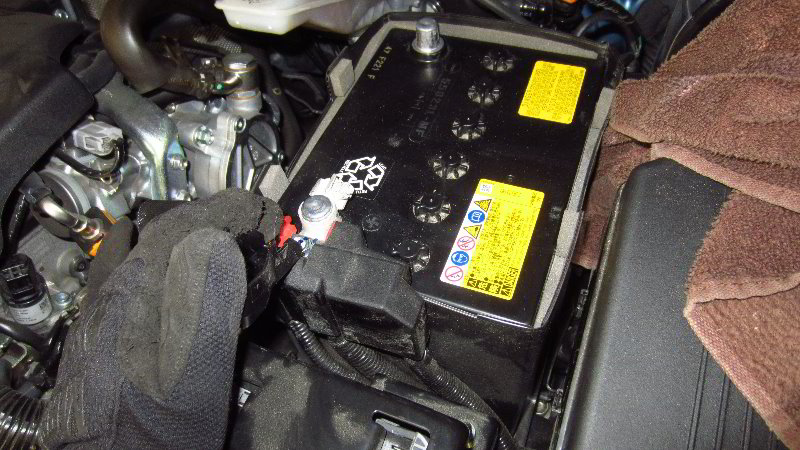
Next, flip open the plastic cover on the top of the “+” positive terminal.

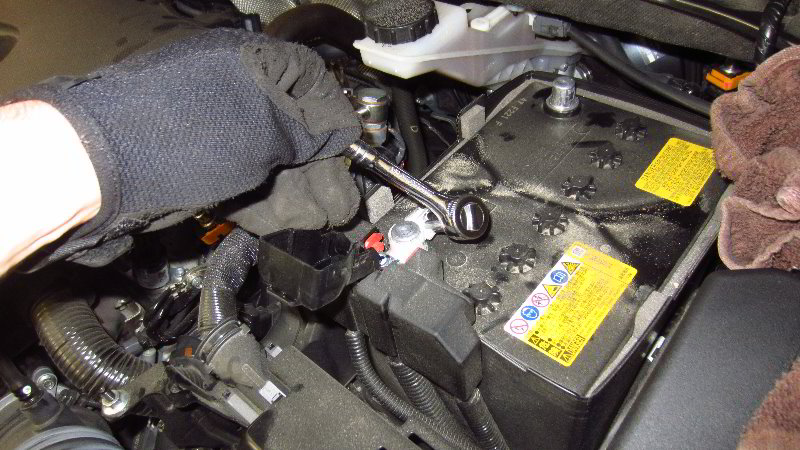
Loosen the nut on the positive terminal by turning it in the counterclockwise direction with the 10mm socket and a 1/4″ drive ratchet.

Carefully pull the positive terminal off the “+” battery post.

Close the plastic cover over the positive terminal and tuck it away on the left side of the battery.

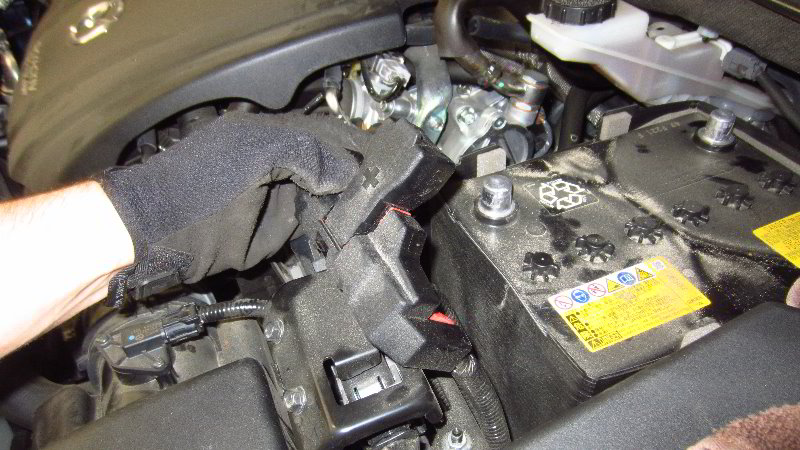
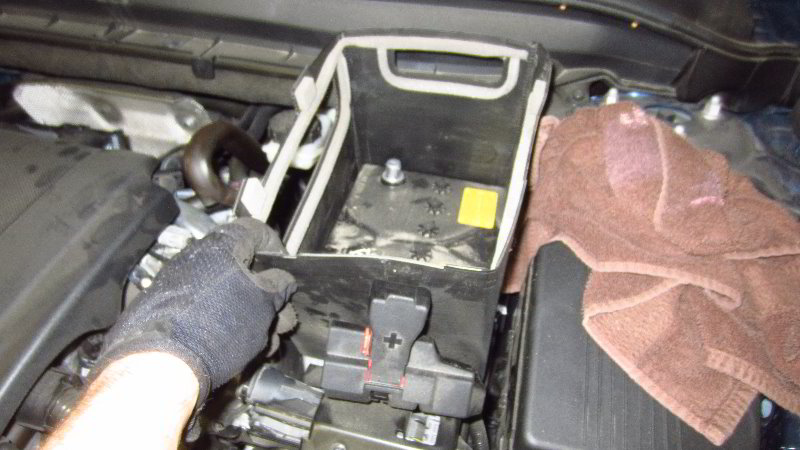
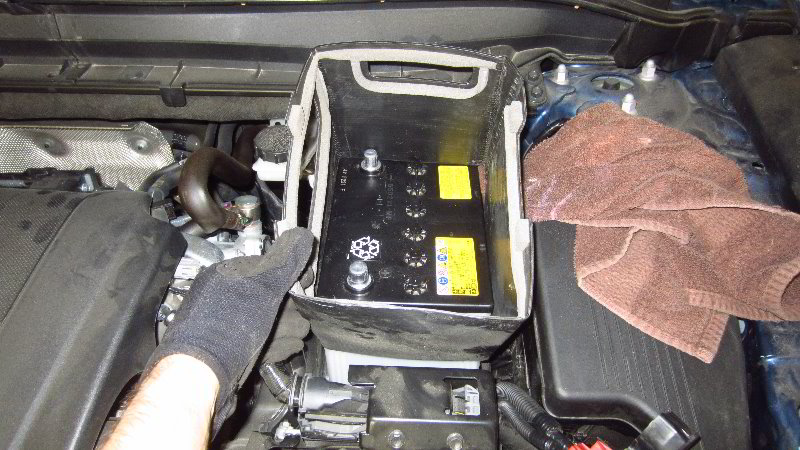
Pull the plastic and foam heat shield box off the old battery and set it aside for reinstallation later on.

Carefully lift the old battery straight out of the engine bay.

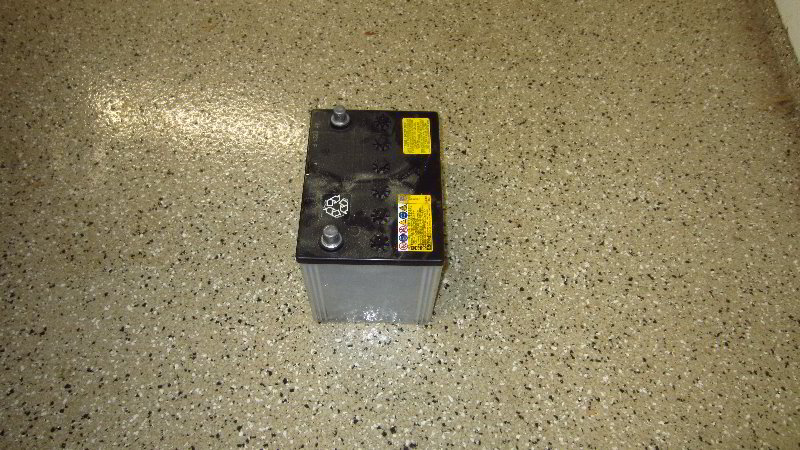
Gently set the old battery down on the ground. Try to avoid dropping or tipping over the old battery to prevent from having acid leak out.

The original battery in this 2019 Mazda CX-5 was marked as part number Panasonic 55D23L-MF.

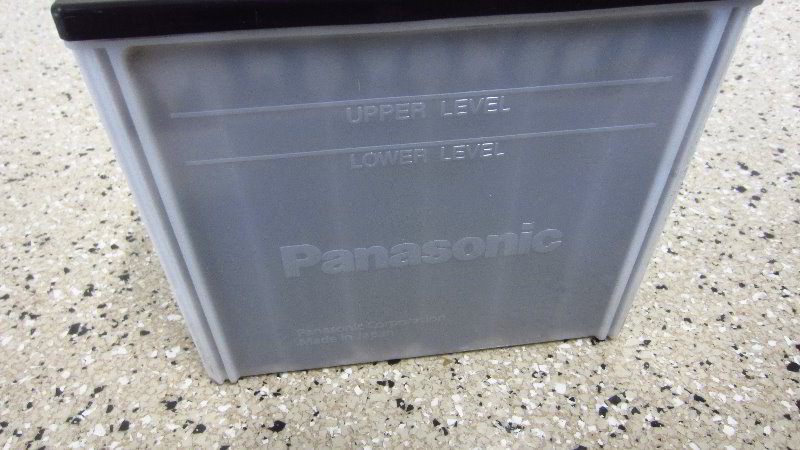
To check the distilled water level in the old battery, shine a flashlight on the side. There are lines indicating the “Upper Level” and “Lower Level”.

Be sure to take the old battery with you to the auto parts store, Walmart or Costco so you can possibly avoid having to pay a “core”, “recycling” or “disposal” fee.

The OEM (original equipment manufacturer) battery is a “Group Size” 35 and the part number is Panasonic 55D23L-MF (also known as 55D23LMF or 55D23L MF).

A few compatible replacement aftermarket group size 35 12 volt car batteries with their part numbers include the following: Optima 8020-164 35 RedTopDelphi BU9035, EverStart MAXX-35N (Walmart) and Interstate Batteries 8850242 (Costco).

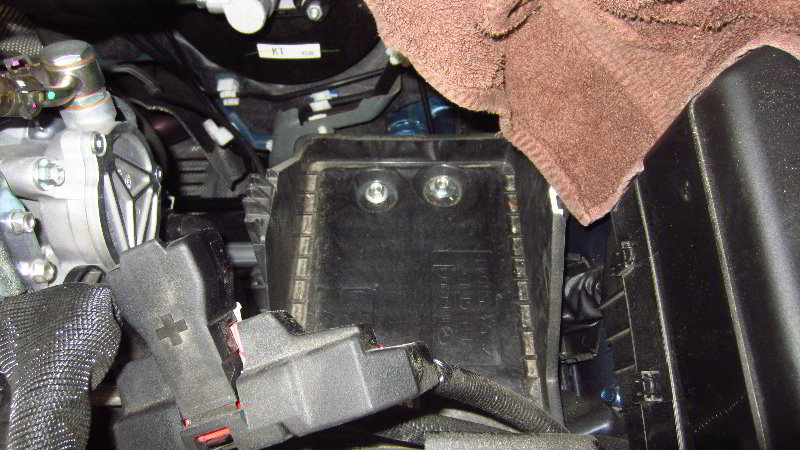
Clean off any debris from the plastic tray so that the new battery will rest evenly on it.

Orientate the new battery in the correct position.

In this 2019 CX-5, the negative battery post should be at the rear of the engine bay near the windshield and the “+” positive post should be closer to the front of the SUV near the engine air filter housing.

Carefully lower the new battery down into the engine bay.

Slide the heat shield box over the new battery.

If you’ve had an issue with corrosion (white, blue or green powder) building up on the terminals or posts, I highly recommend installing some felt anti-corrosion washers over the battery posts.

The felt washers are very cheap insurance against having to replace corroded terminals or cables.

Push the positive terminal over the “+” battery post.

Tighten the terminal nut in the clockwise direction with the 10mm socket and a 1/4″ drive ratchet until it is snug.

Try to avoid over tightening the terminal nut to prevent from cracking the battery post which could result in an acid leak.

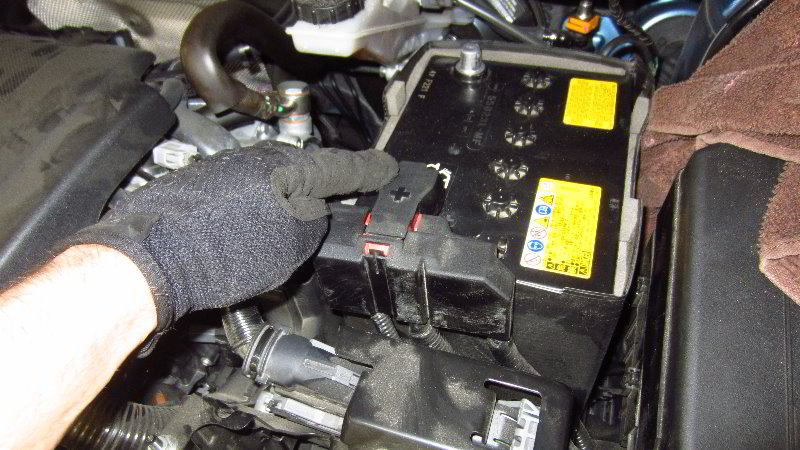
Flip the plastic cover closed over the positive terminal. You should feel or hear the cover “click” securely into place.

Carefully lower the two “J” hook bars and the hold down clamp over the center of the new battery.

Avoid making contact with the terminals or battery posts.

Reattach the “J” hooks to their mounting slots on the left and right side of the battery tray.

Tighten the two nuts on the hold down clamp by turning them in the clockwise direction until they are snug.

Check to see if the new battery can be moved, slid or rocked on the battery tray.

If the new battery can be moved, tighten the two nuts on the hold down bar an extra turn or two.

Carefully push the negative terminal on to the “-” battery post.

Tighten the negative terminal nut by turning it in the clockwise direction until it is snug.

Double check that the two terminals are securely attached.

Please remember to adjust the time on the clock and re-program your favorite radio stations before you start driving.

To test the new 12V battery, start the engine.

If you suspect that your alternator is weak or could be failing, use a digital multimeter tool to check the voltage when the engine is running.

If the alternator is working properly and charging the battery, the voltage on the battery terminals should be at least 13V to as much as just over 14V when the engine is running.

If the engine is switched off, the new battery should read at least 12 volts and about 12.6 volts when fully charged.

Be sure to write down the battery change in your SUV’s service records.

Please check out all of my 2017-2022 Mazda CX-5 DIY Repair & Maintenance Guides.
2017, 2018, 2019, 2020, 2021, 2022, 2023, 2024 & 2025 Mazda CX-5 MAF (Mass Air Flow) Sensor Replacement DIY Guide

This automotive maintenance tutorial was specifically written to assist owners of the second generation (2017, 2018, 2019, 2020, 2021 and 2022) Mazda CX-5 SUV in checking, cleaning or changing the mass air flow (MAF) sensor for the SkyActiv-G 2.5 liter inline four cylinder engine.

(The procedure should be the same or very similar for the turbocharged 2.5L I4, the 2.0L I4 and the SkyActiv-D 2.2L I4 diesel twin turbo engines.)

Owners of other Mazda vehicles such as the CX-3, CX-30, CX-7, CX-9, Mazda3, Mazda6, MX-30, MX-5 Miata, Mazda2, CX-4, CX-8 and BT-50 may also find these DIY instructions to be helpful.

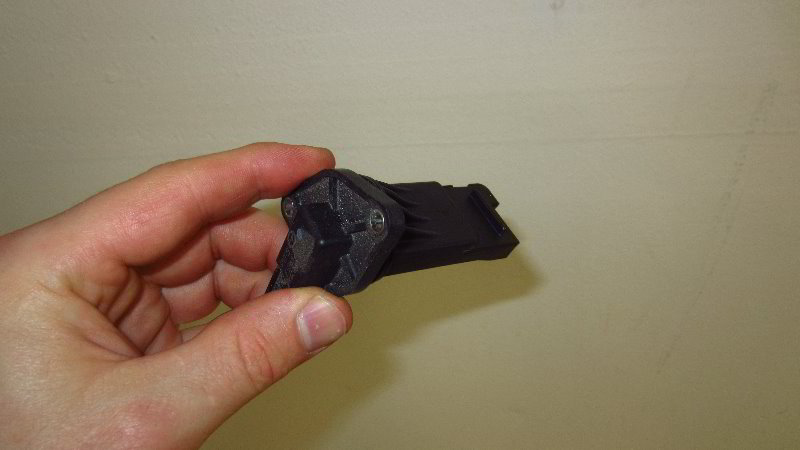
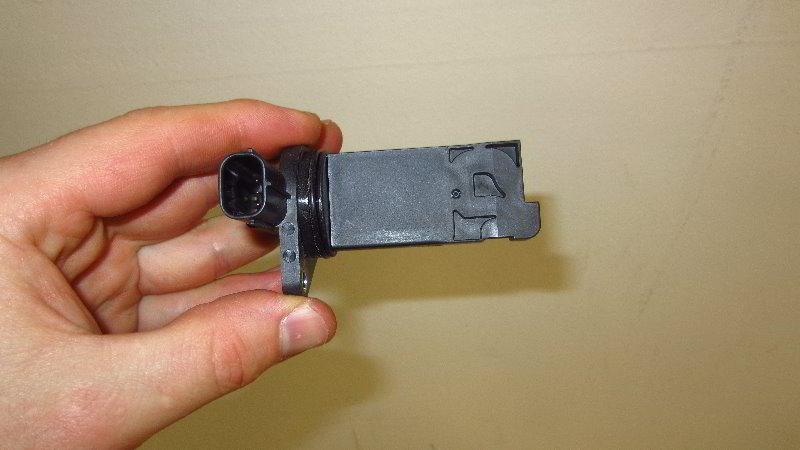
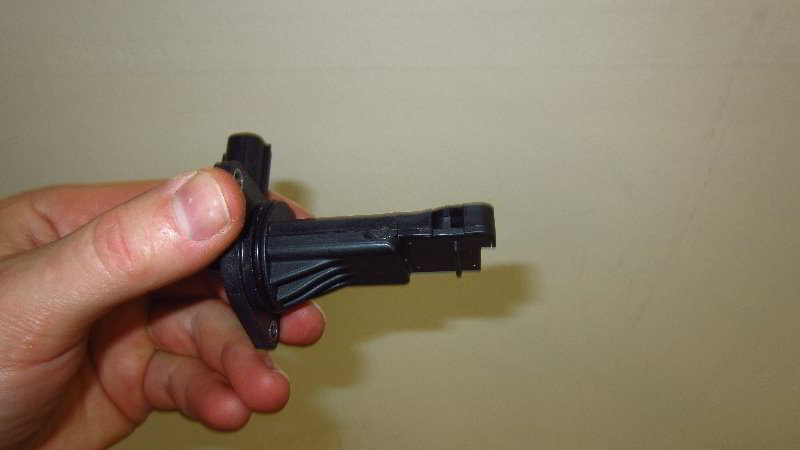
The OEM (original equipment manufacturer) mass air flow sensor part number is Mazda PYFS-13-215 (also known as PYFS13215 or PE01-13-215).

Two compatible replacement aftermarket MAF sensors with their part numbers are as follows: Standard Motor Products MAS0517 and WVE 5S15707.

A few of the most common symptoms of a dirty, failing or faulty MAF sensor include hard starting, rough idling, hesitating, surging, poor acceleration, hiccups, low fuel economy (reduced MPG), stalling, loss of power and misfiring. You might also see a CEL / SES (check engine light / service engine soon warning) displayed on the gauge cluster.

If you have an OBD2 scan tool it should reveal a MAF sensor related DTC (diagnostic trouble code) such as P0100, P0101, P0102, P0103 or P0104.

It’s also a good idea to check for other issues that may produce similar symptoms such as a vacuum leak from a split rubber hose, a clogged engine air filter, a cracked plastic intake tube, a leaking intake manifold gasket and a faulty PCV valve.

The first two steps are to open the hood and move to the right (driver) side of the engine bay.

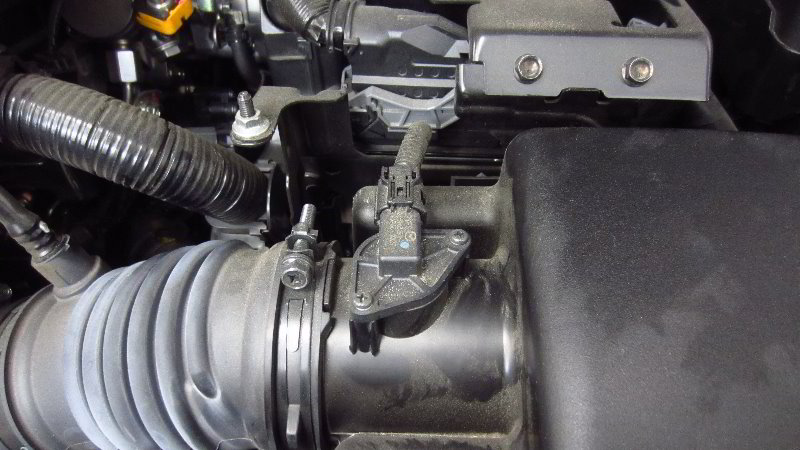
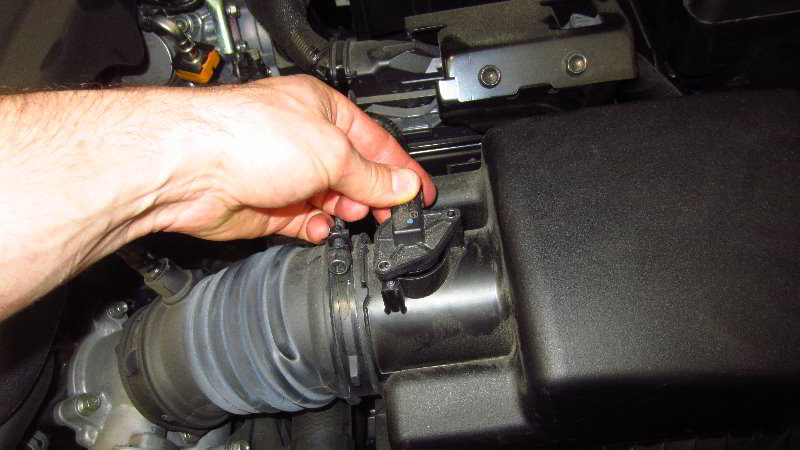
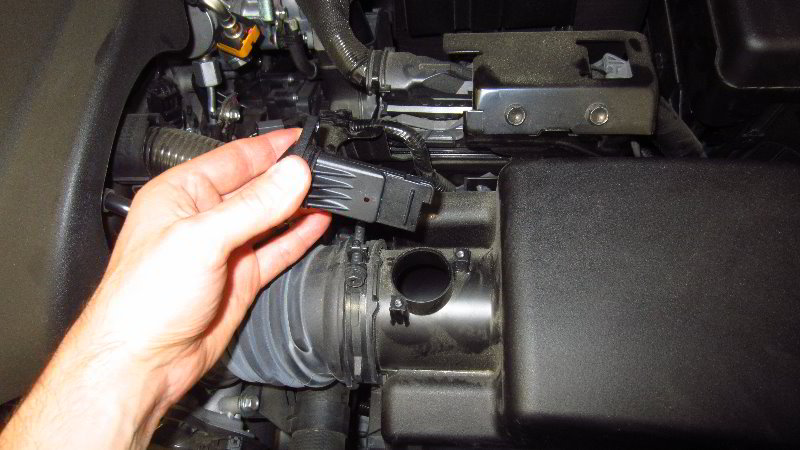
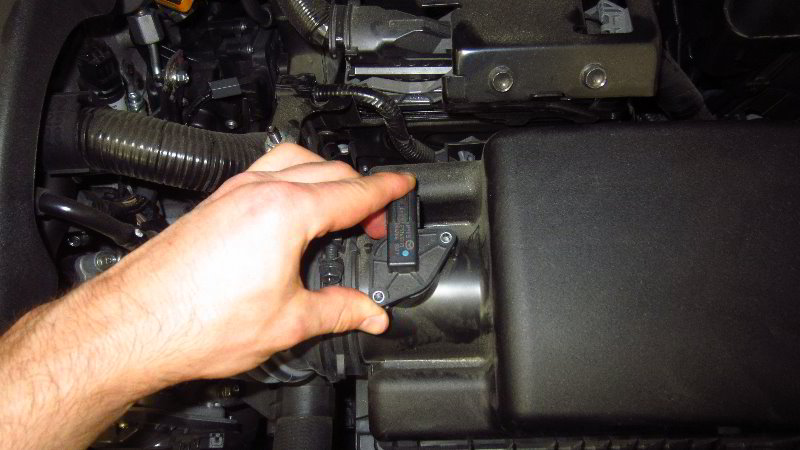
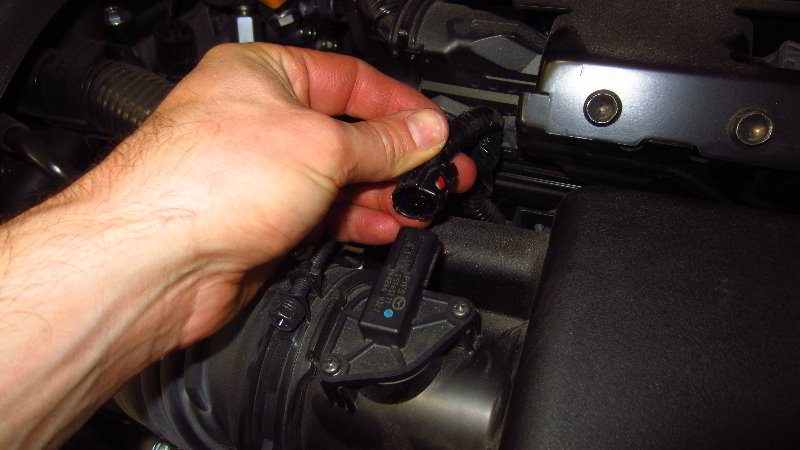
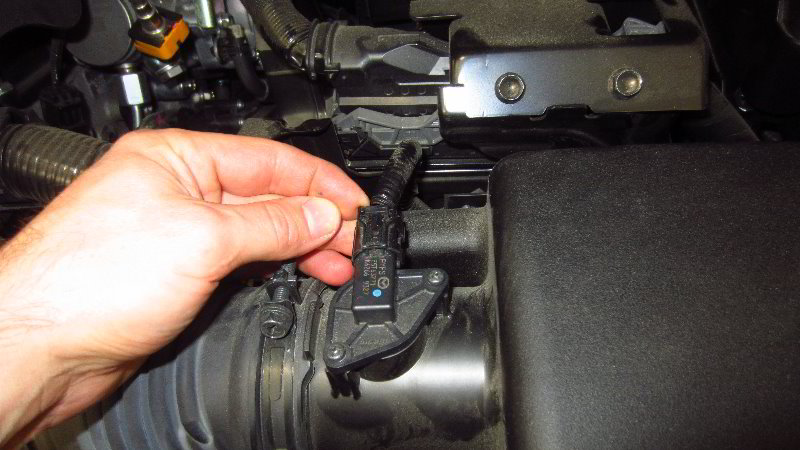
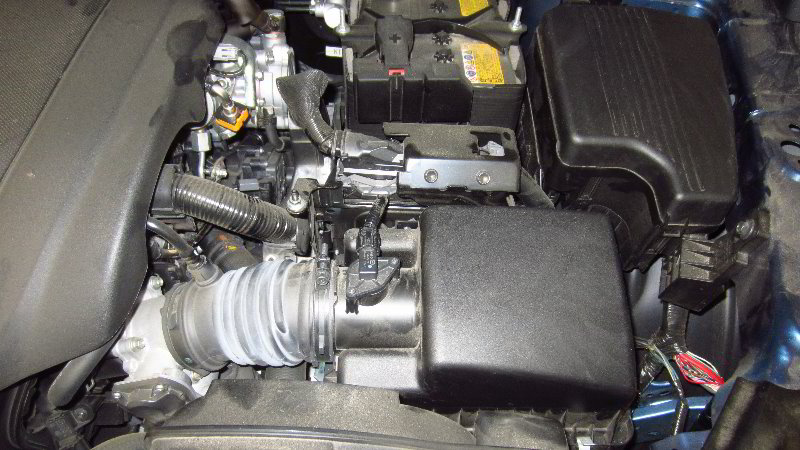
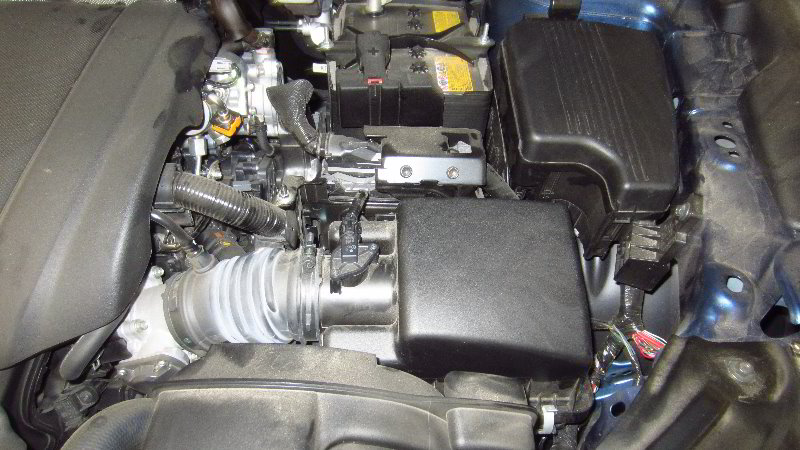
The MAF sensor is located on the top of the engine air filter housing’s plastic air intake tube attached to the rubber air intake hose.

If you’d like to try cleaning the old sensor before you purchase a new one, I recommend using some CRC Mass Air Flow Sensor Cleaner spray.

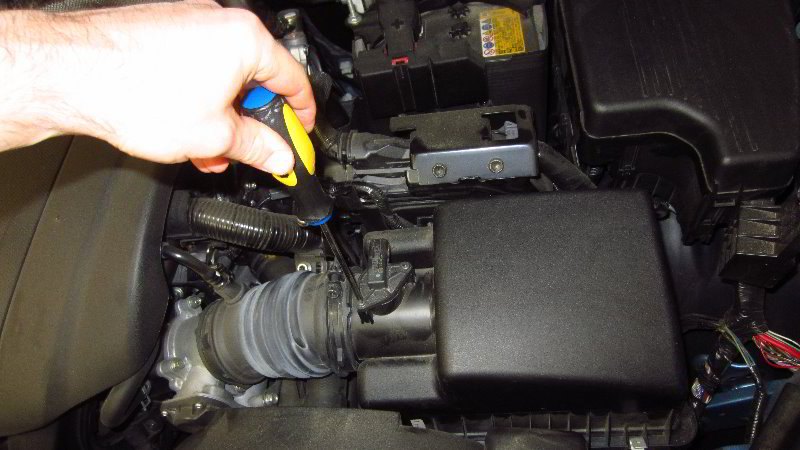
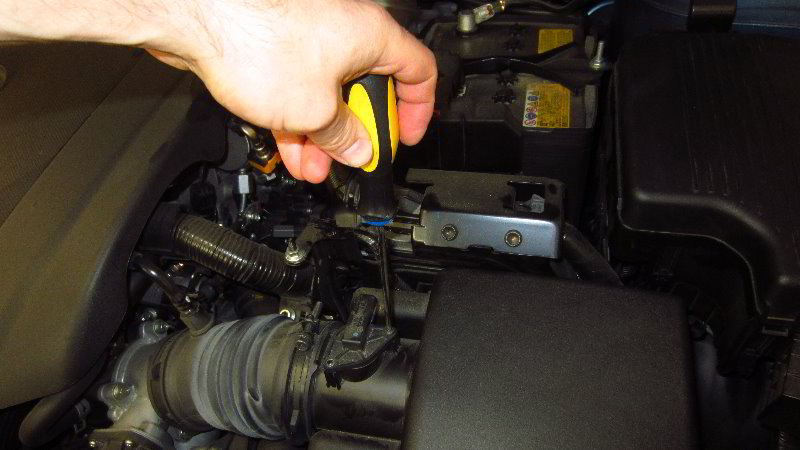
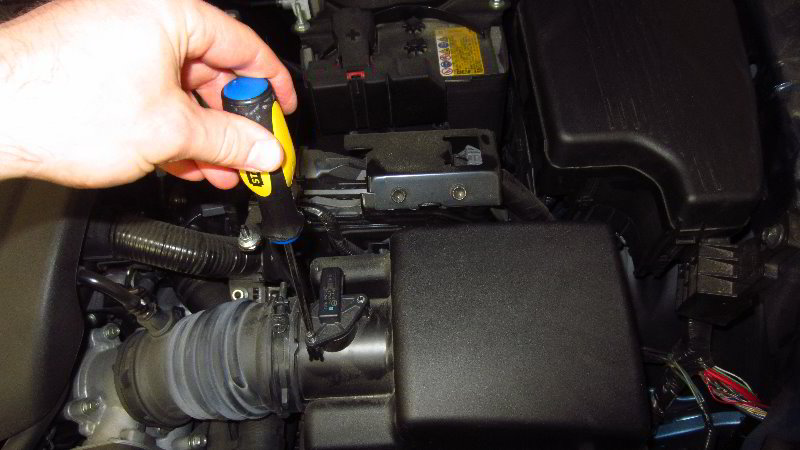
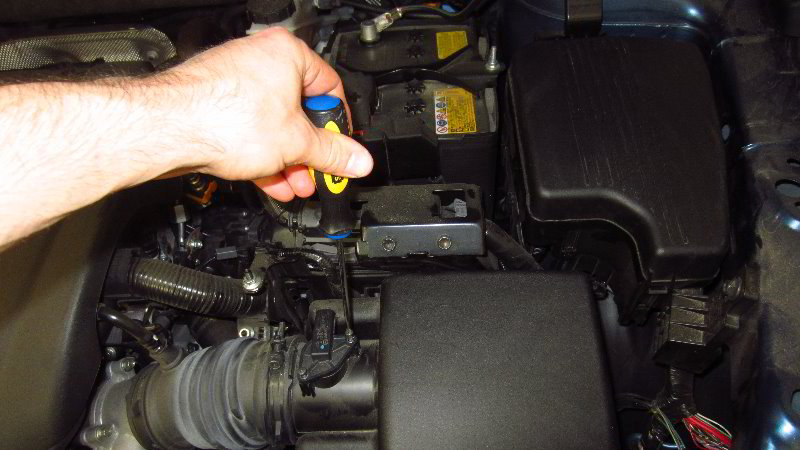
The only tool needed to remove and replace the sensor is a standard Phillips head screwdriver.

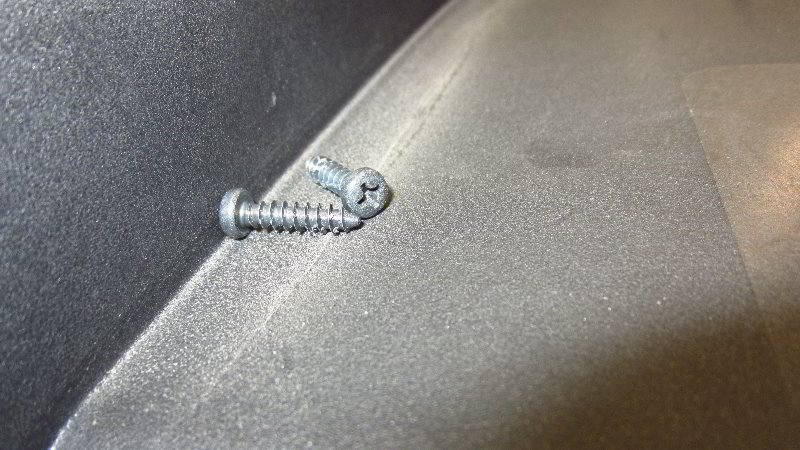
Remove the two screws by turning them in the counterclockwise direction with the Phillips head screwdriver.

Set the two screws aside in a safe place.

Rotate the old sensor back and forth a few times to make sure the rubber o-ring gasket is not stuck to the plastic air intake tube.

If you just pull the sensor straight out, the old brittle o-ring might tear apart and allow pieces of rubber to fall into the air intake assembly.

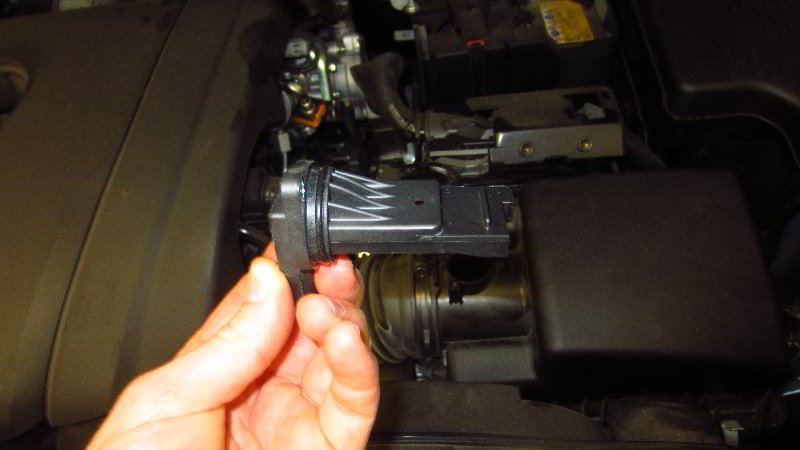
Once the sensor is loose, gently lift it out of the port (opening) in the air intake.

Inspect the old sensor for any soot, oily deposits, other debris or any damage.

To clean the old sensor, gently spray into every opening with some CRC Mass Air Flow Sensor Cleaner.

Do not spray cleaner into the electrical contacts.

To clean the electrical contacts on the sensor or the power plug, use some CRC Electronic Cleaner spray.

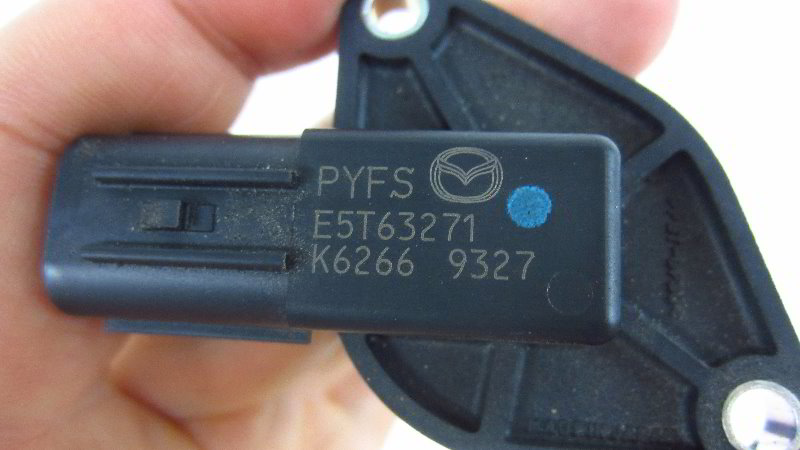
The OEM (original equipment manufacturer) sensor in this 2019 CX-5 was marked as part number Mazda PYFS E5T63271 K6266 9327 (Philips K6266 9327).

Line up the new sensor with the opening in the air intake tube.

Lower the new sensor down into place and line up the two screw holes.

Spin in the two Phillips head screws a few turns with your fingers to help prevent them from falling down into the engine bay and becoming lost.

Tighten the two screws in the clockwise direction until they are snug.

Try to avoid over tightening the screws to prevent from cracking the plastic sensor housing or the air intake tube.

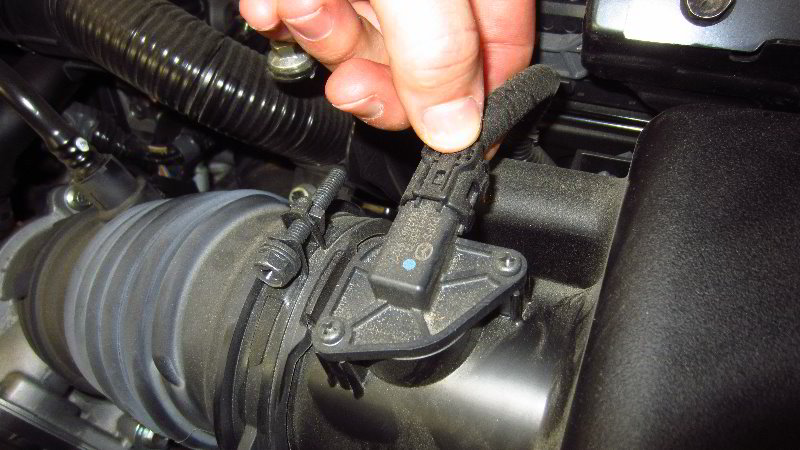
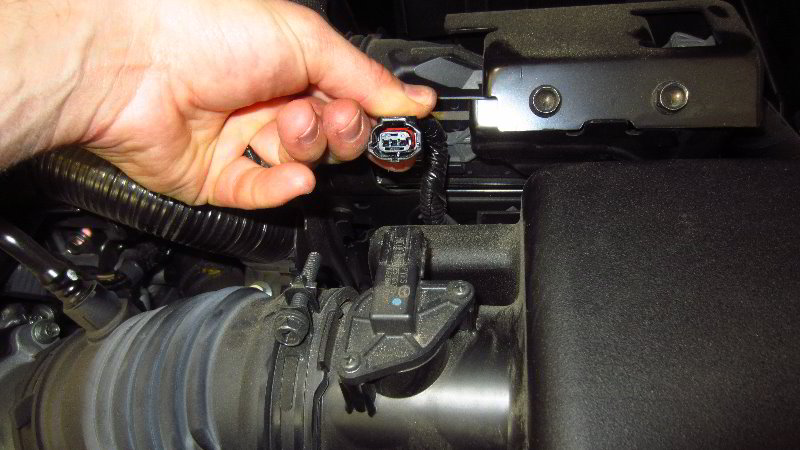
Push the power plug straight on to the base of the new sensor.

You should hear or feel the electrical connector “click” securely into place.

If you have an OBDII scanner, clear any MAF sensor related DTC codes.

Start the engine and listen closely for any strange sounds. If you do hear any weird noises, immediately turn off the ignition and double check your work.

If everything sounds normal, take the car for a short and careful test drive to see if any of the symptoms of a faulty MAF sensor occur again.

Don’t forget to write down the sensor change in your SUV’s service records.

Please check out all of my 2017-2022 Mazda CX-5 DIY Repair & Maintenance Guides.

2017, 2018, 2019, 2020, 2021, 2022, 2023, 2024 & 2025 Mazda CX-5 Engine Air Filter Replacement DIY Guide

This automotive maintenance tutorial was specifically written to assist owners of the second generation (2017, 2018, 2019, 2020, 2021 and 2022) Mazda CX-5 SUV in checking, cleaning or changing the engine air filter element for the SkyActiv-G 2.5 liter inline four cylinder engine. (The procedure should be the same or very similar for the turbocharged 2.5L I4, the 2.0L I4 and the SkyActiv-D 2.2L diesel twin turbo engines.)

Owners of other Mazda vehicles such as the CX-3, CX-30, CX-7, CX-9, Mazda3, Mazda6, MX-30, MX-5 Miata, Mazda2, CX-4, CX-8 and BT-50 may also find these DIY instructions to be helpful.

A few compatible replacement engine air filters for the SkyActiv-G 2.5L N/A (naturally aspirated) I4 engine with their part numbers include the following: EPAuto GPA0AEcoGard XA6280Spearhead MT-259Wix 49247 and Purolator A26280.

If you’d like to the have the OEM (original equipment manufacturer) filter, the part number is Mazda PE07-13-3A0A.

No tools are needed to access and replace the engine air filter.

A wet/dry shop vacuum may be useful for cleaning out the bottom half of the air box.

The first two steps are to open the hood and move to the right (driver) side of the engine bay.

The square black plastic air box is situated behind the driver side headlight assembly and in front of both the primary electrical fuse / relay box and the 12V automotive battery.


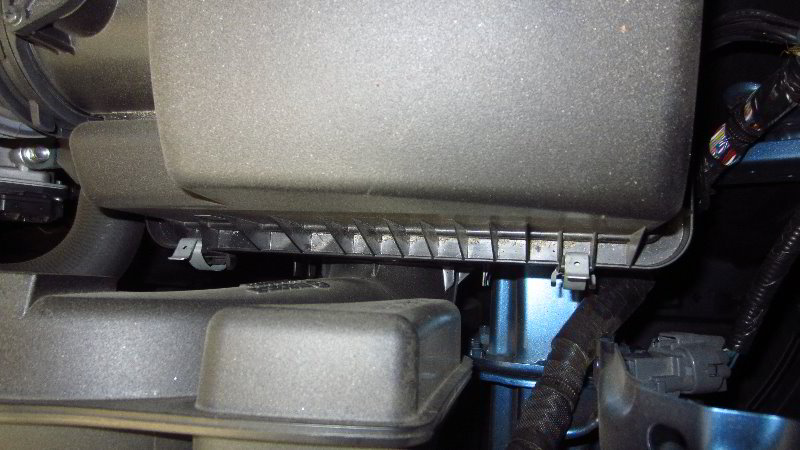
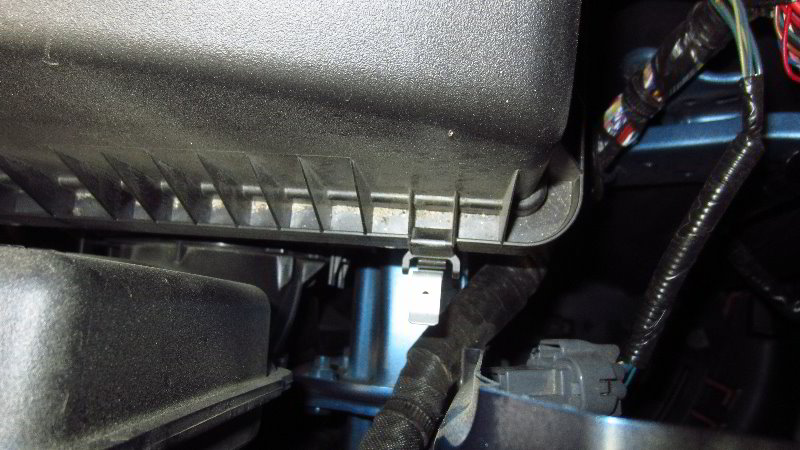
Locate the two silver metal latches on the front edge of the air filter housing (situated close to the driver side headlight).

One clip is located at the front left corner of the air box and the second clip is near the right front corner.

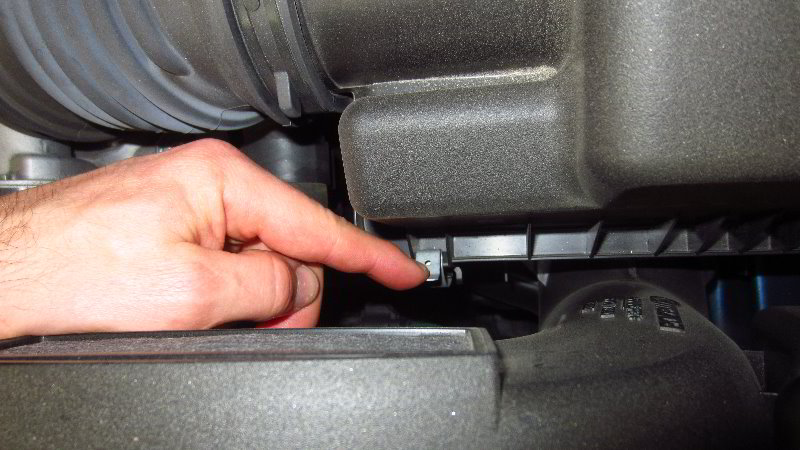
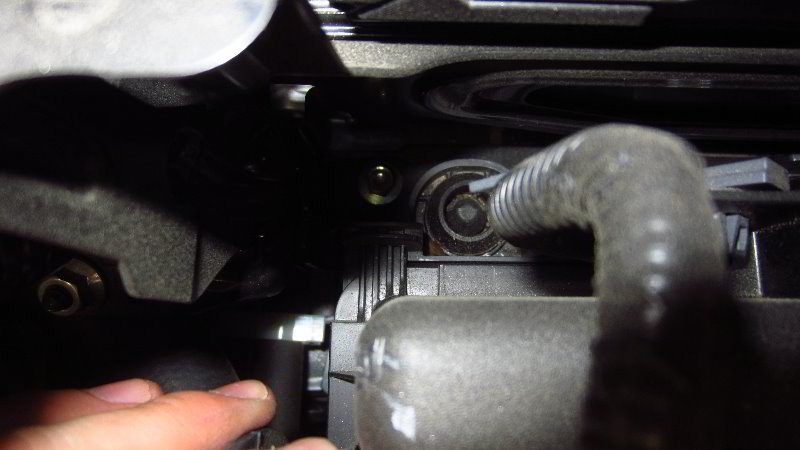
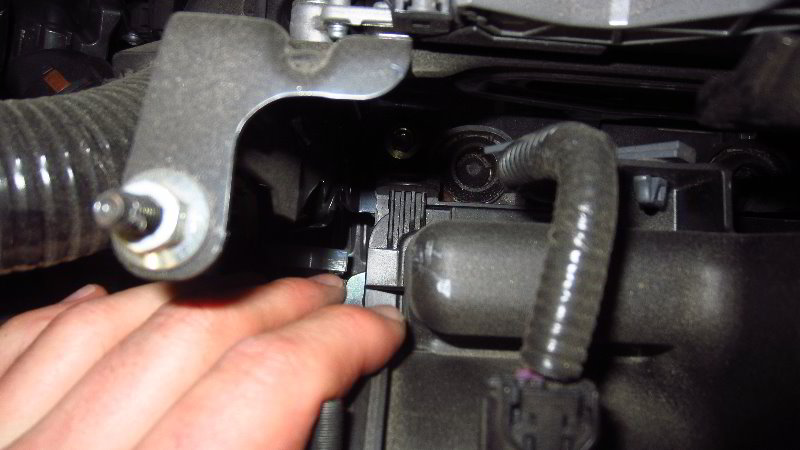
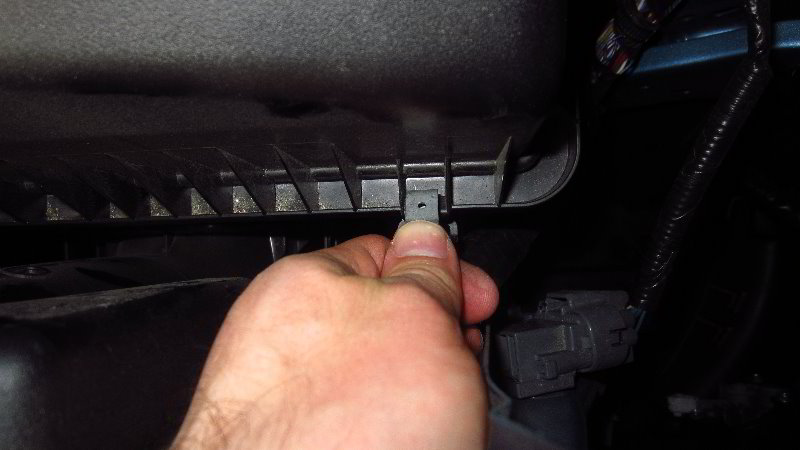
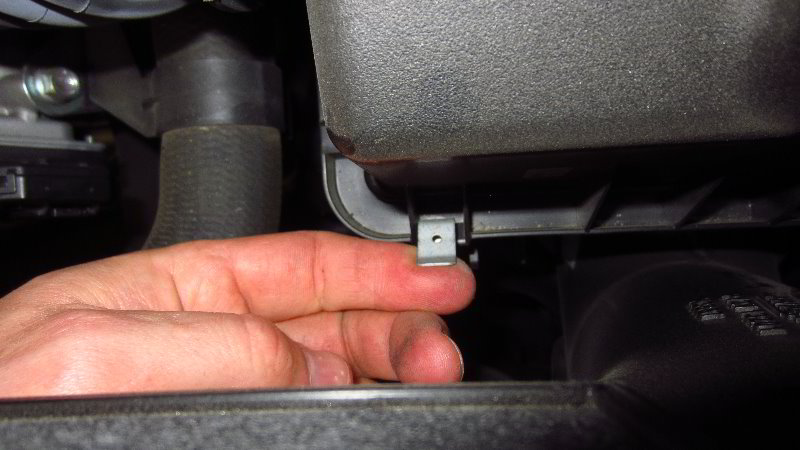
Gently pull the tab forwards to the front of the car and allow it to swing down away from the air box cover.

Repeat the process to release the other retaining clip.

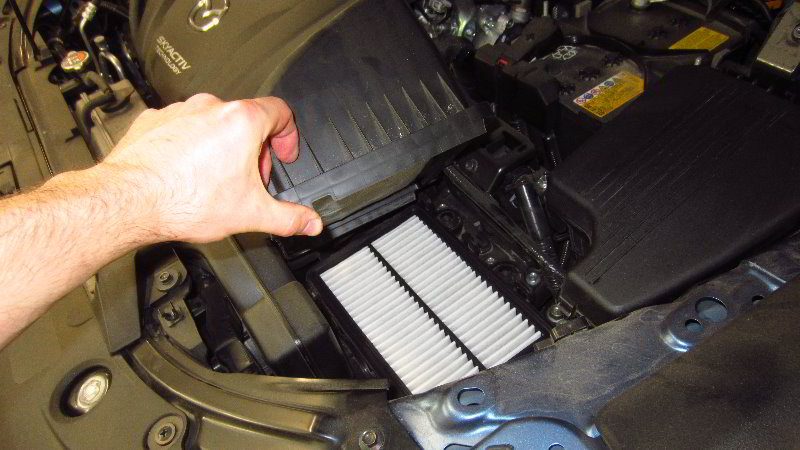
Once both metal latches have been released, slide the air box cover slightly forwards.

Sliding the cover forward will remove the three tabs on the rear edge of the cover from the three slots on the rear edge of the filter housing.

Lift open the cover to access the old filter.

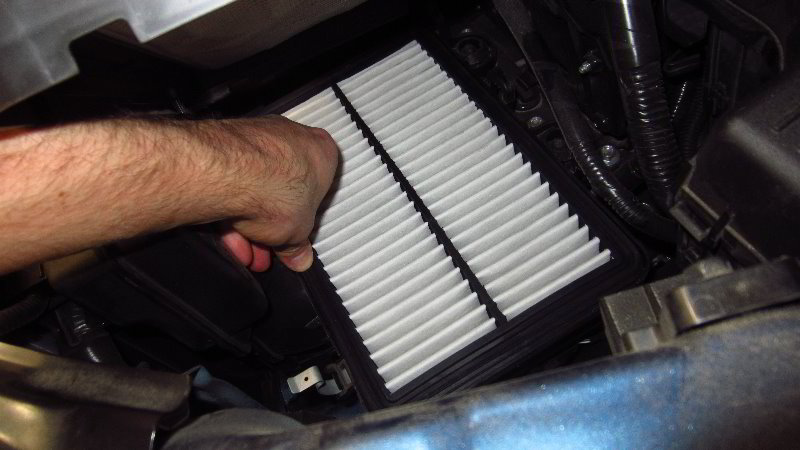
Pull the old filter straight out of the bottom half of the air box.

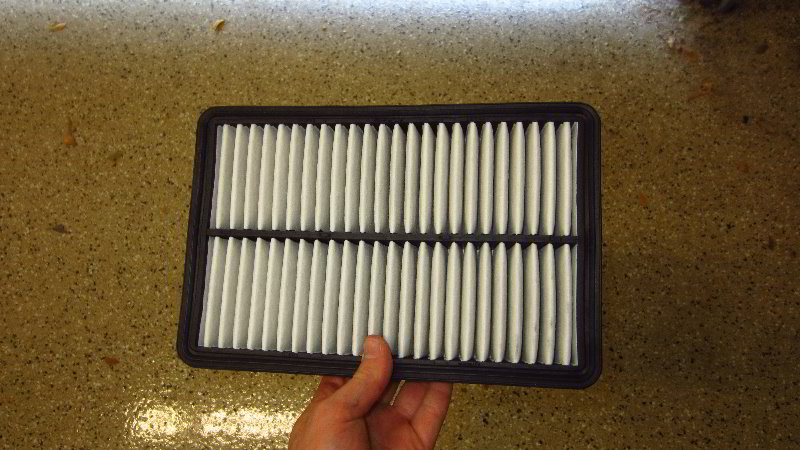
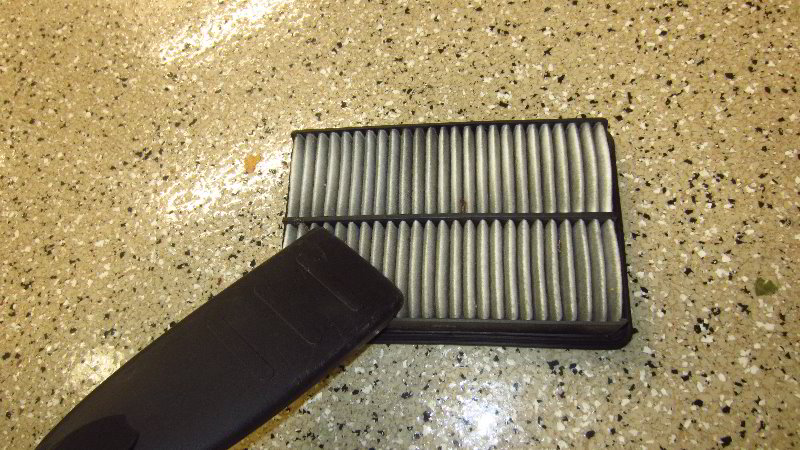
Inspect both sides of the old filter.

The OEM (original equipment manufacturer) filter part number is Mazda PE07-13-3A0A.

If the old filter is dark grey or black and clogged with dirt, dust, sand, pollen, hair, insects, soot, leaves and other debris, it should be replaced with a new element.

If the old filter is relatively clean, just tap out the large debris and remove any fine dust with a vacuum cleaner.

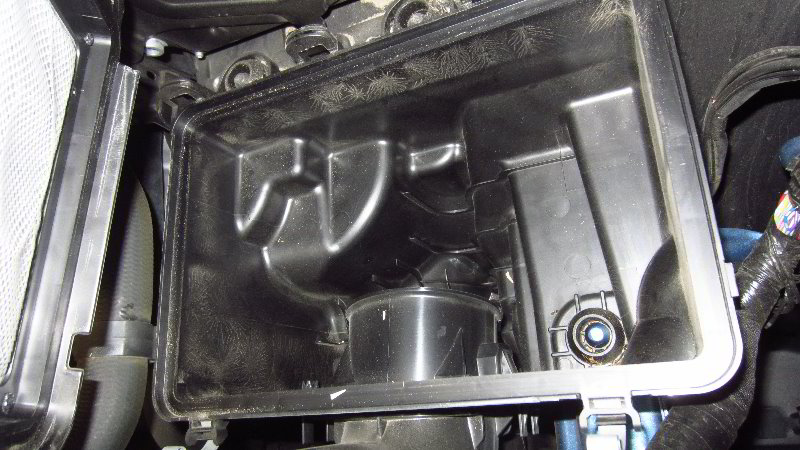
Check the bottom half of the air box for any sand or debris.

Clean out the air box with the crevice attachment of your wet/dry shop vacuum.

Orientate the new air filter with the rubber gasket facing up towards you and the exposed pleats facing down into the bottom half of the air box.

Lower the new filter down into the housing.

Make sure the new filter is fully seated in place.

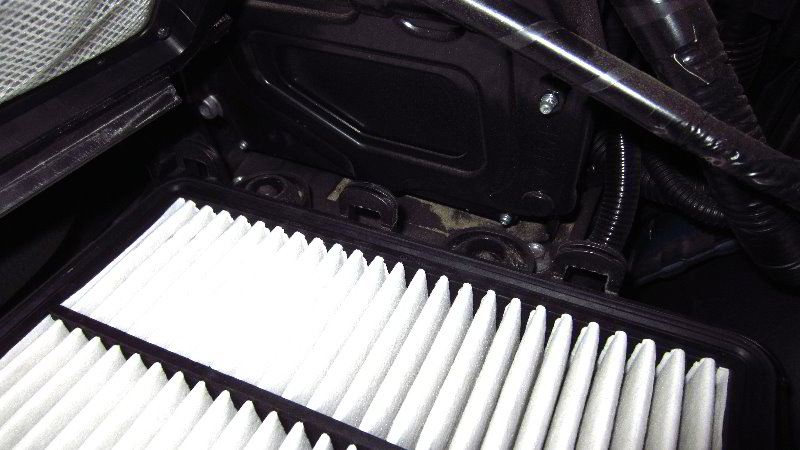
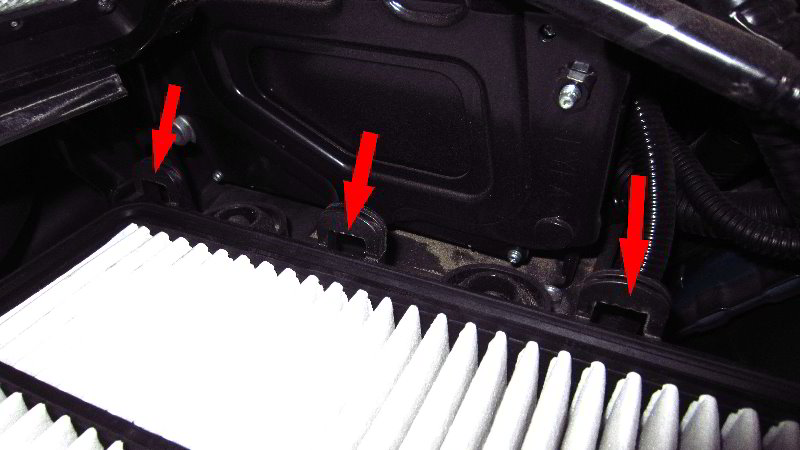
Take note of the three slots on the rear edge of the air box.

Lower the cover down over the new filter.

Slide the cover back to secure the three tabs into their three corresponding slots on the filter housing.

Flip up the two metal retaining latches towards the air box cover.

Snap the latches securely into place over the front edge of the cover.

You should hear or feel the two retaining clips “click” securely into place.

Double check that the two halves of the air box are flush together with no parts of the new filter visible at any edge.

According to the “Scheduled Maintenance” chart in the owner’s manual, the service interval specification for the engine air filter is to change it every 22,500 miles (36,000 km) or at least every 36 months (3 years).

Be sure to write down the filter change in your SUV’s service records.

Please check out all of my 2017-2022 Mazda CX-5 DIY Repair & Maintenance Guides.
2017, 2018, 2019, 2020, 2021, 2022, 2023, 2024 & 2025 Mazda CX-5 Electrical Fuse & Relay Replacement DIY Guide

This automotive maintenance tutorial was specifically written to assist owners of the second generation (2017, 2018, 2019, 2020, 2021 and 2022) Mazda CX-5 SUV in checking or changing a blown fuse or a faulty relay in either the engine bay or interior passenger compartment electrical panels.

Owners of other Mazda vehicles such as the CX-3, CX-30, CX-7, CX-9, Mazda3, Mazda6, MX-30, MX-5 Miata, Mazda2, CX-4, CX-8 and BT-50 may also find these DIY instructions to be helpful.

This 2019 Mazda CX-5 is equipped with “low profile” fuses.

Please check the old fuses in your vehicle before you purchase new fuses!

Some Mazda vehicles may either be equipped with the older mini blade fuses or the newest style Micro2 fuses.

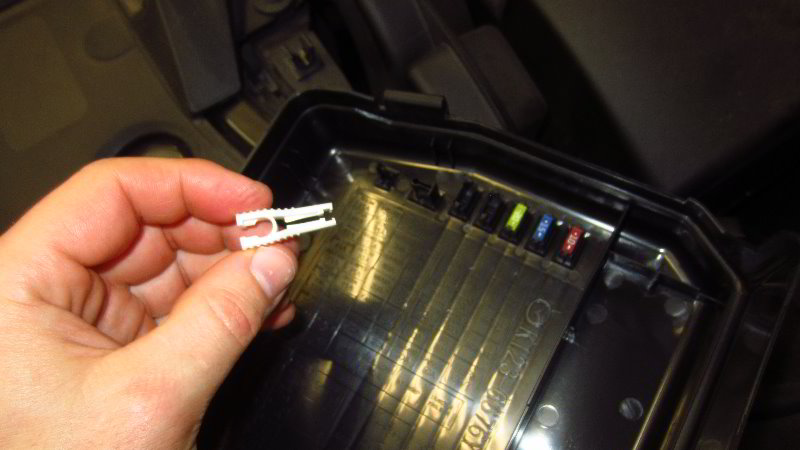
No tools are required to access and replace the fuses. There should be a white plastic fuse puller tool included on the underside of the engine bay electrical box cover.

If the tool is missing, you could use a pair of needle nose pliers with rubber insulated handles for extra safety.

Make sure the ignition is turned to the “OFF” position. An optional step is to disconnect the “-” negative 12 volt car battery terminal to avoid accidental electrical contact or other issues while replacing a fuse or a relay.

 Please proceed with caution and at your own risk.

The first two steps are to open the hood and then move to the right (driver) side of the SkyActiv-G 2.5L I4 engine bay.

(The procedure should be the same or very similar for vehicles with the 2.0L I4, 2.5L turbocharged I4 and 2.2L twin turbo diesel engines.)

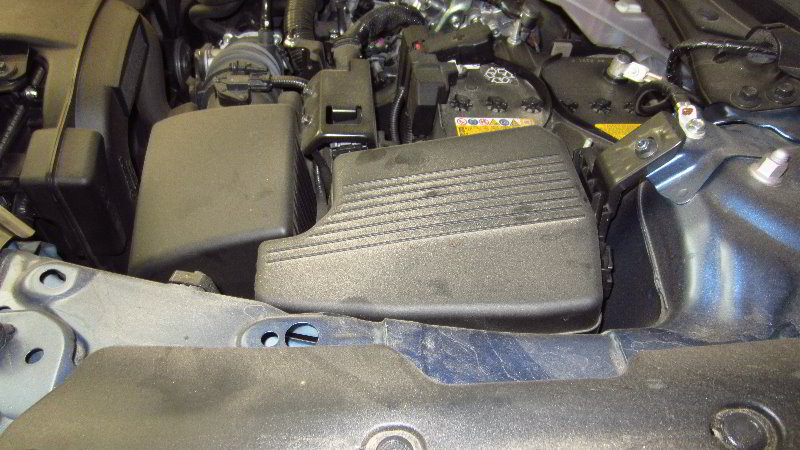
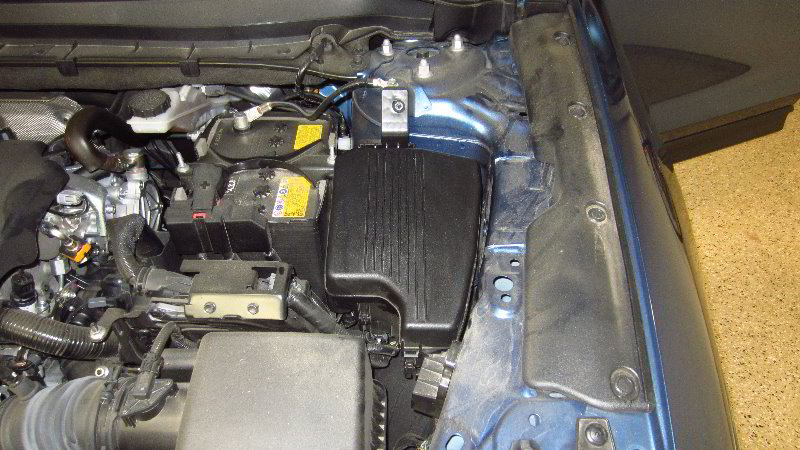
The primary electrical box is located to the right of the 12V automotive battery, behind the engine air filter housing and just in front of the suspension tower.

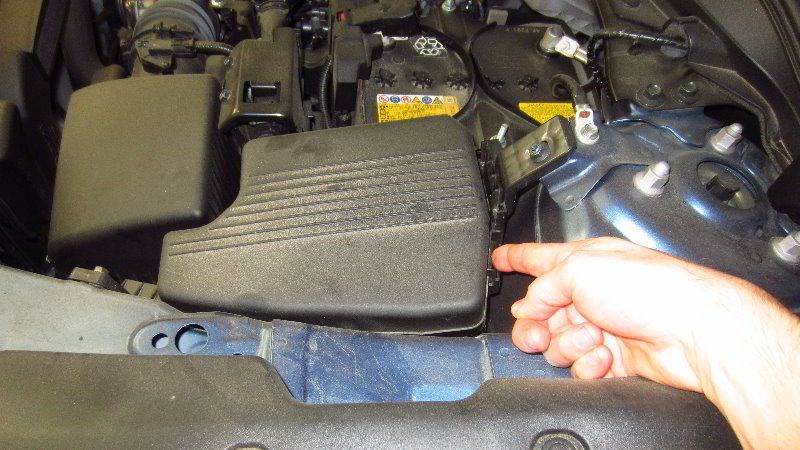
Locate the release tab on the rear edge of the engine bay fuse box (close to the shock tower).

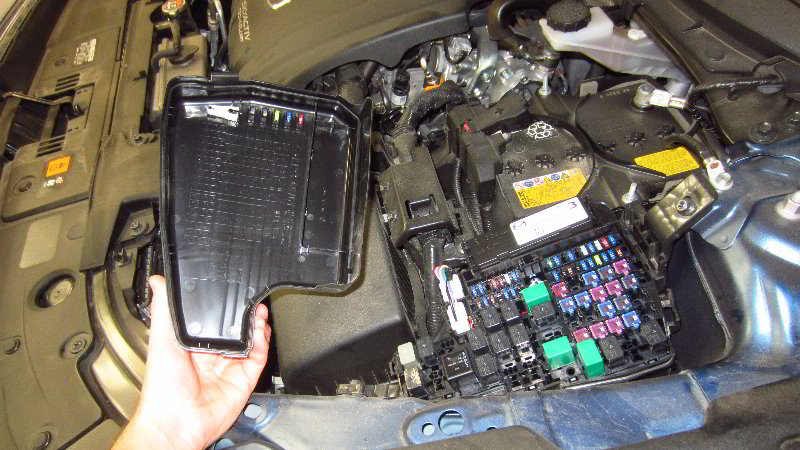
Push in the release tab and lift the cover off the top of the primary electrical panel.

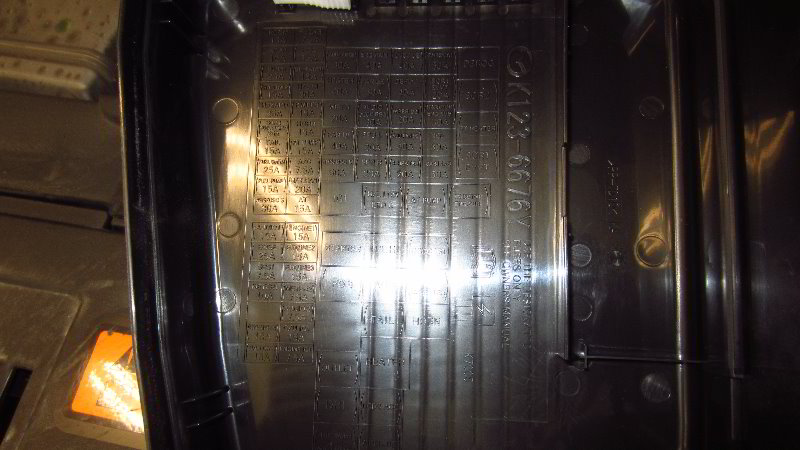
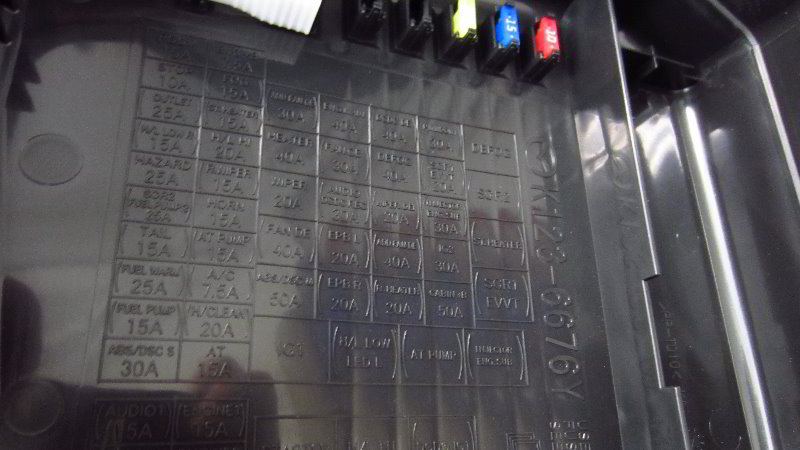
Turn over the cover to view the fuse and relay location diagram. There is also another fuse location chart in your owner’s manual.

There should be a white plastic fuse pulling tool and a few spare fuses attached to the underside of the cover.

Set the cover aside in a safe place.

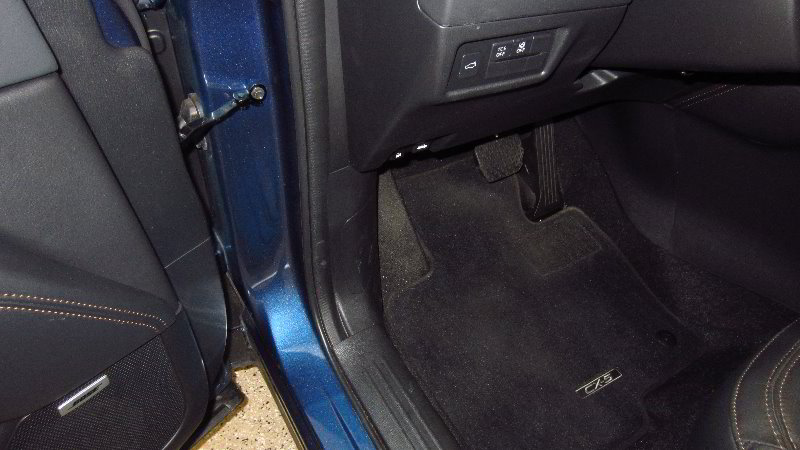
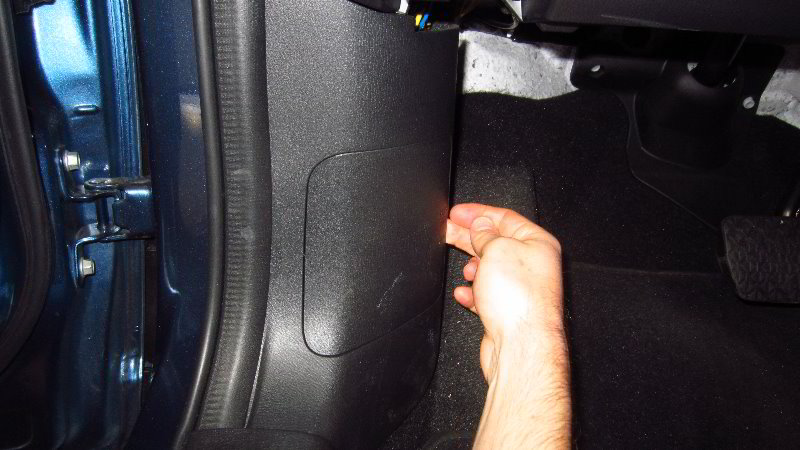
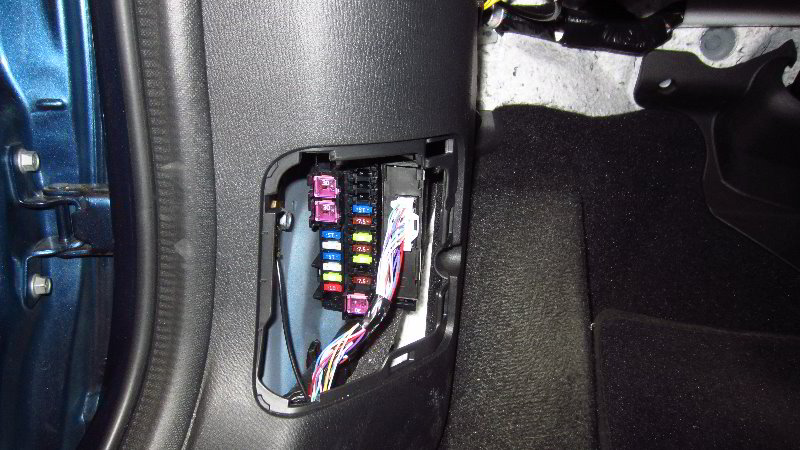
The interior passenger compartment electrical panel is located under the dashboard and near the driver’s foot rest (or “dead pedal”).

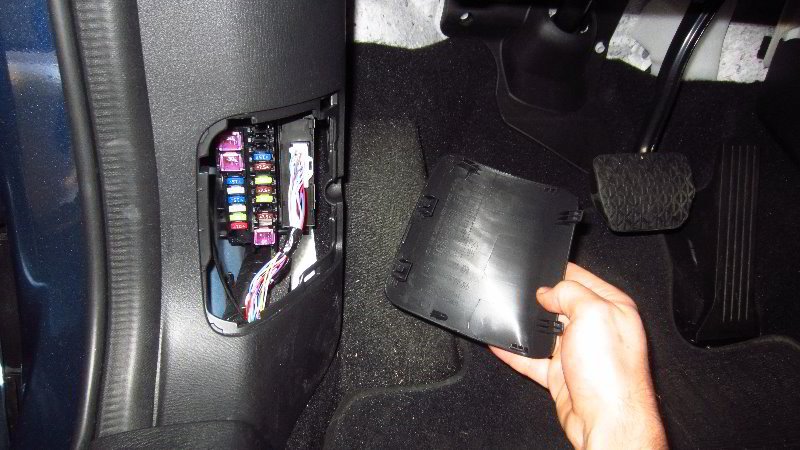
Pull out the inner edge of the access cover to remove it from the trim panel.

There is a fuse location diagram on the back side of the cover.

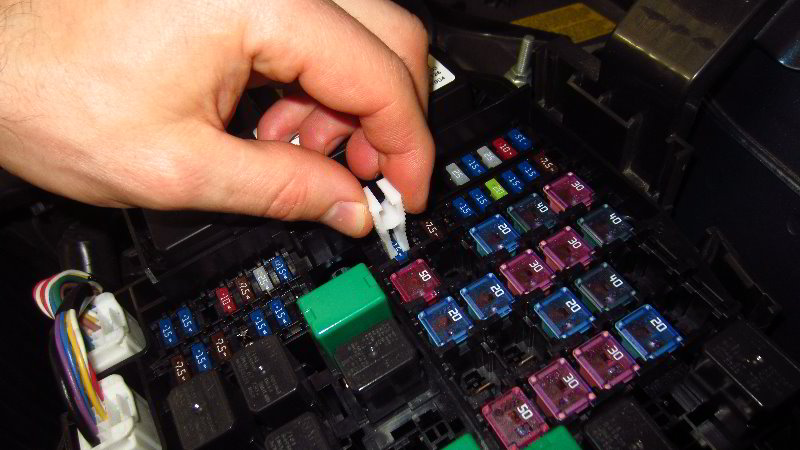
Pinch the end of the tool to open the jaws.

Place the jaws over the old fuse that you’d like to check or change.

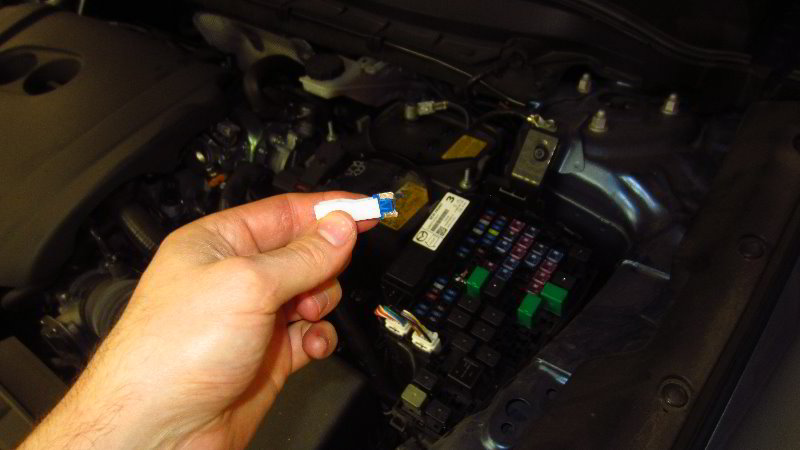
Pull the old fuse straight out of the socket.

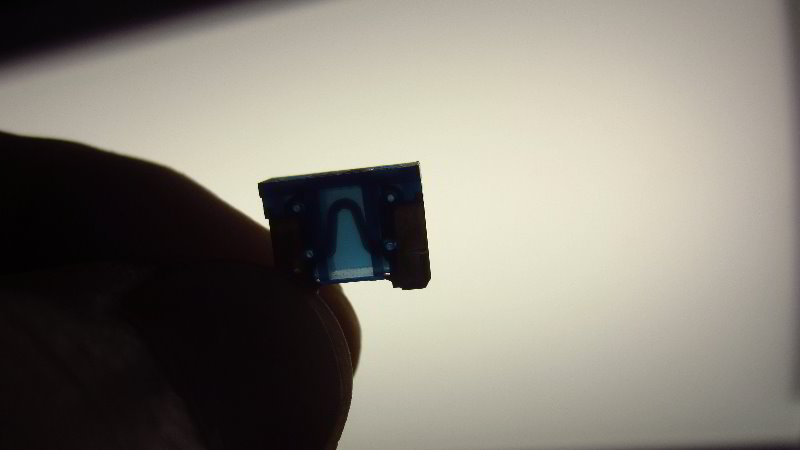
To check the condition of the old fuse, hold it up to a light source.

If the thin metal bar or “strip” in the translucent center of the old fuse appears to be burnt, broken or shriveled up, the old fuse is most likely “blown” and should be replaced with a new one.

If the metal band in the middle of the old fuse appears to be intact, it might still be in good working condition.

Since new fuses are so inexpensive, I still recommend changing the fuse as part of your electrical problem troubleshooting process.

Push a new “low profile” fuse of the same amperage rating (e.g. 5A, 10A, 15A, 20 Amps) straight into the socket.

If you would like to add a hard wired 12 volt power source for an automotive accessory such as a Bluetooth audio adapter unit, a radar detector, an auxiliary gauge (boost, transmission temperature), a dash camera / dashcam or a GPS unit, install an “Add-A-Circuit” fuse tap holder.

If you suspect that a faulty relay is the source of your issue, the easiest way to troubleshoot the problem is to just simply replace the old relay with a new one of the same amperage rating.

If you have a digital multimeter tool, you can test the old relay.

To avoid having to buy a new relay just to troubleshoot the problem, find another relay of the same amperage rating that you can temporarily swap with the one that might be faulty in order to quickly test it.

To remove an old relay, grasp it with the needle nose pliers and carefully pull it straight out.

To replace the access cover for the interior fuse block, first reinsert the two tabs on the outer edge into the opening.

Then gently push in the retaining clips on the inner edge of the cover.

Replace the fuse puller tool by pushing it into the holder on the underside of the fuse box cover.

Push the cover straight on to the engine bay electrical box.

You should feel or hear the retaining clip “click” securely into place.

Test the electrical component that you were having problems with such as the A/C (air conditioning) system, the power windows, power driver’s seat, stereo system (radio), horn, interior lights, headlights, tail lights, windshield wipers, etc.

If you are still having the same issue, there may be a shorted out wire (due to worn away insulation or rodent damage) or the electrical component itself needs to be replaced.

Please check out all of my 2017-2022 Mazda CX-5 DIY Repair & Maintenance Guides.
2017, 2018, 2019, 2020, 2021, 2022, 2023, 2024 & 2025 Mazda CX-5 Cargo Area Light Bulb Replacement DIY Guide

This automotive maintenance tutorial was specifically written to assist owners of the second generation (2017, 2018, 2019, 2020, 2021 and 2022) Mazda CX-5 SUV in changing a burnt out cargo area (or “trunk”) light bulb located in the housing attached to the plastic interior panel of the tailgate door.

Owners of other Mazda vehicles such as the CX-3, CX-30, CX-7, CX-9, Mazda3, Mazda6, MX-30, MX-5 Miata, Mazda2, CX-4, CX-8 and BT-50 may also find these DIY instructions to be helpful.

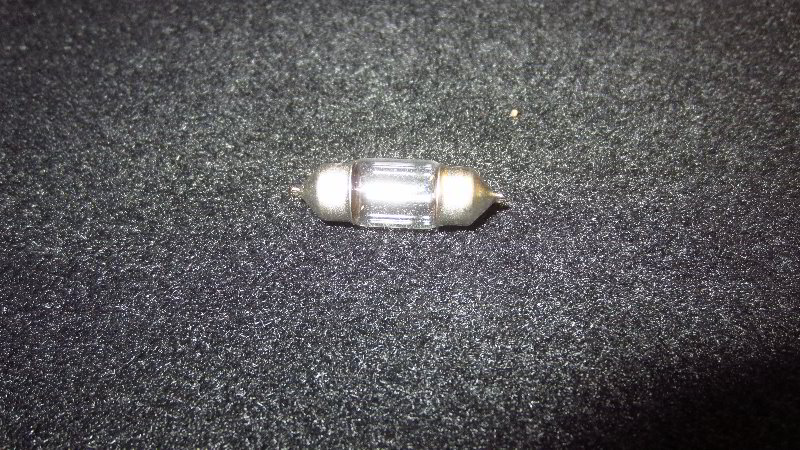
The compatible replacement “festoon” style light bulb part number is DE3175 which is available from various manufacturers such as Sylvania, GE, Bosch, PIAA and Eiko.

If you’d like to have a brighter cargo area light that will also last much longer before burning out like the traditional incandescent bulb, install a DE3175 LED unit.

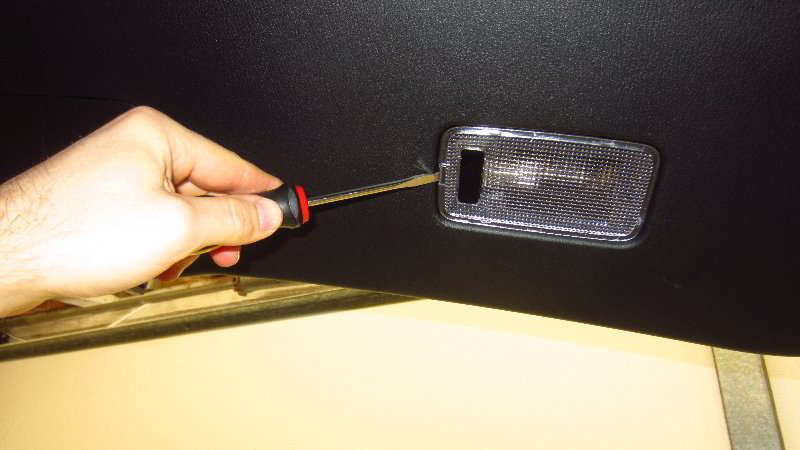
The only tool needed to access and replace the bulb is a flat head screwdriver or a plastic pry bar tool.

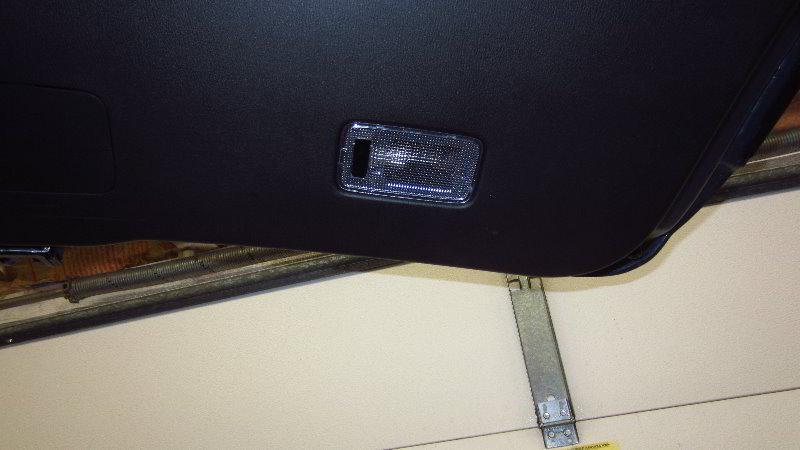
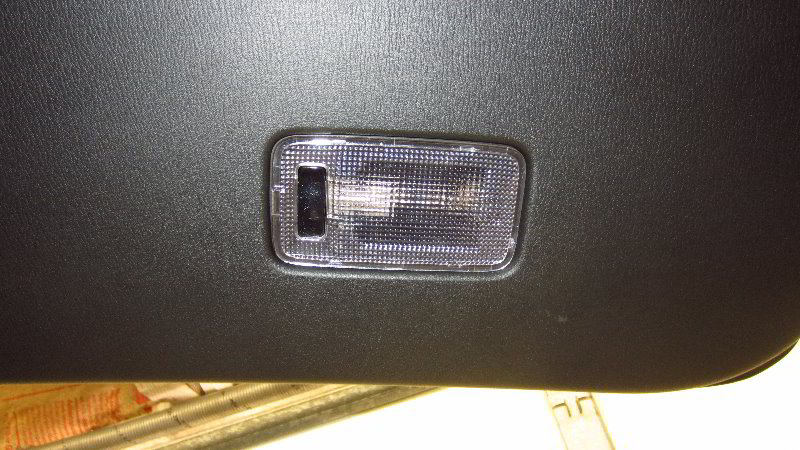
Open the tailgate door and locate the light housing on the right (driver) side of the plastic interior panel.

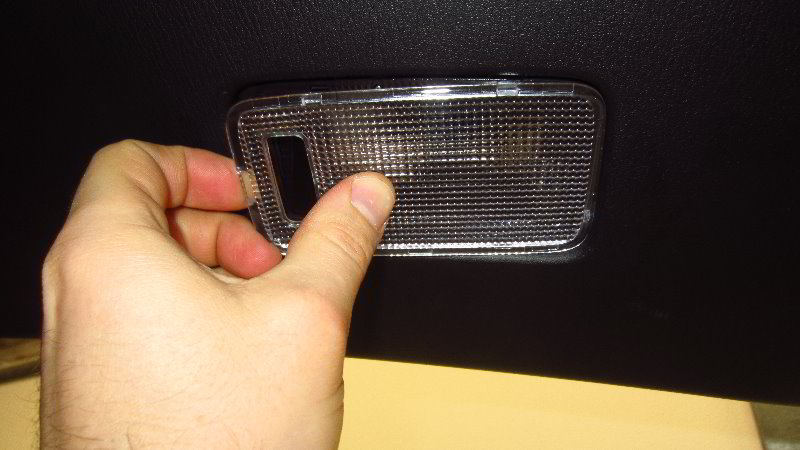
Insert the blade of the screwdriver into the small notch on the left (passenger) side of the translucent plastic lens cover.

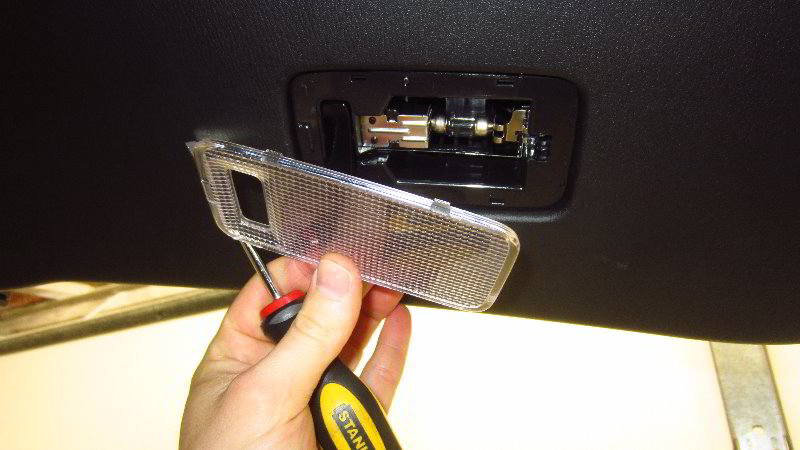
Gently pry out the lens cover.

Try to avoid using excessive force.

The lens cover should pop out relatively easily.

If the old light bulb was recently turned on, it might still be hot enough to burn your fingers. Be careful when you remove it.
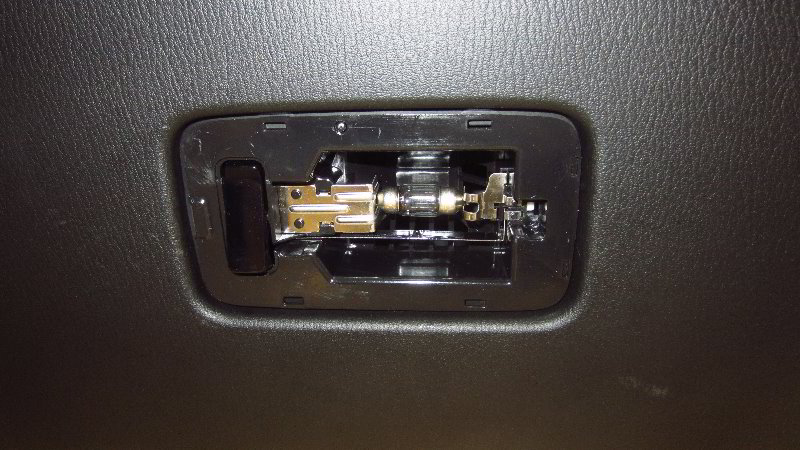
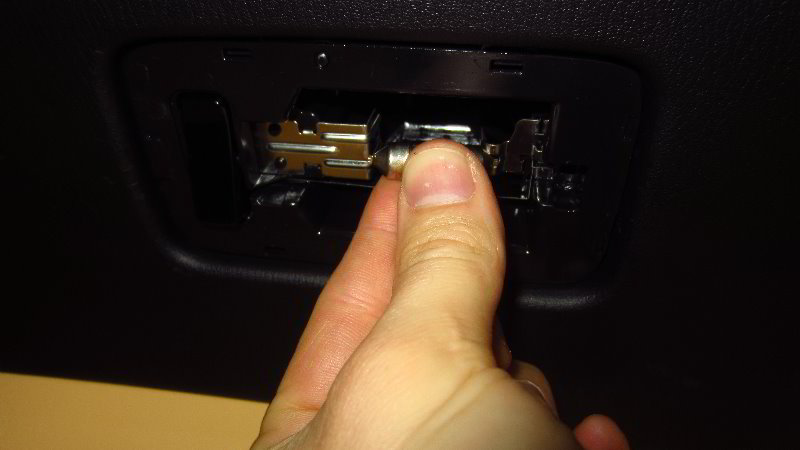
Carefully pull the old light bulb out of the socket.

Try to avoid bending or damaging the metal electrical contacts.
The OEM (original equipment manufacturer) light bulb in this 2019 CX-5 was marked as part number KHA12V8W 49A16F.

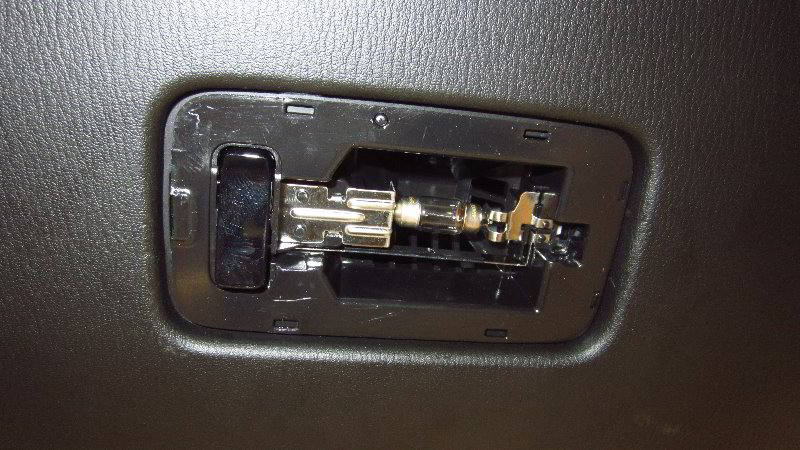
Push a new number DE3175 festoon style light bulb into the socket.

Make sure the new bulb is securely held in place by the two electrical contacts.

If you’d like to have a much brighter cargo area light, install a compatible replacement DE3175 LED unit.

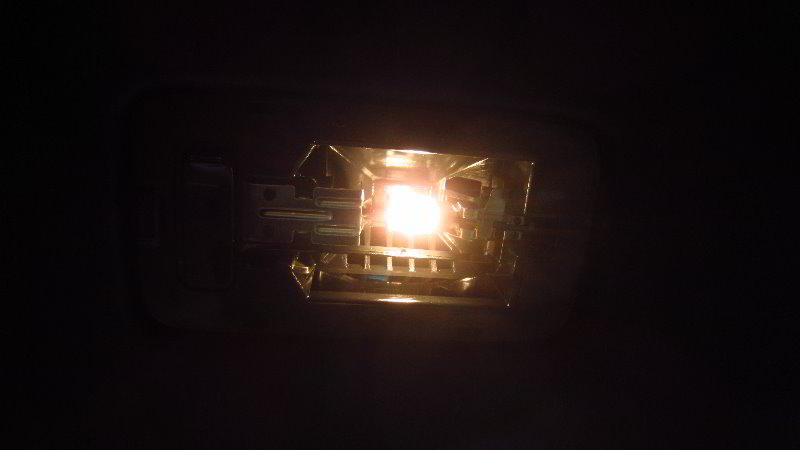
I recommend testing the new light bulb before you replace the lens cover.

Move the “On / Off” rocker switch to the “On” position.

Tip – If you installed an LED bulb and it doesn’t work, try removing it from the socket, rotate it 180 degrees and then push it back into the socket. Some LED bulbs are “polarized” and will only work when the “+” positive and “-” negative electrical contacts are in the correct orientation.

Line up the lens cover with the light housing.

Gently push on the cover to secure the retaining clips.

You should feel or hear the lens cover “click” or “pop” securely into place.

Be sure to write down the bulb change in your SUV’s service records.

Please check out all of my 2017-2022 Mazda CX-5 DIY Repair & Maintenance Guides.